Chanukah Thoughts

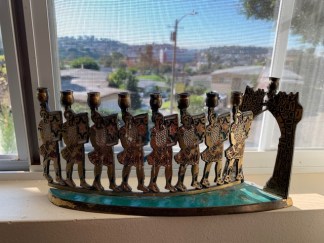
IMG_1101 I am not a particularly observant religious Jew, but my Jewish identity is still very important to me. Chanukah is a festival holiday, one that commemorates an historical event, rather than deeply spiritual holy day like Yom Kippur or the Sabbath. When I was a teenager, my pacifist self was disturbed by the hanukiah my mother dug off a bottom shelf each year. It depicted a line of heavily armed Maccabees entering the gate of Jerusalem to save the Jews from oppression. I’m not an expert on either the history or the religion, but it is unlikely that a group of religious zealots who had been camping out in the wilderness would look this put together. Like so much of religion, this view of Judah and the Maccabees is the stuff of myth. However, that doesn’t mean there isn’t something important in the Chanukah celebration, which seems more relevant now than ever before in my life.

The story is, in its essence, about a fight against an oppressive regime that sought to coerce Jewish assimilation into Hellenic culture. And it is about repairing something that was broken (more on that below). Growing up in New York, I had not been aware of this particular form of insidious coercive influence until my 10th grade English teacher required a paper due on Yom Kippur (and he would accept it neither early nor late). Now, living far from New York in a predominantly Latino and Asian/Asian-American part of LA, the signs and symbols of my culture are few and far between. My cultural practices are tolerated, but poorly understood: “Why can’t you celebrate Christmas? It’s not really a religious holiday.” (I’m sure that practicing Christians of all denominations would likely disagree.)

While the coercion is subtle, the oppression – or attempts at it – are not. Something shifted for me when right wing demonstrators in Charlottesville two years ago chanted “Jews will not replace us.” How can I list my race as “White” on demographic forms when there are large groups of White people who don’t consider me such, while also acknowledging that I benefit from the appearance of Whiteness? We live in a country where oppression is more rampant now than at any time in my life: Black people are profiled (or shot) at traffic stops; people of color are stopped at the border and some held in cages; and women still earn just 79 cents for every dollar earned by men. So…this part of the lesson of Chanukah need not be about Jews at all, but about persistent resistance. As a Jew (as a human, really), I resist this injustice where I see it through words, actions, and the Jewish notion of Tzedakah – not “charity,” but “justice,” — sharing what I have to try to “balance the scales” toward the oppressed and less fortunate than I.

For me the other important lesson is that of repair, in Judaism “Tikkun Olam” or “the repair of the world.” The Maccabees made it into the Temple to find that the menorah was broken and most of the oil was gone. For me, the miracle isn’t one in which God makes the oil last for eight days, but rather one in which a community of people work together to keep the light burning and repair the Temple. It is only through community collective action that we can repair the world – and boy does the world need fixing now!
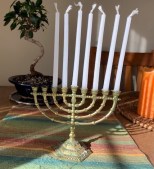
IMG_1102So…I light my candles, using not my mother’s militaristic hanukiah, but this more neutral one that I bought when I was in Israel forty years ago. I light the candles to remind myself and my family that only if we work together can we resist the oppression of all people and repair the world.


Please consider supporting the organizations that will benefit from my own family’s commitment to “Tzedekah” this season:

CHIRLA

RAICES

Byte Back

A couple of posts of interest:

https://www.myjewishlearning.com/article/the-maccabees-heroes-or-fanatics/

https://ajws.org/blog/8-nights-8-jewish-values-reflections-for-chanukah-on-the-jewish-obligation-to-build-a-better-world/


Posted in Culture and democracy, Personal infrastructure | Tagged , , , , , , , , , , , , , | 1 Comment

Building Community Cultural Connections

Analyze > Listen > Formulate > Ideate > Prototype > Evaluate > Iterate

My November letter to Cal State LA College of Arts & Letters focused recent activities that support building community cultural connections. I share it with you here.

Dear Arts & Letters Community:

The past month has been a busy time for the College of Arts & Letters and for me as its Dean. The “big event,” was on November 1, when we hosted a day-long professional development event for students, “Connect the Dots: Pathways into the Creative Industries,” about which you can read more in Kathleen Sanchez’s story by clicking, here. It was also a month when we focused a lot on the College’s strategic priority to “Build Community Cultural Connections.”

I attended the annual convening of Imagining America in Albuquerque, New Mexico, along with department chairs Mike Willard (Liberal Studies) and Linda Greenberg (English), faculty members Kathryn Perry (English) and Tanya Kane-Parry (Theatre and Dance), graduate student Jose Cubias, and undergraduates Ashley Robles and Sam Ortiz. Cal State LA joined the Imaging America consortium last year as part of its effort to expand on its mission of Engagement, Service, and the Public Good. Imagining America focuses on “artists and scholars in public life;” thus the convening includes not just traditional academic panels, but also sharing of smart practices around community engagement, workshops, performances, and exhibitions.

Following on work begun by Professor Emeritus Jose Cruz Gonzalez, Professor Kane-Parry has been working with the Glazer Family Dreamers Resource Center and students in her classes (including Robles and Ortiz) to develop a performance script about immigration to be performed in schools and community centers. With the script still in development, she and her two students used the Imagining America convening as an opportunity to workshop the script-in-progress and receive feedback from other community-engaged artists. I was privileged to be in the room when the reading took place and be a small part of the conversation that will help advance the project. Kane-Parry is collaborating with the Center for Engagement, Service, & the Public Good to book the community-based performance tour.

Dr. Greenberg, Dr. Perry and Jose Cubias presented on the various ways that our Department of English is working toward becoming an engaged English department. This includes the work they already do with students at Lancaster Prison as well as curricular developments that will include an “Engaged English” requirement for all majors. Internships that can fulfill this requirement are made possible in part thanks to The Dr. James Garrett Pathways to Professional Success Program Fund.

IMG_0711

Poet Alice Lovelace meeting with CSU deans at the CCAS annual meeting in Atlanta

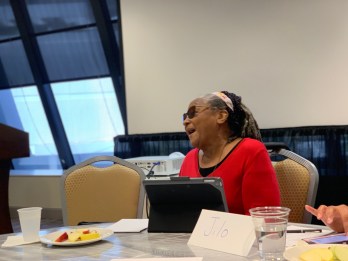
Following on the heels of all of this activity, I led a workshop for other CSU deans of similar colleges as a part of the pre-conference activities at the annual meeting of the Council of Colleges of Arts & Sciences. We had two guest speakers: Jilo Tisdale of Spelman College’s Bonner Office of Community Service and Student Development, and Alice Lovelace, poet, arts advocate, and director of Atlanta’s Arts Xchange. Ms. Lovelace talked with the CSU deans about how the arts can be a powerful force for economic as well as cultural development. I then led my colleagues through a small group exercise to get us thinking about our various institutional contexts, the communities we serve, and how we might listen even more effectively to these communities to develop successful community-engaged programming. This is an important area of the College of Arts & Letters’ work already, and one that necessitates ongoing development as well. Look for announcements soon of new partnerships with the City of LA Department of Cultural Affairs, and the LA County Museum of Art, as well as deepening relationships with local high schools.

…I note that the Thanksgiving holiday is just around the corner. Regardless of whether or how you celebrate this, I hope your time away from campus will be filled with warmth and love.

Posted in arts infrastructure, Arts policy, Culture and democracy, Higher education | Tagged , , , , , , | Leave a comment

Back at it (Finally)

After a summer vacation and some less fun issues (now completely resolved!) that unfortunately coincided with the very busy start of a new semester, I am back at work on my collection of  essays on the relationship between artists, money, and entrepreneurial action. The seventh essay in the collection explores what entrepreneurship means to artists, develops several case studies that illustrate these entrepreneurial principles, and then describes and analyzes several resourcefulness strategies artists employ to enable them to thrive including the development of the “portfolio career” and web-enabled patronage. As in the past, I’ll dribble some teasers out one paragraph at a time, admittedly to incite interest in the project, but also to collect feedback from you, Creative Infrastructure‘s readers. Here’s this week’s entry:

            The very term “entrepreneurship” is distasteful to many artists (and other people) for its neoliberal and/or brashly capitalist implications both historically and recently. Nevertheless, asking artists what the term means for their practice supports the perspective taken throughout these essays: for artists, entrepreneurship means directly connecting their creative work to other people, their audience. Of the forty artists who participated in a Tremaine Foundation phone survey, the plurality (nine of the forty) indicated that being an entrepreneurial artist means connecting their work with other people, while an additional three said it means keeping the buyer in mind and two others noted it means making their work accessible. Only seven said “thinking about yourself as a business” is what it means to be an entrepreneurial artist. Although I note that overall the survey was not analyzed for statistically significant correlations, those seven as a whole are younger than the rest of the group, which may indicate a shift in thinking among artists who have been exposed to arts entrepreneurship as a concept earlier in their careers. Such artists, unlike artists of earlier generations, have been, at minimum, introduced to the idea that being an independent artist means being a sole proprietor of a business, even when generating revenue is not the motivation for the creative activity of the artist.

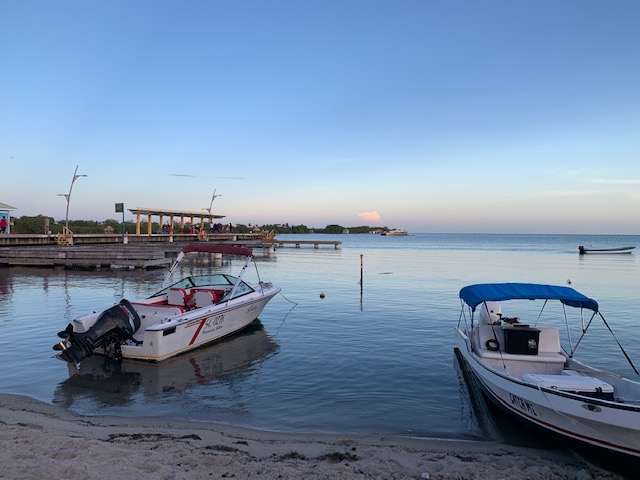
Because I mentioned that summer vacation, I offer some eye candy:

eye candy 2

Posted in Arts entrepreneurship, arts infrastructure, Personal infrastructure | Tagged , , , , , , , , | Leave a comment

Arts Entrepreneurship 11 through 15

Four years ago, I created a series of short videos for use in my class Foundations of Arts Entrepreneurship. I’m no longer teaching the course (and the videos themselves admittedly could use some updating) but for those of you looking for a primer on arts entrepreneurship or some supplemental material for use in your own classes, I’m making these available to the public. For expediency’s sake, I’ve decided to post the remainder of the course, modules 11 through 15. You can find modules 1-10 by scrolling down through the pages or via the search bar.

Module 11: Business models and business forms/types.


Module 12: Business plans and the business model canvas


Module 13: Professional communication


Module 14: Grantwriting and fundraising for artists


Module 15: Public policy and intellectual property basics

I hope you’ve enjoyed Foundations of Arts Entrepreneurship!

Posted in Arts entrepreneurship, Arts funding, arts infrastructure, Arts management, Arts policy, Higher education, Institutional Infrastructure | Tagged , , , , , | Leave a comment

AE 10: Entrepreneurial Decision Making and Basic Finance

Module 10 looks at two approaches to entrepreneurial finance: venture capital vs. effectuation. To understand the module you will need to first seek out and watch the Voyage Air Guitar pitch on Season 1 Episode 3 of ABC’s Shark TankPlease watch this before you listen to the short lecture.

Posted in Arts entrepreneurship, Arts funding, Institutional Infrastructure, Personal infrastructure | Tagged , , , , , , | Leave a comment

Foundations of AE 9: Budgeting

This ninth module of Foundations of Arts Entrepreneurship is the second of three about money: 8 is on financial literacy; 9 is on budgeting; and 10 is on some very basic concepts of entrepreneurial finance. Please note that these modules are specifically geared toward artists and arts organizations and are not a substitute for the financial or tax advice you will get from a CPA or CFP.

Posted in Arts entrepreneurship, Arts funding, arts infrastructure, Arts management, Higher education, Institutional Infrastructure, Personal infrastructure | Tagged , , | Leave a comment

Foundations of AE 8: Fiscal Literacy

This eighth module of Foundations of Arts Entrepreneurship is the first of three about money: 8 is on financial literacy; 9 is on budgeting; and 10 is on some very basic concepts of entrepreneurial finance. Please note that these modules are specifically geared toward artists and are not a substitute for the financial or tax advice you will get from a CPA or CFP.

Posted in Arts entrepreneurship, Arts funding, arts infrastructure, Arts management, Higher education, Personal infrastructure | Tagged , , , | Leave a comment

Foundations of Arts Entrepreneurship 7

In this companion video to Foundations of Arts Entrepreneurship 6, I discuss marketing plans, audience segmentation, and branding .

Posted in Arts entrepreneurship, arts infrastructure, Arts management | Tagged , , , , | Leave a comment

Foundations of Arts Entrepreneurship 6

Marketing.

You know the drill: Four years ago, I created a series of short videos for use in my class Foundations of Arts Entrepreneurship. I’m no longer teaching the course (and the videos themselves admittedly could use some updating) but for those of you looking for a primer on arts entrepreneurship or some supplemental material for use in your own classes, I’m making these available to the public by posting one video per week.

This video is the first of two about marketing. In it I introduce marketing concepts; utilities of exchange; marketing approaches; and the marketing mix. The reading is from workshop materials produced by the National Arts Marketing Project and the chapter “Magnetism” from Anne Bogart’s book and then, you act.

Posted in Arts entrepreneurship, Arts management, Higher education, Institutional Infrastructure | Tagged , , , , | 1 Comment

Disability is Not a Costume

I am utterly disgusted by Madonna’s putting on an eyepatch to adopt the “persona” of her alter ego Madame X. Disability is not costume or character – it is disability. And when it comes to the eyepatch, I have some experience. Throughout my childhood, my mother wore an eyepatch after her eye socket and optic nerve were destroyed by a gangrene infection. After her eye was removed, she was no longer able to drive; her depth mom in glassesperception was gone; and she had my father walk on her left side out in public so she could have an extra set of eyes on that side. People stared at her, so she wore large dark glasses. An eye patch does not signify a mysterious character backstory; it signifies a disability.

I think about my mother and her half-blindness when I read about issues of representation on stage and screen, whether representation of disability, gender, or race. If Madonna wants to create a Madame X character with a disability, she should hire a disabled actor to play the part.

Posted in Arts policy, Personal infrastructure | Tagged , , , , , | Leave a comment