The Culture of Possibility

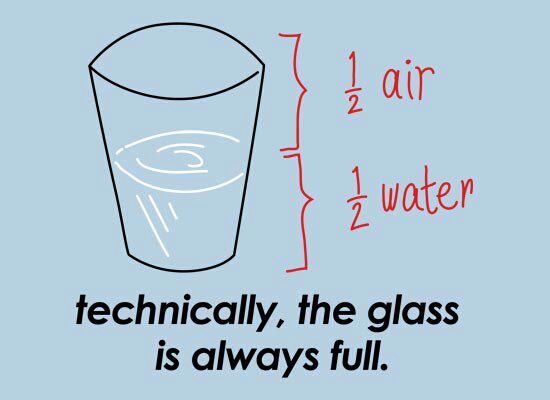
full glassI am an optimist.  Not a “glass is half full” kind of optimist, but a “glass is always 100% full” optimist (see illustration for an explanation). It’s all in the way you look at the glass. Arlene Goldbard is an optimist too – although she denies it right there on page 33 of her new book The Culture of Possiblity.  The basic premise of the book is like the 100% full water glass: if we shift our perception, if we shift the background (culture) to the foreground, a world of possibilities will be open to us. She is asking for a complete paradigm shift – a phrase she uses throughout the book – “a radical revision of a model of reality, changing the meaning of all that we see and do” (p. 173).  And why not? For too long, or at least as long as I’ve been following along, arts and culture advocacy arguments have been trafficking in small ideas, ideas about price and economics, rather than big ideas, ideas about the role of arts and culture in improving our basic social existence.

So, this is less a book review and more a love letter.  Like a person, the book is not perfect, but overall, I love it.  I don’t love every page or every idea, but I love Arlene for articulating the importance of art and culture to human existence, for articulating the importance of empathy and storytelling, and for putting the lie to economic-impact-only arguments on behalf of arts and culture.  The book is in three parts. The first is an essay in which she introduces the basic premise of the book  – the need to switch our context – and describes this switch in terms of two opposing social spaces: “Datastan” and “The Republic of Stories.”  This oppositional juxtaposition, the world of numbers versus the world of thought-and-emotion, is my only substantive quibble with Arlene’s approach.  She wants us to leave Datastan and inhabit the Republic of Stories more fully.  I, on the other hand, want to embrace both approaches simultaneously, the quantitative and the qualitative.  (Remember, I think the glass is 100% full of both water and air.)

The second part of the book is 28 very short essays that serve as an antithesis to the “talking points memo” one often sees on arts advocacy sites encouraging us to tell our legislators about the material impact of the arts for our communities. Instead, Goldbard offers 28 talking points about art’s capacity to increase human potential and social good.  In this section she devotes several of the short “chapters” to the concept of “framing,” the topic of the lengthier essay that makes up part three.  Along the way, she offers real and specific examples of art affecting social thought, such as the Thousand Kites project, the film Trash Dance, or how viewing Rodin’s The Burghers of Calais helped her to understand the aftermath of the BP disaster.  Next time you write to your elected officials about arts funding (and I hope you do so often), check out these “Twenty-Eight Reasons to Pursue the Public Interest in Art.” I would like to think that Arlene won’t mind if you appropriate some of them to further the cause of good policy.

The book concludes with a single long-ish essay that pulls together several themes, using metaphor and story.  In this section, “Datastan” becomes “Corporation Nation,” a world that “knows the price of everything and the value of nothing” (p. 155, after Wilde).  I wish that the Corporation Nation metaphor had been used throughout instead of Datastan, since, as I implied earlier, data itself is not the enemy; it is how data is framed that is.  I quibble with a few of her examples. For example, the essay implies at one point that the motives and values of a solar panel manufacturer are somehow on higher ground than those of a petroleum producer, but that is not necessarily the case.  Even arts organizations struggle with corporate social responsibility.

The value of the concluding essay is in its big ideas and its celebration of beauty and metaphor over profit and numbers.  That, too, is the value of the book as a whole.

In love and empathy,

Linda

PS. You can read more about The Culture of Possibility and its companion novel, The Wave, on the author’s website.
Posted in Arts funding, Arts policy, Culture and democracy | Tagged , , , , | 4 Comments

798

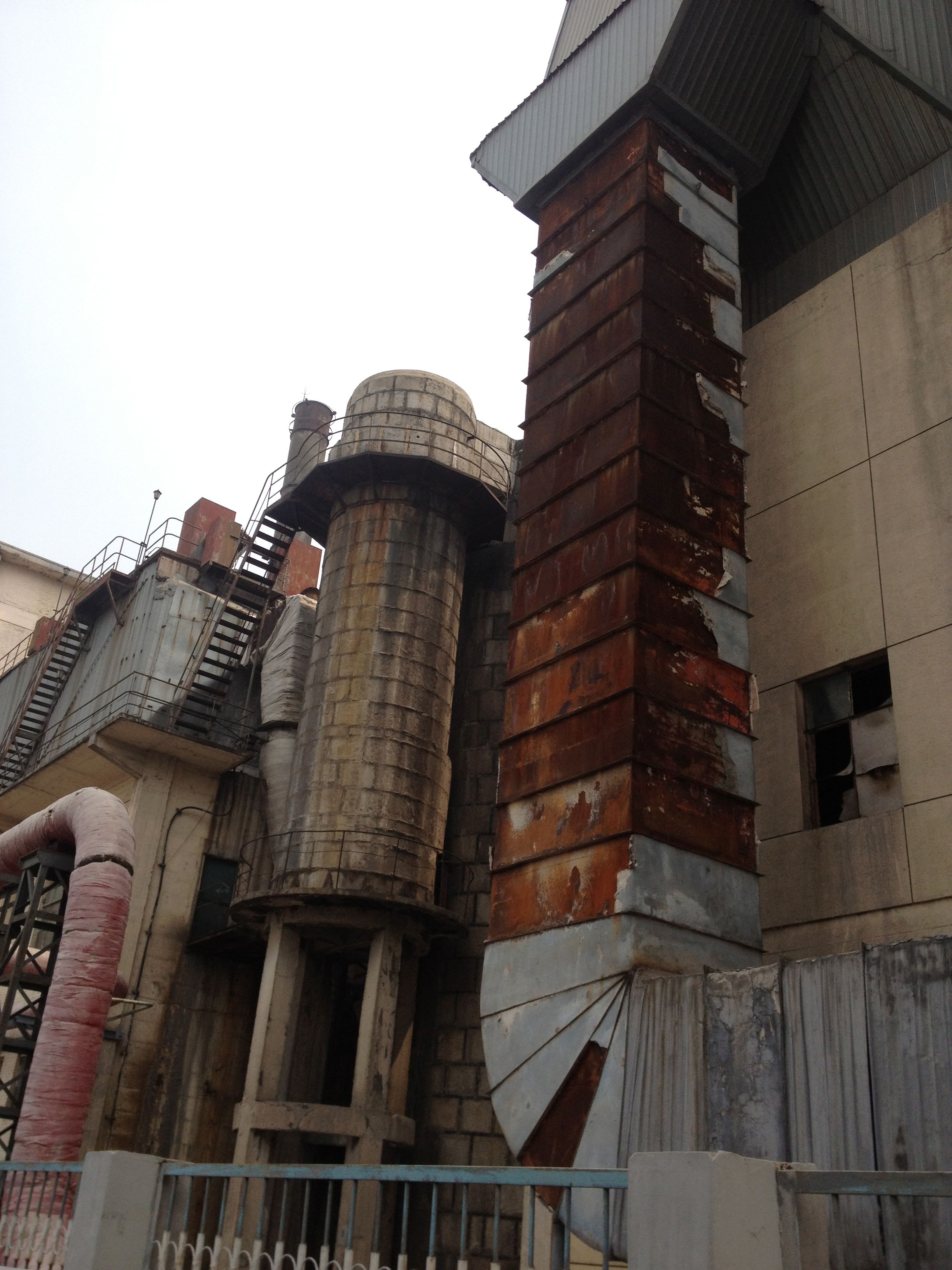
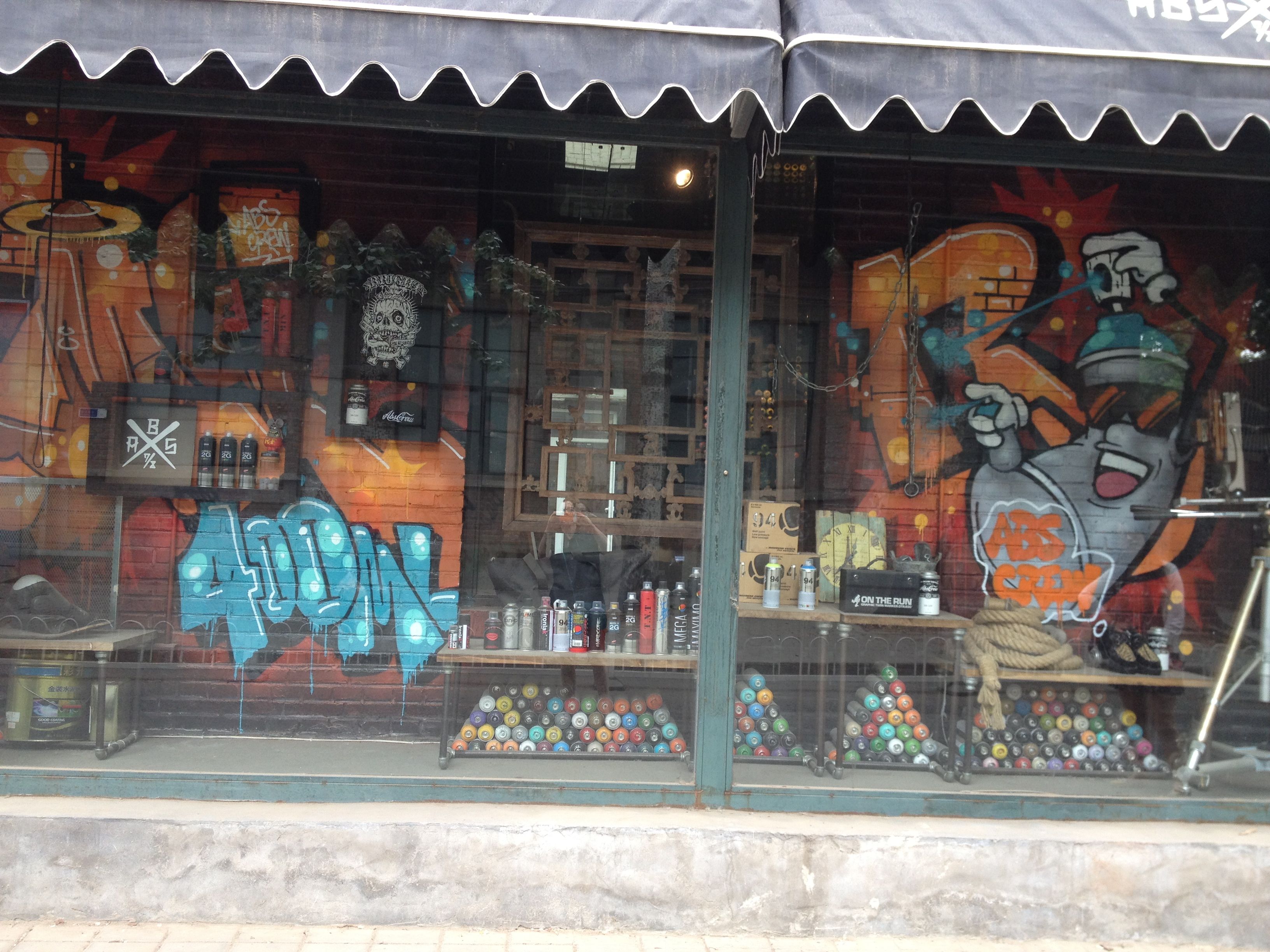
IMG_0655State owned facilities turned into artist live/work spaces. Pedestrian friendly streets with cafes and shops. Open studios where you can drop in and see sculptors and painters at work.  Street art that is street art and not gang tags.  It sounds like a utopia of creative placemaking, except you had best not mention June 4 or discuss the Dalai Lama publicly, because this cultural district is in Beijing.

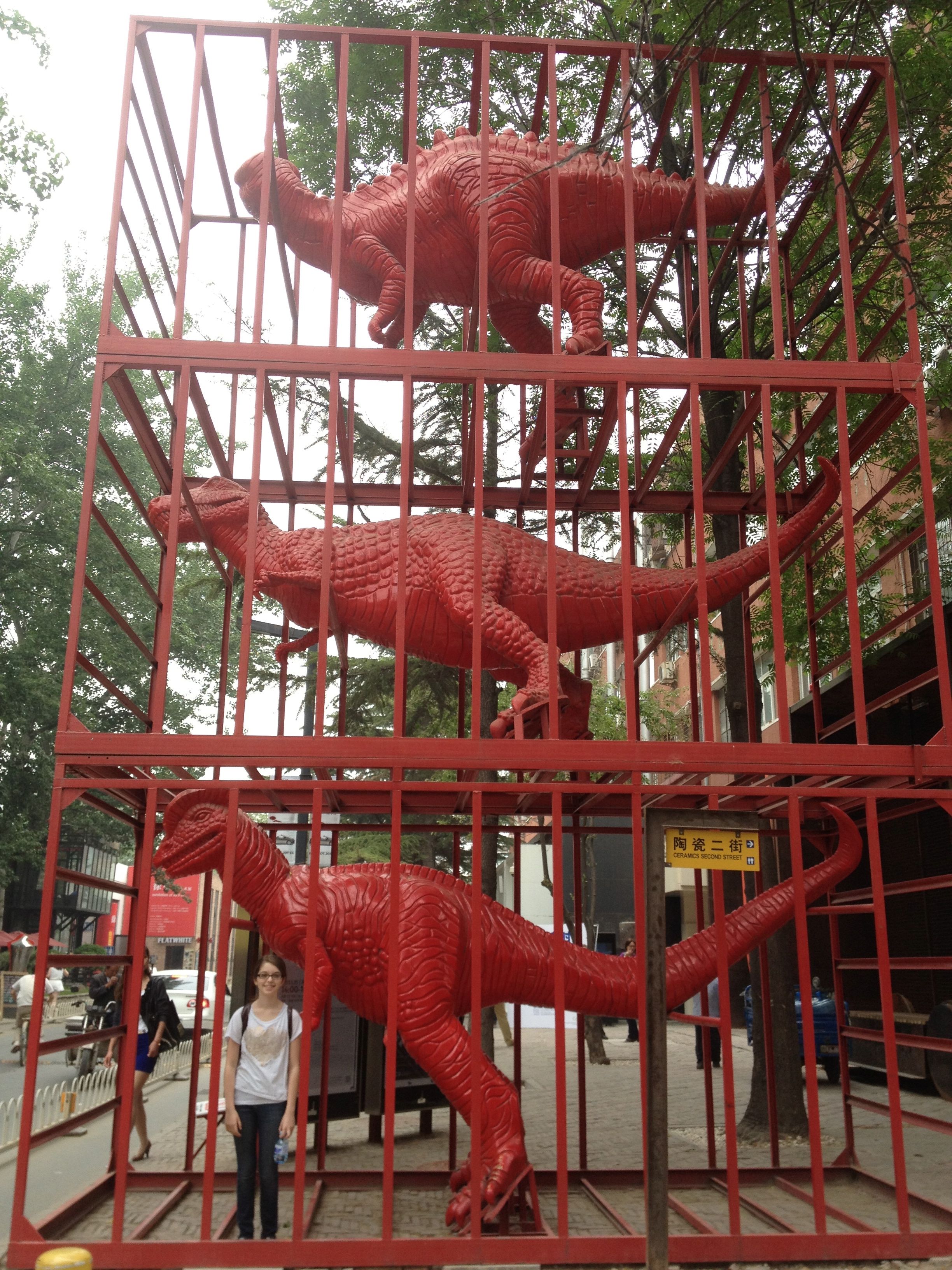
IMG_0659My visit to the 798 Arts District was a highlight of my recent trip to China. With cars restricted and its repurposed industrial architecture of red brick and attractively rusted metal, the district felt like an island of respite in a city of taxicabs and gray brick and glass.  Art is everywhere within the district.  Outside of the district, the primary visuals are slogan-driven public sculptures (“Patriotism, Innovation, Inclusiveness, Virtue – the Spirit of Beijing”) and commercial advertising. In the district, there are gallery windows, public sculptures, and carefully placed graffiti.  We didn’t quite make it into the anchor of the district, a large factory built in the 1950s by an East German electronics firm, or several of the other large and more famous spaces, but we were able to stroll among scores of other galleries.  Several displayed the work of North Korean landscape painters (imagine if Thomas Kinkade had painted the Hamgyong Range); the major photography gallery had a show of iconic photos from the early 1970s of peasants chopping granite and building one of China’s many dams; a large sculpture on a side street depicted hundreds of tiny people sucking from the teats of a larger than life-size cow.  Some art was playful, like the stack of red dinosaurs in cages,IMG_0654 or the acrylic paintings of western commercial icons on traditional Chinese silk brocade.  I was struck by the beauty of the work in one of the galleries that exhibited contemporary versions of classical Chinese renderings of peonies and chrysanthemums by an artist whose name I unfortunately neglected to note.  They seemed deeply authentic and, while based on tradition, did not feel derivative, as some of the other work did.  Our translator told us that the paintings were by one of China’s most famous artists. She had never heard of Ai Wei Wei.

As we walked into gallery after gallery, especially where more abstract work was displayed, our translator asked what I thought a piece “meant,” or commented on how “she doesn’t understand what it means.”  I replied that sometimes art doesn’t have one meaning, that there are many meanings, or ambiguous meanings.  In my mind, I connected her search for one meaning with my earlier thoughts about the educational system that culminates in a single test taken by all high school students.  How does one handle ambiguity as an adult when as a child they are taught that questions have one right answer?

As I write this two days after my return, I am left wondering if the 798 district is the island oasis of my first impression, or instead an art ghetto in which the state can contain creative expression within a fixed boundary.

Posted in arts infrastructure, Arts policy, Culture and democracy, Uncategorized | Tagged , , , , | 2 Comments

Talking Creativity in China

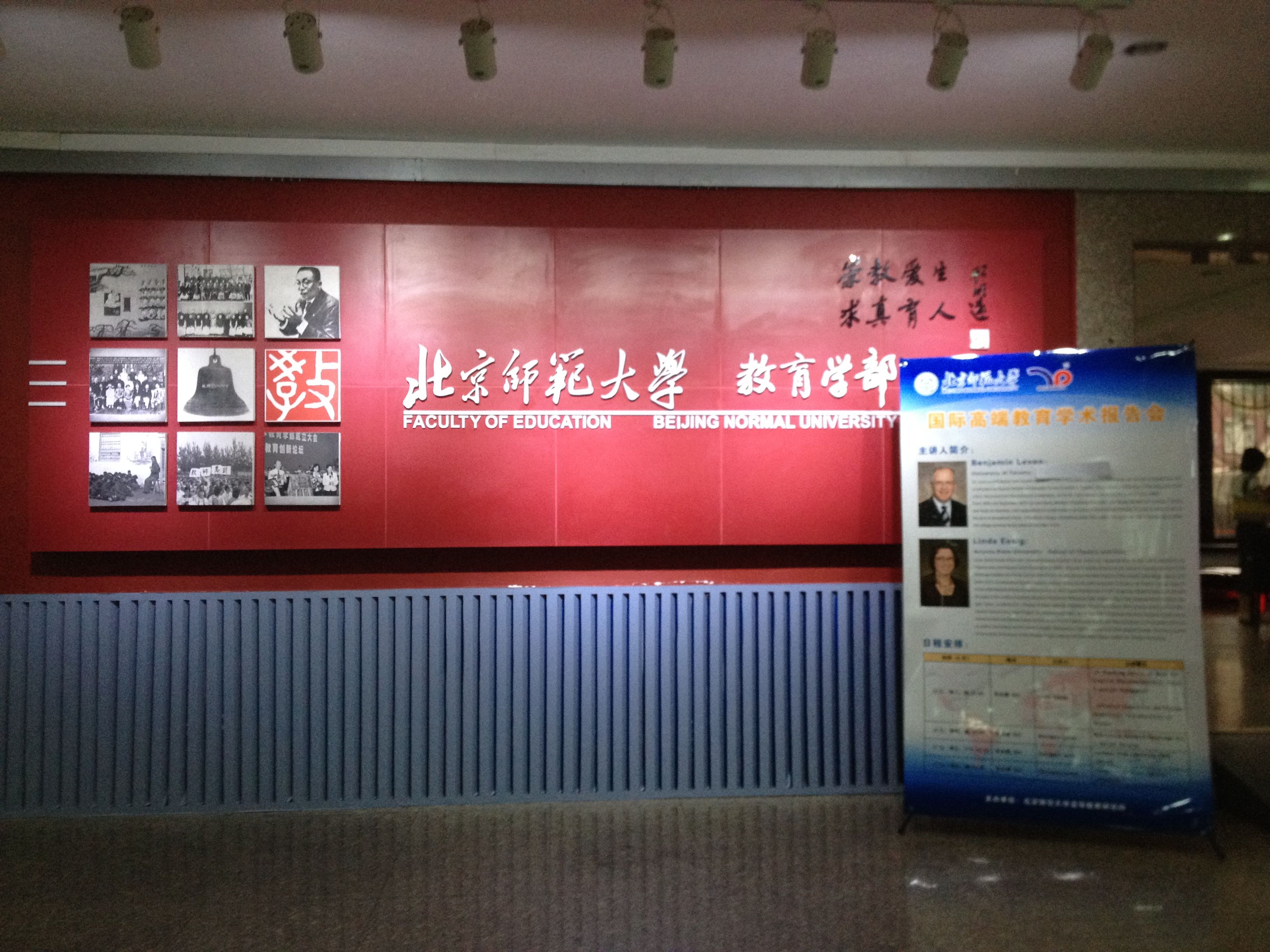
IMG_0672I was honored to have been invited to Beijing Normal University’s Institute for Higher Education to talk about educating for creativity.  One topic was something I have discussed informally here and more formally in the journal Artivate: framing pedagogies for teaching creative entrepreneurs. My second topic was a bit more problematic for the context: group creativity and diversity.  Although my lecture was well received, it seemed disingenuous to be discussing the advantages of heterogeneous group collaboration for creativity to an audience of mostly (90%) female graduate students of mostly the same ethnic group (Han Chinese), age, and course of study (higher education leadership and policy).  Even more paradoxical was talking about process creativity and improvisation to a group of young people and faculty members who may not have ever had an opportunity to participate in improvisational activities.

Chinese secondary education culminates in a placement exam taken by all Chinese teens.  As my host explained, “this test is very important. The student’s future depends on it.”  Parents in the US (including me) may complain about the “teaching to the test” pedagogy that has pervaded our education system here since No Child Left Behind, but that is nothing compared to the high stakes testing environment in China. When I began my talk on group creativity, I asked the attendees, “How many of you played a musical instrument in an ensemble, orchestra or band? Or participated in a theatrical performance as a child?” Not a single student had had a collaborative arts experience – ever. One faculty member, my host, had performed in traditional opera thirty years prior, but he was the only person in the hall to have done so.  I mentioned this to another visiting professor, Ben Levin, an education policy scholar from University of Toronto, who responded, “I’m not surprised; their entire primary and secondary education is geared toward the test. There is no time for anything else.”  As I summarized some recent cognitive research related to process creativity and improvisation in my lecture, I wondered to myself if the lack of opportunity to participate in process-oriented creative thinking has put the brakes on the cognitive abilities of these young people.   IMG_0677

Posted in Arts education, Higher education, Uncategorized | Tagged , , , , | 5 Comments

Millennial? No, Boomer

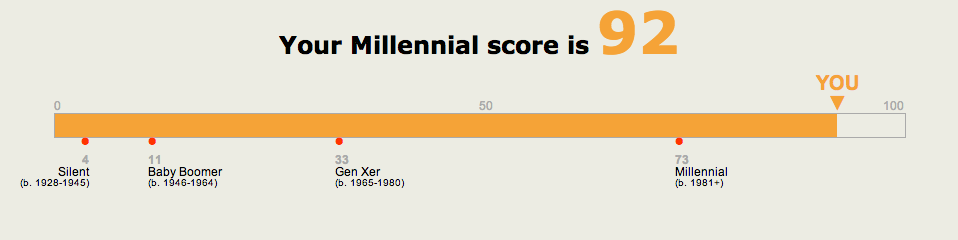
A survey from Pew Research came across my twitter feed. It is designed to measure “How Millennial Are You?” Pew’s report is titled “Confident. Connected. Open to Change.” These are, apparently, the defining characteristics of the millennial generation, those who came of age in the new millennium—i.e. people born after 1981.  I am a baby boomer, although born at the very end of the boom. With a father who returned from serving in WWII, married, and had three kids, my family background defines that generation.  Baby Boomers in aggregate score 11 on Pew’s quiz. I scored a 92, without having piercings or tattoos (two of the fourteen questions).  Screen Shot 2013-05-11 at 8.21.27 PMMy score may be anomalous overall, but I am certainly not alone. Being millennial in spirit if not in age, I posted the link on facebook where several of my “friends” responded with their scores.  What many of my facebook friends and I have in common is not only our young boomer age and our millennial quiz score, but theatre.  Those who responded with high scores are playwrights and performers and designers, people who tend to be confident, connected, and open to change.  My totally unscientific conclusion is that to be hip, you don’t have to be born after 1981 or live in Portland – you just have to be a theatre person.

Posted in arts infrastructure, Technology and arts | Tagged , , , , , , , | 3 Comments

Get Out of Your Room!

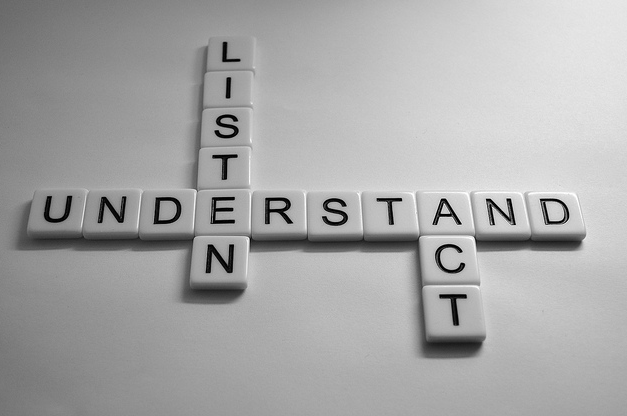
The hottest idea in entrepreneurship education circles for the last year or two has been the “lean launch pad” or “lean canvas” for business model generation as explained in Osterwalder and Pigneur’s book of that name and as evangelized by entrepreneur and business guru Steve Blank.  Blank recently wrote an article on the topic for the Harvard Business Review blog that is worth looking at.  Blank’s contribution is an iterative concept of “customer development.”  I heard Blank speak about this concept recently; my takeaway advice from his talk is, “get out of your room!” [Or, as Blank puts it, “get out of the building!”] Translation: you think you have a great idea, test it in the field with potential customers; listen to them; change your idea; talk to the potential customers again, then launch and then, once launched, continue to get out of your room and listen to the customers.

Listen-Understand-ActWhat can this mean for arts organizations? What can it mean for individual artists? And for teaching arts entrepreneurship? I’ll address the third question first, because I integrated this approach during the semester just ended.  In my Foundations of Arts Entrepreneurship class, students, working either individually or in self-selected groups, develop a concept for a hypothetical arts-based venture. I ask them to develop a needs assessment.  For the first time this semester, I required they “get out of the room,” and actually test their ideas on the people they think are their potential customers.  Those students who identified an audience segment and then surveyed that segment (this is so easy to do with a tool like surveymonkey.com), developed richer, more sophisticated, ideas for their project because they were responding to actual needs and wants from their target audience.  One student is launching his music criticism magazine following the surprising finding (surprising to him, that is), that people actually want to read about the music they listen to.

Individual artists can benefit from this approach as well, but in a somewhat different direction. Artists make the work they make, and may not want to alter that work for market reasons. Instead, they can use the customer development model to pivot the market for their work, rather than the work itself. For example, an artist may think their work is best suited for purchase by elderly golfers, but by getting “out of the room” and surveying – and listening to –  alternative audience segments, may find a whole new audience for their work, one they may not have considered.

The analog to this for the arts organization, as I see it, is to be truly responsive to the community, to make work not solely for the company, but for the community of which it is part, however that is defined.  To do so also requires getting out of the room, be it the board room or the conference room.  Mission driven arts organizations should listen to the people that mission is meant to serve. Who are they? What do they need? What do they want? What do they care most about? As arts organizations struggle to discover more sustainable business models, they might look to this iterative customer development model, which is actually designed to aid in the discovery of appropriate business models.

Artists and arts organizations are sometimes reluctant to look to the world of business for advice, but if you want to have an audience, who can argue with a suggestion to “ask the audience?” Get out of your room.

Posted in Arts entrepreneurship, arts infrastructure, Uncategorized | Tagged , , , , , , , | 3 Comments

Sticky Madness

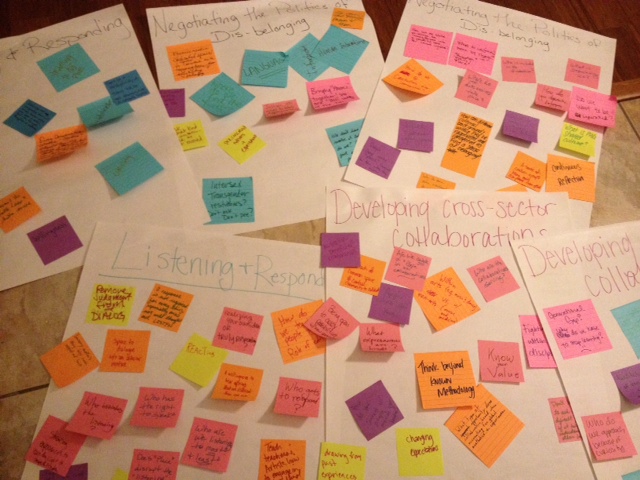
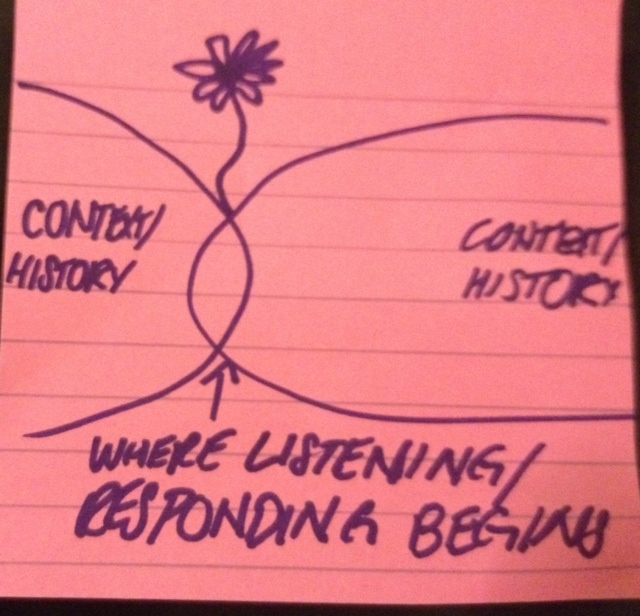
For the concluding session of the recent Pave symposium on Entrepreneurship, the Arts, and Creative Placemaking, we wanted to bring the discussion to a local level, so recruited the Phoenix chapter of Emerging Arts Leaders (EALPHX) to lead an interactive workshop.  The team, consisting of Alex Nelson, Jessica Rajko, Korbi Adams, and Samantha Johnstone, developed a three-part workshop, which culminated in a short movement piece that embodied our conceptions of place, an Alphabet of Culture and Community, and the segment described following.  Having participated in all the preceding sessions, the quartet identified three thematic challenges to creative placemaking efforts in the Phoenix area.  They then asked participants to comment upon Venn1these challenges, write their thoughts on sticky notes (hence “sticky madness”), and sort them by theme.  “The prompt to participants was to contribute their thoughts on how physical place, as well as personal and inter-personal relationships to place might contribute to those challenges or provide insight to those challenges, and then, if they cared to go so far, to share thoughts on how entrepreneurial arts activities could begin to work at solutions to those challenges,” according to Alex Nelson.

The three themes were: 1. Negotiating the politics of dis-belonging (the subject of Roberto Bedoya’s talk), 2. Developing cross-sector collaborations (which Ann Markusen described in her keynote address as necessary for effective placemaking efforts)  and 3. Listening and responding (a theme central to Laura Zabel’s examples from the Irrigate Arts project).  Below are the responses to these prompts, submitted anonymously by a group of about 25 students, artists, scholars, and community members.  This is raw data – check back for analysis in a future post.

1. Negotiating the politics of dis-belonging

  • Phoenix needs a dedicated space/center to converse on an ongoing basis
  • Asking about what matters to them before creating art
  • Ask what kind of invitation would be best received
  • Where do we find the “hives?”
  • Language
  • Infrastructure
  • Human interactions
  • Ask others what “belonging” means to them
  • Bringing “Phoenix” together. We are THE Valley of the Sun
  • Just because you want to know the answer to a question doesn’t mean you will/should get it
  • Preconceived notions/expectations
  • Intersex trans-gender restrooms? Don’t ask don’t pee?
  • How can my white privilege be transformed into a powerful voice for racial justice?
  • What do we (artists) mean by change? Perception? Policy? Place?
  • What is separating us?
  • How do you determine belonging?
  • In a transient society, do we belong?
  • What is Phoenix’s shared culture?
  • How can different cultural backgrounds within Phoenix be negotiated and connected to find a sense of belonging?
  • A sense of certain groups being more displaced than others
  • Check assumptions
  • Continuous reflection
  • Why do some strive, intentionally, to not belong in a place?
  • People carry many “places” (contexts) with them when they move
  • We don’t have to resolve it today do we? Can we just explore the problem? Even further?
  • Who is included in the discussion?

2. Developing cross-sector collaborations

  • Generational gap? Why do we have to stop learning L
  • Non arts discipline engagement
  • Who do we approach because of curiosity
  • Work together
  • Networking
  • Recognize your own power and behavior through someone else’s eyes
  • Be honest with myself (and transparent) about what I want out of a project.
  • Don’t try to collaborate with every group, and accept that you will need to support your partners’ top priorities
  • Mutually beneficial collaborations
  • Alack fo common space and central community to collaborate
  • Are we aware of “plae” in our collaborations
  • Within arts (eg music + dance) vs. with non-arts (eg. music + medicine)
  • Who are the collaborations serving?
  • Work to foster and MAINTAIN relationships
  • Fighting stigmas within our own disciplines
  • What expectations are brought?
  • Think beyond known methodology
  • Know your value
  • Don’t be afraid to ask the difficult questions; it helps us understand each other
  • What type of opportunity does collaboration bred when accounting for global aesthetics and experiences
  • Changing expectations
  • Drawing from past experiences

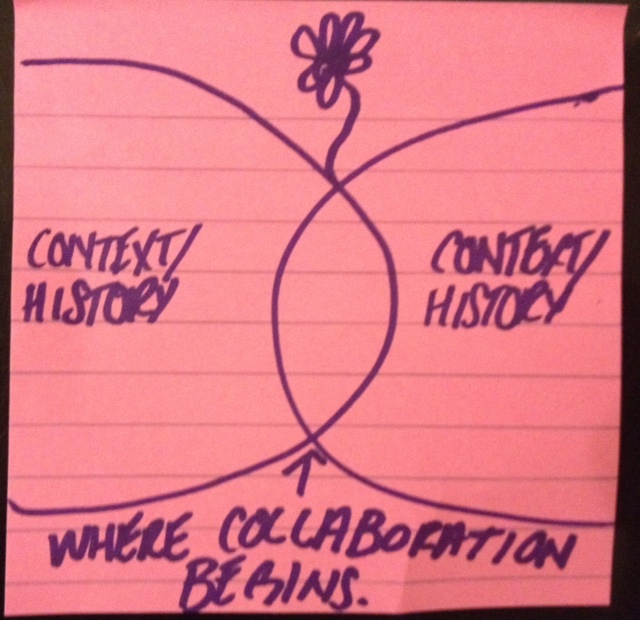
And this Venn diagram: sticky madness

3. Listening and responding

  • Remove judgment from the dialogue
  • A response is not reqired for every thing, especially ones [that] are not well thought out. LISTEN
  • Realizing your own idea or truly responding?
  • Reacting
  • How do we teach people to listen? Role of education?
  • Who gets to respond?
  • Space to dialogue without an ulterior motive
  • Learning another’s story helps create respect and trust
  • Who initiates the listening
  • Who has the right to speak?
  • Sharing experiences to ear the right to share and listen
  • “If you want to know someone else’s story, you have to tell your own”
  • Listening to myself
  • Openness
  • Does “place” disrupt the “listening” process?
  • Who are we listening to most? Least?
  • A willingness to hear opinions that are different than one’s own
  • Teach teachers and artists how to engage in intercultural dialog
  • Allowing expectations to dissolve
  • Curiosity
  • Acceptance
  • Space for dialogue
  • Face to face connections
  • Listening to someone else and not my own thoughts
  • I want to talk less and listen more
  • Willingness
  • Every conversation across “borders” should begin by asking what three things they do not want heard/said about their group
  • Listening and responding does not simply mean our ears and voices but also through thoughts and actions
  • Traveling to different places
  • Mindfulness
  • Curiosity
  • There is a multiplicity of story. We do not always have a shared history.

And this Venn diagram:Venn2

Video of the entire symposium is available through our livestreaming partner, Howlround/newplay tv, in a raw unedited form.  High res video will be available soon on the Pave website.

Posted in Arts education, Arts entrepreneurship, arts infrastructure, Arts policy, Culture and democracy, Higher education | Tagged , , , , , , , | 1 Comment

An Alphabet of Culture and Community

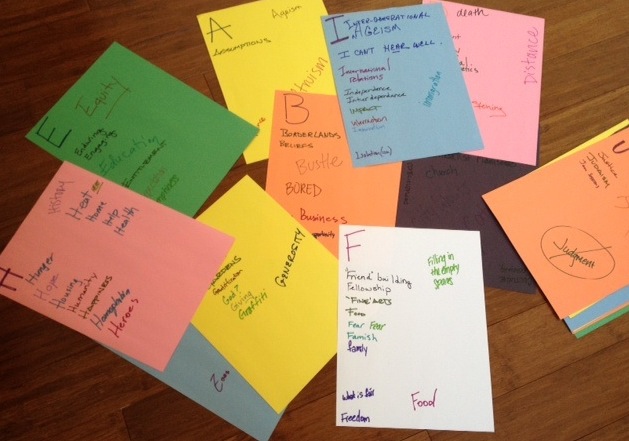
ABCAs part of the third biennial Pave symposium: Entrepreneurship, the Arts, and Creative Placemaking held April 12-13, the Phoenix chapter of Emerging Arts Leaders facilitated a workshop on connecting arts to communities in the Phoenix metro area (or “The Valley” as we sometimes call it).  For part of the workshop, the team distributed paper around the space, each with a single letter of the alphabet and asked people to write a single word on as many as possible that related to the theme of culture and community – either in support of strengthening communities through arts and culture or hindrances to doing so in the region.  This was the last session of the symposium, so attendance had dwindled to about 25 students, community artists, and other presenters and attendees.  I share with you here, without editing, the results of that exercise, an alphabet of culture and community:

A – altruism, acceptance, arguments, assumptions, ageism

B – Borderlands, beliefs, bustle, big business, bored, burdens (v. opportunity)

C – centralization, consciousness, church, city limits, catalyst, children, cooking, complications, Cannibalist Manifesto

D – deep listening, development, design, death, de-colonial aesthetics, dialect, dependence, distance

E – equity, enduring, engaging, educating, entitlement, expectation, emptiness

F – friend-building, fellowship, “fine” arts, food (2), fear (2), famish, family, fairness, freedom, filling empty seats

G – gender, growth, gardens, gentrification, God?, giving, graffiti, generosity

H – hunger, history, hope, housing, humanity, happiness, homophobia, heroes, heat (2), home, help, health

I – intergenerational ageism, international relations, independence, interdependence, impact, interaction, innovation, isolation(ism), immigration, I can’t hear well

J – justice, Judaism, joy, jam sessions, judgment [this last with a line through it]

K – knowledge, keep, kindle, kindness, kin

L – language, listening, love, love ≠violence, leaders, laughter, lifting, lifecycle events, learning, laughter

M – men, mobility, meaning, music (2), mastery, mystery, money, matching, magical, mindful

N – nice, nuance, neo-colonialism, no one comes, nodes, numb, numbers, narcissism

O – opportunity, organize, oppression, otherness, optimism, organizations, openness, open-minded.

P – perspective, people, pluralistic, pollution, population, privilege, places

Q – questions, quiet, quandary

R – reactive, religion, relationships, race, research, radio, respect, re-invent, reaction

S – space, skeptical, sustainability, storytime, sprawl, suburbia, spatial, separate, stigma, simplicity

T – transportation, time together, theory, trial, tangible, transition, traffic, turmoil, time

U – underrepresentation, underdeveloped, underserved, Umbanda, useful, union, unity, urban

V – vandalism, validation, venture

W – water – lots of it, work, wisdom (who has it?) women, willing, world-view, willingness

X – xenophobia

Y – yarn, yearn, youth

X – zoos

The group discussion that followed focused, in large part, on “sprawl,” how sprawl is a hindrance to “equity,” and how equity is a preequisite for healthy commmunities.  (For more from me on equity and the arts see “Diversity, Equality, Bus Lanes, and Arts.”)  There was also some discussion of food as both a carrier of culture across generations (intergenerationalism was a bit of a throughline as well) and a friendly, non-threatening way to introduce new cultures into communities.

In the next week or two, I’ll be publishing more outputs of the symposium.  You can watch video of the proceedings on the livestream.com newplay channel.

Posted in Arts education, Arts entrepreneurship, arts infrastructure, Arts policy, Culture and democracy, Higher education | Tagged , , , , , , , , , , , | 1 Comment

Spiraling Up

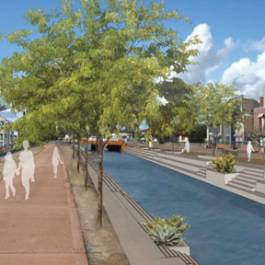
Rendering of proposed redesign of the canal at 16th St and Indian School Rd. From "Canalscape"

Rendering of proposed redesign of the canal at 16th St and Indian School Rd. From “Canalscape”

I went to a talk by my visiting colleague Nan Ellin recently.  Nan is an urbanist and visionary, as well as well-respected scholar.  She was talking about her new book, “Good Urbanism.” Her thesis is a simple one: in order to improve cities, we shouldn’t build toward sustainability by identifying problems and finding solutions but instead build toward prosperity by mining (or “prospecting,” to use her term) the assets that already exist in a place and spiralling upward from there.  Coming from her background in urban design, she understandably focuses on physical assets, in the case study she discusses, the canals of Phoenix. (Did you know Phoenix has more miles of canals than Venice and Amsterdam combined? See the Canalscape project for more info). As I mentioned in my previous post, Stern and Seifert take an analogous approach – make best use of existing assets — but focus more on human capital in their conception of “natural cultural districts.”

Can we apply this concept to the arts sector? Of course. And when we do, in a concerted way, the sector as a whole can prosper.  One example of doing so in a small way was explained in James Carter’s recent post on the ArtsForward blog.  His suggestion is to build up from the administrative capacity of artists by employing them in hybrid administrative/creative positions.  Doing so would support both artists and organizations while, and here’s what I like most about the idea, supporting the creation of new art.  There are other means too, including the “never be dark” concept of making maximum use of unused performance spaces.  This concept hit home to me as I was out walking this morning (it’s a weekend).  I passed the sprawling campus of an elementary and middle school.  Nobody will be in those buildings from Friday at 3pm to Monday at 7am.  That’s 64 hours during which a theatre company might be able to use the stage or gym for rehearsals.  The asset exists, but we (the arts sector) are not making use of it.  For fundraisers, this concept means shifting away from the “my cup is empty, please fill it or I will go thirsty” approach, to a “look at the fertile seeds we have, if you provide some water, the world will enjoy the flowers” approach.

Nan suggests starting the process of spiraling up with an inventory of assets rather than problem identification. Look at what you have, what is good, and what can be built upon as you spiral up toward prosperity and more creative places.*

* For more on Creative Placemaking, consider attending the Pave program’s third biennial symposium, “Entrepreneurship, the Arts, and Creative Placemaking,” April 12-13, 2013.

Posted in arts infrastructure, Culture and democracy, Uncategorized | Tagged , , , , , | Leave a comment

Cultural Infrastructure, Cultural Districts, and Creative Places

I was excited by the title of a recent post on the Americans for the Arts blog earlier this week.  “Assessing Cultural Infrastructure,” would seem to be right up the alley of my interests in evaluation and creative placemaking, but the bulk of the piece is about anchor buildings such as the Guggenheim Museum in Bilbao, Spain and the new Louvre being designed for construction in Abu Dabai, whose emir wants it to become the cultural capital of the region.  Such projects stand in stark contrast to what Stern and Siefert call “Natural Cultural Districts,” in which neighborhoods grow cultural assets from within, often with the help of artists who work there.  Such areas seem to me to be at the heart of truly creative places.  That is why keeping the art and the artist at the center has become the hidden subtitle of the upcoming Pave symposium: Entrepreneurship, the Arts, and Creative Placemaking.  How can arts entrepreneurial activity build on the assets that already exist in communities while also building new ones?  Join the discussion in Tempe and Phoenix next week! initiatives_pave banner

Posted in Arts entrepreneurship, arts infrastructure, Arts policy, Culture and democracy | Tagged , , , | 2 Comments

From Reformation to Aggregation

cameron_4c_picTwo years ago, when Ben Cameron of the Doris Duke Charitable Foundation delivered the keynote address at the Second Biennial Pave Symposium on Entrepreneurship and the Arts, and in his Ted talk of 2010, he spoke of the arts being in a period of reformation.  Last night, in a speech sponsored by the Piper Trust delivered to a choir of Phoenix area arts advocates, he echoed those comments and went a step further to offer a strategy for artists and arts organization to navigate this new terrain: aggregation.  First, what does he mean by “reformation?” Cameron draws an analog between the sixteenth century religious Reformation, in which reformers sought to remove the middleman between worshipers and God, and the current state of the arts in which arts consumers can choose to be participants in creative arts experiences without the need of a middleman (a professional arts organization).  With so much creative activity happening and then being distributed via youtube, sold via etsy, and funded via kickstarter, what are professional artists to do?

Cameron offered “aggregation” as a strategy for artists and arts organizations to come together, to pool resources, and speak with a louder voice.  His idea of aggregation extends beyond the arts, however, to artists and arts organizations aggregating with like-minded civic organizations to advance not only an arts agenda, but a civic agenda. In an opinion piece in the Arizona Republic published prior to his visit, Cameron wrote of the strength of both the extrinsic values of the arts (economic and educational benefits) and the intrinsic (inspiration, delight, joy) saying, “It is time to combine these extrinsic and intrinsic arguments, to let go of an arts agenda and seize a new civic agenda…the arts encourage us to come together with people whose beliefs and lives may be different from our own, to listen deeply, and to celebrate the things that bind us together instead of retreating behind the things that drive us apart…supporting the arts defines the kind of community in which we wish to live.”  By aggregating both with and against “type,” the arts can and should play a significant part in building the kinds of communities in which people live healthy, vibrant, meaningful lives.

The public talk and the opinion piece that preceded it set the stage nicely for our THIRD biennial Pave symposium: Entrepreneurship, the Arts, and Creative Placemaking. Creative placemaking was defined in an NEA whitepaper by this year’s keynote speaker, Ann Markusen, as a movement that “animates public and private spaces, rejuvenates structures and streetscapes, improves local business viability and public safety, and brings diverse people together to celebrate, inspire, and be inspired.” The concept of the civic agenda is present in this definition and will be the focus of a workshop on “Civic Practice” being led by theatre artist Michael Rohd.  To register, click here.

Posted in Arts entrepreneurship, Arts funding, Culture and democracy, Uncategorized | Tagged , , , , , , , , , | 6 Comments