Seed funding?

Michael Wilkerson, on the ArtsJournal blog, made an interesting proposal to fund the nonprofit arts sector: tax for-profit cultural products and funnel those restricted funds to the nonprofit sector.  A day later, he backpedaled from the proposal, on the advice of his son who pointed out that such a scheme would not help artists/creators/producers operating outside the traditional nonprofit organizational model.  On the same day, Scott Walters posted the first of a two part series that “compared the income and wealth disparities in the American economy to that of the philanthropic support of the nonprofit arts economy.”

Reading these two threads as a dialogue with one another (although neither acknowledges the other) highlights a problem endemic to the arts ecosystem: a focus on arts organizations rather than on artists.   Walters sees the concentration of arts funding in the hands of large organizations to be a social justice issue.  As long as those large organizations are dominated by one majority demographic, it is that. Wilkerson’s son sees the arts funding problem as one of economic equity, and it is that too.  So, here’s a radical idea: remove the middleman (or middlewoman) that is the arts organization. Get funding directly into the hands of the artists and makers.  To be clear, I’m not advocating the dissolution of arts institutions, but rather a revisioning of the way artists are funded.

What if individual  (that is, institutionally unaffiliated) artists and producing arts collectives – playwrights, painters, choreographers, composers — could apply to a large fund – perhaps funded through Wilkerson’s tax on for-profit cultural products – and then have funding distributed quite literally as seed money without curation or reporting.  Funding would not be decided based on past performance (I’ve written before about the problems caused by the three-year rule) but on a lottery system.  Any artist meeting some sort of minimum qualifications would have equal chance at securing funding as any other artist.  No reporting necessary – unless that artist wants to go on to second round funding beyond the seed level, in which case some evidence of having produced something would be required.

This idea grows out of the work I do with Phoenix Fringe Festival.  I support the fringe because the opportunity for independent artists to present their work is the lacuna of the arts ecosystem.  These independent artists may be, as Wilkerson describes them “outside our comfort zone,” but they are the artists of the future.  Large 501c3 organizations, and the 501c3 structure in general, are designed to reduce risk. But, without risk there will be no innovation.  By taking the 501c3 out of the equation, by funding artists directly, who knows what artistic innovation may result?

REMINDER/REJOINDER/DISCLAIMER: This blog is a place for me to throw wild ideas into the wind and does not necessarily reflect the rigorous scholarship I insist on in my day job.
Posted in Arts funding, arts infrastructure, Culture and democracy | Tagged , , , , , , | 7 Comments

TedxText

On 11.11.11, I had the pleasure of delivering the following at TedxPhoenix (see http://www.youtube.com/playlist?list=PLEBA22ED9AF4194B5&feature=view_all for the video).

Experience failure for a change.

Experience.  Why is experience important? Experience is a way of learning – and it’s a way of learning that “sticks.” John Dewey understood this when he and his wife Alice founded the Lab School at University of Chicago over one hundred years ago  — the place where the concept “learning by doing” was the guiding principle.  Math, for example, were taught by having children – young children – cook real food in a kitchen.  They experienced the application of math and so learned its principles.  They experimented.  Sometimes they got it wrong, but sometimes they got it right. And they learned.   Learning to fish is a good example of learning by doing.  We’ve all heard the adage, give a man a fish he eats for a day, teach a man to fish, he eats for a lifetime.   One does not learn to fish by reading about lines and sinkers and taking a standardized test.  Instead, the student casts a line into the water over and over again. If lucky enough to have a mentor/teacher, the mentor teacher coaches the student on how, where and when to cast the line. Thus the student fisher learns to fish by experiencing fishing – and so independently and self-reliantly eats for a lifetime.

So, experience is a way of learning but failure is…well….failure.  Brain scientist Jason Moser at Michigan State recently isolated our reaction to failure. While the initial reaction is negative, there is a second positive reaction to failure that, if sustained, indicates attention to and learning from mistakes; from failure. What does the experience of failure teach?  What is it that we can we learn from failing? What can we learn from being given the opportunity to fail?

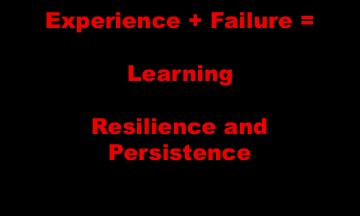
Experience plus failure teaches resilience and persistence.

Why are resilience and persistence are important?

Resilience and persistence are habits of mind.  They are  thoughtful, intelligent behaviors.

Resilience and persistence are habits of mind that lead to

That lead to entrepreneurial behaviors…

For artists and other people   My interest is not in entrepreneurial behavior in the commercial marketplace of small business creation, but rather in the entrepreneurial behavior that supports artists and artistic creativity.  How can we help artists be more “entrepreneurial?”  More persistent, more resilient?  And in doing so, help them to successfully get their art – their creative products – in front of their audience.

Artists who are habitually persistent and resilient will not only persistently create work, they will – even if – and perhaps becausethey fail – resiliently and persistently keep putting their creative work in front of an audience until, like the proverbial spaghetti on the wall, it too sticks.

Joseph R. Reeves; More Spaghetti Art

Because failure is an excellent teacher, we (and by we I mean people who teach artists and support artists) we should provide environments where artists are allowed to fail

The “show must go on” mentality of the arts conservatory may be doing a disservice to emerging artists.

Instead, we can create an environment where artists can not only experiment with new forms of art, but also with new business models for the arts.  That’s why I’ve devoted the last few years of my professional life to a university-based arts venture incubator.
.   In the p.a.v.e arts venture incubator student artists  “learn by doing” as John Dewey advocated, and sometimes they fail – before they succeed. Modeled after small business venture incubators, the p.a.v.e. arts  incubator provides an experiential learning opportunity in which student artist can launch – or attempt to launch — an arts-based venture.  They can get their creative work and innovative ideas in front of an audience.  The primary objective of the incubator is educational.  Return on investment, whether in financial or cultural capital, is secondary to the program’s educational objectives.  The incubator provides seed money and mentorship and connects student arts entrepreneurs to business services.  Students must secure matching funds to the incubator investment.  This is perhaps the most direct means by which the incubator teaches persistence.  The student must persist at securing support or they will “fail,” where failure is defined by the withdrawal of seed funding.  A former student who launched an online music business commented, “Sometimes you have to go through those mistakes and learn how to make hard decisions.”

So, lets encourage artists to develop work – and ideas for disseminating that work – that “stick” ;  by providing environments in which failure is not only accepted but encouraged as a learning tool.  Through failure, artists — and other people — can develop the habits of mind necessary to be successful. Thank you.

(you can watch the video at http://www.tedxphoenix.com/live)

Posted in Arts education, Arts entrepreneurship, Arts funding, arts infrastructure, Higher education, Uncategorized | Tagged , , , , | 4 Comments

Other People’s Mission

This post originally appeared on the 2am theatre blog (#2amt).

“Other people’s money” is not just the name of a play by Jerry Sterner.  It is the temptation put before an “agent” when working on behalf of a “principal” that gives rise to “moral hazard.”  Other people’s money is also what nonprofit organizations – like theatre companies – use to produce work.  There is a lot of business literature, organizational behavior literature, and economics literature that address the relationship between agents and principals and the moral hazard inherent to the task of using other people’s money.  There’s even some scholarly literature on principal agent relationship in the nonprofit sector, but nothing specific to the arts.  As my colleague Andrew Taylor said, “the nonprofit arts are dripping with principal-agent problems. Just ask any governing board who they work for.” Seeing this question as part of a public conversation on twitter spurred #2amt editor David Loehr to ask me to explain moral hazard and principal agent theory as it relates to theatre.  Here’s one example of how the principal-agent problem plays out :

A visionary director, let’s call her Jane Doe, decides to start a theatre company in a mid-size city and, against the advice of her friend the arts administrator, incorporates in her state as a 501c3 with a mission “to enrich the cultural life of the region by presenting new plays generated from interaction with the regional community.”  She has three years to get a board in place. She quickly recruits people she trusts, people who buy into her vision and the mission of the organization.  Her college roommate is now a lawyer – score!  Her neighbor is an accountant – score again! And, her best friend does PR for a health group to round out the functional board trifecta: legal, financial, and marketing.  Fundraising begins and private gifts come in. Grant applications go out and grant money comes in.   Plays get written and produced. Sometimes, people even buy tickets, but not too many.

Jane’s artistic vision evolves and she wants to direct more classics.  Her board of three friends goes along with her programming.  Oops…the board now appears to be reporting to Jane rather than the other way around.  In a nonprofit organization, the board – the governing body —  is the principal, the steward of the mission and all of its funds, and the artistic director is the agent.  Here the moral hazard results from stewardship of mission rather than money, but whenever the goals of the principal and the agent fall out of alignment, you got yourself a principal-agent problem.  There are myriad examples of this situation, the unintentional (or intentional) mission drift that happens over time, mission drift that goes uncorrected because of principal-agent reversal.  I’m too polite to name names.

This situation begs the question: “Why did Jane bother with a board at all?” Law require it of a tax-exempt organization. If she had developed a more flexible organizational structure instead of a 501c3, she likely could have recruited the assistance of her three friends while maintaining her artistic autonomy.   Poor Jane.

Posted in Arts entrepreneurship, Arts funding, arts infrastructure, Arts management, Uncategorized | Tagged , , , , , , | Leave a comment

Lighting Design and Arts Entrepreneurship

I taught lighting design for a long time before transitioning into arts entrepreneurship and policy, with a stint in academic administration along the way. I’ve been thinking about this period a lot lately, in part because of the imminent release of the third edition of Lighting and the Design Idea, and more recently because of a fabulous open letter to young theatre artists from Bay area lighting designer @batfishLD. What IS the connection between lighting design and arts entrepreneurship? For anyone who has done the former, the relationship is obvious. My focus here, though, is on the connection between teaching lighting design and teaching arts entrepreneurship.

This post germinated on the plane back from the ISSOTL (International Society for the Scholarship of Teaching and Learning) conference in Milwaukee where I presented on “Teaching the Artist of the Future: Habits of Mind for Arts Entrepreneurship.” The presentation focused on three pedagogies for arts entrepreneurship: 1) Mentorship, 2) Collaborative Projects and 3) Experiential Learning. Eureka! These are the self same pedagogies employed in teaching lighting design.

Mentorship in an experiential context can be likened to teaching/learning to fish: the mentor shows the student how to cast their line and then offers feedback on the student’s strategy, technique, and results. Thus, the student fisher eats not just for one night, but has food for a lifetime (see an earlier post on this theme). The mentor models techniques for self-reflection as well, so that the student can evaluate his or her own results when they work independently upon program completion. Coaching the student lighting designer in the studio and supporting their work at the tech table is similar. Theatre is inherently collaborative – by collaborating students develop what Howard Gardner calls “The Respectful Mind.” Finally, there is no substitute for experience in teaching the emergent designer. The very first academic panel I was ever on had a title like “Alternatives to the Lighting Lab for Design Training.” My argument was there IS no alternative. Light needs to be experienced – it needs to be felt.

Some of my recent work revolves around the concept of failure – creating learning environments where students can fail in order to learn resilience and persistence. Too often, theatre programs don’t provide that opportunity to fail. The “the show must go on” mentality prevalent even in academia may not create the most effective learning environment. When I was teaching lighting, I tried to build plenty of extra time into the focus, cue setting and even tech process (much to the chagrin of some of my colleagues, but they got over it) so that there was time for the lighting designer to try things out and fail with them – and then LEARN and fix them. Developmental time IS learning time in an academic theatre environment; it’s not wasted time. And my advice to young lighting designers is “don’t let anyone tell you otherwise.”

Posted in Arts education, Arts entrepreneurship, arts infrastructure, Higher education, Uncategorized | Tagged , , , , , | 3 Comments

Capacity and Innovation

After returning from the Grantmakers in the Arts Conference, a dear friend and well-respected colleague who knows I’m always looking for creative ways for my students to find funding for their projects tipped me off to Power2give.org.   Power2give allows donors to connect with (i.e. give to) arts, science, history and heritage projects that are based in the Charlotte/Mecklenburg area.  The program is appealing because it crowd-sources giving opportunities while maintaining a local focus.  The funding infrastructure in the Phoenix area where I live and work tends to focus on large established institutions with less focus on smaller newer organizations (see an earlier post on that topic).  Thus, the Power2give model impressed me as a way to fulfill an unmet need in the Phoenix arts community.  When asked what she thought about bringing the model to Phoenix, my friend replied “Interesting idea to pursue.  It might take a while; we are challenged by the gap between our ideas and our capacity.”

This exchange occurred about two weeks after I floated another idea to a different group, including the head of a community development corporation.  This earlier idea was to produce a Nuit Blanche light art festival in Phoenix.  One colleague noted “I just want to mention that I love this idea.  I’m curious about the funding. . . The last time I spoke with the Public Art Program they expressed their budget cuts and other such woes.”  The third and last idea I “floated,” just a few hours ago, is to initiate a series of theatre salons akin to those happening in San Francisco, as described on the HowlRound #newplay blog.  Trying to make use of my social networks, I posted that idea on Facebook but only received a couple responses. “I’m up for it if there’s collective interest.”  So far  — granted it’s only been out there a few hours – there doesn’t seem to be enough collective interest.

As I reflected on these three examples, I notice that although they are each quite different, they possess several commonalities. 1)  They each require an expansion of organizational capacity, although at differing scales. 2) Social media played some role in idea generation and/or dissemination. 3) All three ideas originated in other places: Power2Give in Charlotte, Nuit Blanche in Paris, and the salon idea in San Francisco.  None are homegrown, and thus none are truly innovative.  They are ideas that were created, incubated, and implemented elsewhere already.  Perhaps capacity will follow true innovation.  I’ve always been an “if we build it they will come” kind of person.  The talent is here, the money is here (even if it’s very conservatively invested), the passion is here.  Capacity will grow to meet the needs of homegrown cultural innovation.  These three ideas might not be right for Phoenix, but others will be. I have to believe.

Posted in Arts funding, arts infrastructure, Culture and democracy, Uncategorized | Tagged , , , , , , , , | Leave a comment

Reflections on YES and NO

Arena Stage’s Polly Carl wrote a really beautiful piece on the HowlRound blog about “The Theatre of Yes.”  This was followed up in HowlRound’s weekly tweet chat (#newplay) with the question: “How do we start to say yes?” I believe the question was meant to refer to saying yes in the theatre and, perhaps, specifically to playwrights but the twitterverse being open, the “chat” was far ranging.  I responded to the question by tweeting “Recognize that “no” is an exercise of power, but “yes” is an exercise of empowerment.”  I’m not a playwright and was pleasantly surprised with myself for coming up with something rather poetic (so surprised, in fact, that I assumed I had read it somewhere before and spent some time looking for a citation but not finding one).

 This is a time of year for reflection in the Jewish community, these ten days between Rosh Hashanna and Yom Kippur. The question of “No” or “Yes” became my focus for that reflection.  Who have I said “no” to in the past year? past decade?  has my saying no stopped someone else’s creativity in its tracks?  Did I ever say “no” merely to exercise power?  I’m happy to say that upon reflection the answer to this last is itself “no,” or at least “I don’t think so, not consciously.”

Saying “yes” is so much more joyful than saying “no.”  But, sometimes “no” is the answer.  Last week, I was able to say yes to several students who want to develop an entrepreneurial idea into a full proposal.  I said “no” to one.  Well, not just me, it was a committee decision, but I had to communicate that decision.  In doing so, I tried to make the letter be about the project, not the person, but in reviewing it and reflecting on it, I could have done better, been more encouraging, suggested the student come in and meet with me to discuss the project.  But I did not.  For this, I ask forgiveness, because that’s what this holiday is about — about turning the bad into the good through forgiveness (also prayer but I don’t believe in that as much and justice & equality, which I believe in lots).

Firmly in middle age, I have heard both “yes” and “no” many times.  “Yes” often sounds like “Great idea – now go find the funding for it,” which may be followed by a “no” that sounds like “Great idea – but no, we won’t fund it.”  The “no” that hurts, however, is the one that is not about money, or even about the idea.  The “no” that hurts the most is the one that comes with no explanation, no rationality, no context.  This is the “no” that feels to its recipient like only an exercise of power.  Its mirror image, the “yes” that has no strings attached, is the yes that brings the most joy, for that is a “yes” that comes with trust…and sometimes a kind of love.  Not love in the affectionate, romantic, or even friendly sense, but love of creativity, love of the idea itself.   Learning to say “yes” with joy and without strings is a management skill to be nurtured as much as is the ability to say “no” with kindness and reason.

When I lead my students in brainstorming exercises, we first lay out some ground rules: suspend judgment, encourage freewheeling, avoid killer phrases, and so on.  Creativity – the generation of novel ideas – flourishes in an environment in which “no” is removed from the vocabulary, even if temporarily.

Posted in Arts education, Arts funding, Arts management | Tagged , , , , , , , | 2 Comments

Incubating the Incubators

Devon Smith recently visited the ASU campus as part of the p.a.v.e. program in arts entrepreneurship speakers series.  Her visit followed close on the heels of her blog about arts incubators and how they differ from business incubators.  In response to that blog, Diane Ragsdale, on her Jumper blog, posted some thoughts on incubation as well as several questions – the questions that I wrestle with every day as the director of the p.a.v.e. program:

  1. What is the goal of a successful arts incubator?
  2. What should it be?
  3. Is it wrong to think that it should be not only about improving the quality of the work but also about discovering avenues by which to exploit it (i.e. derive full value from it) in the marketplace?

I’ll answer #3 first, because it’s easiest: of course it’s not wrong.  What separates an entrepreneurial approach to art-making from a non-entrepreneurial approach is an entrepreneurial approach is about connecting the work to its audience — read “market” — in such a way that is has value for the market and its production simultaneously has value (intrinsic as well as extrinsic) for the artist/maker.  The incubator can provide a physical or virtual environment that helps the artist both recognize and develop those connections.

Diane’s first question leads to a question of my own in which I am particularly interested: How do we measure the success of an arts incubator?  My preferred method of evaluation, and the one I use in the p.a.v.e. program’s evaluation plan is goals-based.  Is the incubator achieving its explicit and implicit goals or mission?  There is very little literature on assessment tools for business incubators and even less for arts incubators.  What little there is is largely anecdotal.  For example, the Arlington Arts Art Incubator indicates that it has successfully “accomplished a myriad of goals . . . most notably expanding the number and diversity of arts available in Arlington” but I could not find hard data about that expansion or diversity. They do have some excellent advocacy tools available on their website, though.  Americans for the Arts, through its Animating Democracy program, offers some guidance on evaluating the social impact of arts programs of any type that can be informative.  (see my earlier post on this topic)

On to Diane’s second question: What should it [the goal of a successful incubator] be? In all likelihood, there are as many answers to that question as there are incubators.* In the case of a university-based incubator, the primary goal may be process- rather than product-oriented because of a program’s educational mission.  P.a.v.e.’s primary goal is to “educate students, artists and educators about how the principles of entrepreneurship can support the development of creative opportunities for artists of all kinds,” secondarily to assist individual students in increasing their self-efficacy in relation to artistic creativity, and, implicitly, to enhance the cultural richness of the region through the development of sustainable arts enterprises.   For a municipal incubator, something closer to the third of these might be the goal, or, like the North Carolina Arts Incubator, the goal likely revolves around community economic development.

There is a national association for business incubators, the National Business Incubation Association.  There is no similar organization for arts incubators but  maybe there should be.  Americans for the Arts published its Introduction to Arts Incubators back in 1995.  Now that there is more interest in arts entrepreneurship, more interest in the arts as a factor in both economic and community development,  and a growing list of arts incubators, perhaps more attention could be paid to the evaluation of arts incubators.  I feel a new research project coming on . . . .

*At my last count a year ago there were about two dozen municipal or public/private arts incubators plus three university-based arts incubators.

Posted in Arts education, Arts entrepreneurship, arts infrastructure, Uncategorized | Tagged , , , , , , , , , | 1 Comment

It’s Not Rocket Science

I’m teaching a unit on fiscal literacy next week in my arts entrepreneurship class, leading up to the unit on budget and finance. This content spurred me to revisit something I posted on the entrepreneurthearts blog last year.  Because it never hurts to review some basic principles, I’m reposting some of that content here:
A BUDGET IS A PLAN.  A budget is only a plan for how a venture is going to spend the money it raises and earns. So, in the simplest terms, the budget plan is a list of all real and projected sources of revenue and a list of all anticipated expenses. The accounting that happens afterward is an opportunity to assess how well the plan worked in achieving the goals of the venture or project.

REVENUE SHOULD EXCEED EXPENSES. My quick lesson on financial management is simple: the total revenues must meet or exceed the total expenses. THIS IS NOT ROCKET SCIENCE.

It will probably come as no surprise to hear that sometimes student arts entrepreneurs don’t include everything they should on their planning budgets. What is surprising is that the most common mistake on the revenue side is the exclusion of earned income from the budget. Students – especially coming from an arts background — don’t always realize they can count the money they will generate from ticket sales or DVD sales, or tuition to the community arts workshop they’re proposing in their budget. These students are smart and have big ideas, but they’re not yet fully thinking entrepreneurially. My guess is that leaving earned income off the budget plan is a problem of mindset. These students don’t expect to make a profit right off the blocks (if at all) so why include earned income? Because:

REVENUE AND PROFIT ARE TWO DIFFERENT THINGS.  Revenue is all the money that comes into the project. Profit (or deficit) is the difference between the revenue and the expenses. Most of our student arts entrepreneurs aren’t out to make a profit out of the box, but it is our hope * and theirs * that they will make the money needed to sustain their ventures.

BUDGET PLANNING DOES NOT REQUIRE HIGHER LEVEL MATH. Some arts entrepreneurs are intimidated by the math needed to create a budget. There really isn’t anything more than basic arithmetic needed — primarily addition and subtraction. Multiplication may be needed if sales projections are part of the plan, but that only involves multiplying the unit price (e.g. ticket price) by the number of units projected to be sold.  Furthermore, software can do that math for you.

RESEARCH REQUIRED.  Sometimes, student arts entrepreneurs leave key items out of their budget or grossly underestimate the cost of something important — like marketing materials. It just takes a small amount of research to find out what it would cost to print and mail a thousand flyers, buy a domain name, or maintain a constant contact email service.
START PLANNING. With a little research, some basic arithmetic, and the necessary foresight, putting together a budget can be pretty simple — especially when we’re only talking about four- or five-figure numbers. Multiple funding streams will make things more complicated, but by the time there are multiple funding sources to keep track of, the venture may want to consider a professional business manager or accountant. Think ahead, face your fears, and get started!

Posted in Arts education, Arts entrepreneurship, Arts funding, arts infrastructure, Arts management, Higher education | Tagged , , , , , , , , , , , | Leave a comment

Authenticity?

I interviewed lighting designer Allen Hahn recently about his curatorial approach to the lighting designs in the US National Exhibit at last summer’s Prague Quadrennial of Scenography.  He explained that the curatorial team identified a trend toward “authenticity” in the contemporary design aesthetic:  “Authenticity in terms of spaces created by set designers and lit accordingly – spaces that didn’t present themselves as scenery but more as architecture presented on stage. . . .Well into the age of the Internet we are very aware of authenticity.  A simulacrum doesn’t pass muster in the way it used to, unless it’s used as a style. “  This last reminded me of something director Peter Sellars asked me rhetorically twenty years ago or so, “Which is more real, a Noh stage with a pine planked back wall painted with a tree, or a set for Plaza Suite with fully articulated moldings carved of Styrofoam, working doors and windows with plexi-glass, and all the doorknobs,” The answer, as obvious to me then as it is now, is the Noh stage, because the painting of the tree is an authentic painting of a tree, it is not trying to be anything else.  The molding on the set of Plaza Suite is as fake as a three dollar bill.

This in turn got me thinking of Allen’s other statement: “well into the age of the Internet we are very aware of authenticity.”  But are we?  How do we know what – or more to the point who —  is “authentic” on the internet.  I’m not just talking about the little fibs we tell about ourselves  (if everyone who described themselves on a dating site as “athletic and toned” were really as described, this country would not have an obesity problem) but about the substance of being on the Internet.  The question of “is there any there there?”  I’ve become a more active user of twitter lately (follow me @LindaInPhoenix), which has led to an expansion of my universe or twitterverse of online-only acquaintances.  Some of these are people who know people I know, so I believe them to be authentically people.  Others, however, are some other kind of entity: a business using what seems like a person as an effort toward humanization or, more interestingly, a person purporting to be a business entity but having no actual organizational existence.  As one of my twitter followers noted (thank you @krysVS),  “people don’t like authenticity as much as they like the *illusion* of authenticity…”

Krys’s comment is particularly interesting in light of the comments Allen made about American stage design.  When we place something “authentic” on stage is it authentically authentic, or merely presenting an illusion of authenticity?  Some years ago, I designed a production of “Kiss of the Spider Woman” (the play, not the musical).  Because I have always had a distaste for the fakery of much traditional scenery and because I wanted to hear the sound of shoes on the cell floor, I insisted that the prison cell be encased in real concrete.  Where there was not real concrete, there was real brick.   At the end of the play, the stage, which had seemingly been a neutral black expanse beyond the cell, filled with a full-stage projection of orchids.  What was more real, the cell built of 2X4 and plywood, albeit covered in real concrete or the projection of flowers.  The projection, of course, as it was meant to be a projection.    Yet, the illusion of authenticity of the cell was successful dramtically as the illusion of authenticity often is onstage.  Whether the illusion of authenticity of shell entities in my twitterverse will be successful at whatever it is they are trying to do is anybody’s guess.

Posted in Technology and arts, Uncategorized | Tagged , , , , , , , | 1 Comment

The Synthesizing Mind, or Why I Like Cooking

One of my earliest postings on this blog referenced Howard Gardner’s “Disciplined Mind.” I continue to use his “Five Minds for the Future” as a framework for teaching arts entrepreneurship. Recently, I have become particularly interested in “The Synthesizing Mind.” Gardner writes that the synthesizing mind is characterized by “the ability to knot together information from many different places into a coherent whole.” Synthesizing is a “connect-the-dots” form of creative action that many entrepreneurship theorists point to as well. Gardner creates a taxonomy of outputs of the synthesizing mind:

  • narratives
  • taxonomies
  • complex concepts
  • rules and aphorisms
  • powerful metaphors, images, and themes
  • embodiments without words
  • theories
  • metatheory

To this, I add: menus. Yes, the kind that includes groupings of dishes, designed to be eaten separately but that work well together as a meal, with a specific audience in mind, at a specific place and time. As noted in another early post, I am frequently asked in one form or another, “where did your creativity go?” I find the development of a really good menu from fresh local and/or sustainable ingredients to be my most enjoyable form of creative synthesis. Here are two examples:

Example #1: A meal in four bowls (a.k.a. dinner for two, when trying to impress or seduce):

  • Bowl one: Carrot ginger soup
  • Bowl two: Moules marinieres
  • Bowl three: Wild mushroom risotto
  • Bowl four: Homemade chocolate strawberry sorbet
  • Wine

Example #2: Midsummer beat-the-heat buffet:

  • Melon salad : farm fresh melon with Greek yogurt, honey, mint
  • Green salad : strawberry vinaigrette
  • Lobster roll: with bacon and basil aioli on homemade rolls
  • Roasted new potato & red pepper salad: Balsamic vinegar and fresh herbs
  • Homemade rocketpops: Orange cream, strawberry basil, and chocolate chili
  • White sangria (and a lot of it)

A good menu has the hallmarks of a successful creative ventures: it is mindful of resources, fills a need, is designed with a specific audience/market in mind, and offers a return on investment (the return is the satisfaction of my friends and the investment my time and only ¼ the amount of money a similar meal might cost in a restaurant). All in all, a menu can be a very successful creative endeavor, one that exercises my synthesizing mind.

If you’re interested, here are a few links to recipes from the menus above, but some dishes are my own and not written down anywhere. I encourage you to adapt (synthesize!) freely:

Posted in Uncategorized | Tagged , , , | 9 Comments