Personal Symbiosis

I think about personal symbiosis a lot.  Some people, including sometimes me, call this “work/life balance.” But calling it “work/life balance” implies a separation between the two, with work on one side and life (all that is not work) on the other.  Somehow, to be successful in both, one might assume they remain in their separate realms and, like the sides of a scale, can somehow be balanced if the right amount of each is placed on the pan on either side

But life and work are mutualistic, two systems that work together.  This mutuality is what I’m calling personal symbiosis.  It is one’s personal infrastructure.  If one is going to work in arts/culture/higher ed/creative industries (pick as many as apply) and also have things that are not work kids/marriage/family/friends/neighbors/religion/politics/service (pick any and all that apply) finding a healthy interaction between the two is both a challenge and a necessity.

Last week, I shared my “Ten Things I Wish Someone had Told Me When I Was First Starting Out” with a large class of freshman and transfer students.  As I got to #2, “Your life outside the theatre is more important than your work inside the theatre,” and glanced out at the crowd of over 150 students, I noticed students nodding in understanding.  The nodders were all women.  Why? Is it that the young men in the class didn’t agree? Or, more likely, that these young women understand that achieving the personal symbiosis they will need to sustain life and career is a challenge?  Is it more of a challenge for women than for men? I would like to say “no,” but can’t because I don’t experience life as a man.  I do know, through both research and observation, that the challenges are different for women than for men and that on the professional front at least, remain greater for women than for men.

There’s been a lot of chatter in my particular corner of social media space about imbalance in theatre programming such that plays by men make up the vast majority of plays programmed by large institutional nonprofit theatres. The most widely publicized version of this inequity being the Guthrie Theatre season announcement.  So, if you’re a woman playwright, the odds are not in your favor professionally. Despite the fact that contemporary lighting designers stand on the shoulders of giantesses like Jean Rosenthal and Tharon Musser, historically, only just over 20% of Broadway shows have been designed by women.*  Even if all else is equal at home, women are more likely than men to find gender bias against their work in the theatre.

My life has been a constant series of choices that adjust the symbiotic mutuality of the home system and the professional system.  As I get older, I realize that there is a third system that requires attention as well: the actual biological system that demands healthy food, adequate rest, exercise, and access to healthcare.  Creative infrastructure is not always funding or buildings or skills.  Sometimes, creative infrastructure is the symbiosis of these three mutually dependent systems.

* For more on this, see my article “On Their Shoulders: Women in Lighting Design” Theatre Design and Techology, Fall 2005.

UPDATE: New post, a follow-up to this and Anne-Marie Slaughter’s “Why Women Still Can’t Have it All” – (Not) Having it All

Posted in Uncategorized | 4 Comments

Avoiding the Begging Cup – redux

Late last week, Richard Dare of the Brooklyn Philharmonic posted a column on the Huffington Post about the unsustainability of a donor-based business model for the arts.  A colleague, seeing this, wrote, “I’ve been saying that for years.” To which I replied, “me too.”  I believe the first time I wrote publicly about this issue was in 2009 on the entrepreneurthearts blog in a post titled “Avoiding the Begging Cup.”  Lightly re-edited, I re-post it here as a way to keep the conversation going from the recent past into what I hope will be a more sustainable future.

AVOIDING THE BEGGING CUP (originally posted 12/25/09)

"Please sir, may I have some more"

I was contacted by a fellow entrepreneurthearts blogger with some provocative questions. I address two of them, paraphrased slightly:

1. Can we teach our aspiring theatre artists to avoid the traditional path of the begging cup?

2. Would it be so bad to have a slew of privately-owned for-profit theatres (to avoid the begging cup that comes with 501c3 status)?

How many times have we gone to a performance at our regional professional nonprofit theatre and been greeted at curtain time by the artistic director or managing director making a plea for support? The curtain speech plea has become ubiquitous in the last 18 months [remember, this was written 12/09, so that eighteen months marked the beginning of the financial collapse] as theatres have struggled to stay alive. But, it’s a technique not confined to the nonprofit market. Broadway cast members have been making their annual Broadway Cares/Equity Fights Aids fundraising plea for the six weeks leading up to the New Year. Both certainly have the air of the begging cup about them. The most successful development efforts, however, have nothing to do with begging during a curtain speech. Successful development efforts have at least three major components: partnering with community, developing audience, and effective grant-getting.

When development focuses solely on asking for money, it is doomed to fail. However, when a theatre (or any non-profit arts organization) meets a community need, [when it creates value,] then the community will support it. The question is not how can we avoid the begging cup? but rather WHO can we partner with in our community? and how can we better serve our community? I don’t have any easy answers, but in general, arts organizations need to be focused outwardly rather than inwardly: Who are our constituents and how can we give them something of value? Rather than what do we need to do to maintain our current programming and structure?

This is where the second component comes into play: audience development. If the current audience is not supportive, it’s time to develop new audience, which usually means a change of direction or expansion of programming, rather than a contraction. I’m trying to expand our audience for my current institution by offering more performances, some at nontraditional times. Is it working? Unfortunately it’s very unclear, but we haven’t lost anything in the trying (yet). We took a risk. We’re expanding services to niche audiences like elder hostels and children. But we can’t measure success based on ticket revenue alone. We will measure success on whether or not the organizations and programs we partner with want to continue the relationships we form. [Note: I have since stepped down from that position, but know that some partner organizations continue to be partners, while others do not]

I listed effective grant-getting as a component of development because grant writing and grant-getting have several benefits. The mere act of writing grants (which are usually only available to nonprofits) forces an organization to focus and articulate its mission. Grant getting is also a form of community partnerships. Foundations want to partner with organizations that help advance the mission of the foundation. It is a bi-directional relationship.

My provocateur expressed a utopian idea of having many small for-profit theatres, privately owned, and risk taking. Here Jim and I disagree. We have a model of for-profit theatres: Broadway. Some are privately owned, some owned by large corporations, but very very few are risk-taking and none of them small. (The risk-taking exceptions are the commercial Broadway productions mounted by nonprofit theatres; here we see riskier fare like Sarah Ruhl’s In the Next Room). But, much as small independent bookstores and mom-and-pop grocers are few and far between, so too would be privately owned for-profit theatres. Such theatres would have no choice but to pander to the ticket buying audience (a demographic not always known for risk-taking) and, driven by a profit motive, would not stay small for long because if successful, there would be buy-out offers from Comcast or Universal or Disney. Making art is risky enough without the art makers having to invest and risk losing significant capital.

That having been said, maybe theatre makers should look to filmmakers for a for-profit model in which a company is formed around a specific project, money raised for that project, and then return on investment may (or may not) take place after distribution. Perhaps the way to have a for-profit theatre infrastructure is to avoid the institutional structure completely and consider each project as an independent venture. That would be an idea worth pursuing, but fundraising for a for-profit project-based venture brings us full circle back to the begging cup.

[Now, 2 ½ years later there IS a way to raise money for those for-profit project-based ventures: CROWDSOURCING! Change is happening; hopefully, for the better.]

Posted in Arts entrepreneurship, Arts funding, arts infrastructure | Tagged , , , , , , | 5 Comments

10 Things I Wish Someone Had Told Me

Americans for the Arts posted a summary from the Arts and Science Council’s emerging leaders program session entitled “For Women by Women: No Really…Things We Wish Someone Had Told Us at 25.”  The post reminded me that a month or so ago, my colleague and friend Vickie Scott from UC Santa Barbara asked “What are the 10 Things I Wish Someone Had Told Me When I Was Just Starting Out?”  It was late when I received the email request and I hastily dashed something off to her.  Lightly re-edited, and in no particular order, here is my list:

  1. CARPE FUTURUM
  2. Your life outside the theatre is more important than your work inside the theatre.
  3. You don’t have to live in NY/work on Broadway to be a successful theatre professional.
  4. Just because your union sets a minimum scale doesn’t mean you have to accept that minimum.
  5. The people you meet in college and grad school will be your friends and collaborators for the rest of your life.
  6. It’s better to learn from the mistakes you make than to avoid the risk of making the mistakes in the first place.
  7. Sometimes, you have to just do it.
  8. If you can keep your eyes open to unexpected opportunities, you may see unexpectedly positive results.
  9. Knowing how to read music and speak a second language will serve you well.
  10. THERE IS NO RUSH

Today, #6 is my favorite but that could change tomorrow.

[PS. #11 is from the end of Craig Lucas’s Prelude to a Kiss. “Old Man: Can I give you two a piece of advice? Floss.”  What’s on your list?]

Carpe Futurum temporary tattoo from Tattly. Design by Kelli Anderson

Posted in Arts education, Arts entrepreneurship, arts infrastructure, Higher education | Tagged , , , , | 5 Comments

What’s My Discipline?

I have just returned from the USITT annual conference with the often repeated question “So are you still doing lighting?” ringing in my ears.  In retrospect, I should have replied “Yes,” and left it at that because what does it mean to “do” a discipline?  Am I regularly laying out instruments in a CAD program, choosing colors, building cues in the theatre? Not so much.  But, I “do” lighting design because I am disciplined to think like a lighting designer and apply that thinking process to all that I do.  In “Five Minds for the Future,” a book I have referenced often here, Howard Gardner explains “discipline” as a distinctive way of thinking about the world.  I’ve “done” lighting for a long time. The “way of thinking” won’t go away.

In an earlier post, I connected the teaching of lighting design with the teaching of arts entrepreneurship, my current academic focus.  But, there are also connections between thinking like a lighting designer and my other intellectual (pre)occupations, arts management and arts policy.   Arts management, like lighting design, demands an ability to view an issue from multiple perspectives, to see a situation as existing not only in space, but also in time.  Lee Bolman and Terry Deal refer to this as “reframing.”  And, like lighting design, arts management (or any organizational management), demands an ability to focus simultaneously on the big picture and the small detail, the full stage composition and the way light sculpts an actors face.

Professional knowledge is not the same as disciplinary thinking.  A crash course in personnel management or nonprofit finance can provide professional knowledge.  Disciplinary thinking comes with, well, discipline, the repeated application of professional knowledge in context.

I’m blathering on about this in part because of my misguided decision to enter the Spring for Music “Great Blogger Challenge,” which, in my decision to withdraw, got me thinking about peoples’ tendencies to draw limits around their discipline, their practice, and even their culture.  Their prompts reified limits by asking bloggers to consider one place or one type of cultural product as more valuable somehow than another.  An entrepreneur sees the opportunities in such limits, transforming them from limits to something else. Disciplinary thinking can likewise be transformed, reapplied, turned sideways, and re-purposed.

Posted in Arts education, Arts management, Arts policy, Higher education, Uncategorized | Tagged , , , | Leave a comment

Withdrawn

The “most”… cultural “capital”… “best” blogger.  Spring for Music seems determined to narrow things down.  My professional work in teaching arts entrepreneurship and helping organizations succeed is about the reverse: expanding thinking, broadening perspectives, looking outward, cooperating rather than competing. Douglas McLellan, in his explanation of the rationale behind the design of “The Great Arts Blogger Challenge” writes, “There are as many ways to write a blog as there are people who write them. It’s difficult to compare them in a useful way. And yet you have to make distinctions somehow.”  I’m not convinced we need to make such distinctions.  Blogging is democratic and participatory.  The elimination of one over another, the recognition of one person’s perspective on culture as somehow better than another’s is antithetical to my professional and personal philosophy. And so I withdraw from Spring for Music’s “Best Arts Blogger Challenge.”  Instead, I return my focus to the list of topics around which this blog revolves:

  • Arts policy
  • Arts management
  • Culture and democracy
  • Higher education
  • Arts education
  • Local economies
  • Technology and arts
  • Creativity
  • Arts funding
  • Evaluation and assessment

…..and occasionally cooking.

_________________________________________________

A followup 3/31:  Upon reading the post above, the contest organizers emailed the following to me: “How interesting. You entered a contest, then pulled out saying it’s because it’s a contest, thereby taking away someone else’s spot. Interesting.”  To which I replied:

“I certainly did not enter with the intent of withdrawing.  My decision is not about the fact of the contest but rather about the nature of the prompts.  I was on the fence to begin with because of the focus of the first question but found a way into it.  I did not feel I could continue in good conscious when the second question seemed to be about  presenting one art form as somehow better (or at least more representative) than others.  Had the question been more expansive, I would have been more inclined to continue.

If you are concerned about my entry having taken up someone else’s spot, perhaps you can slot in a “runner up?”

Thank you for the opportunity, “

There is an opportunity here for the people who care enough about arts and culture to write about it to imagine, to look to the future rather than the present or the past, and to envision a world where orchestras are not going bankrupt, artists are not starved for opportunities or financing, and arts education is recognized and considered a necessity.  I sincerely hope that the next round of questions encourages participants to do so.

Posted in Culture and democracy, Uncategorized | Tagged | 1 Comment

Culture Quilt

Great Arts Blogger Challenge – 1

Spring For Music has initiated the “Great Arts Blogger Challenge,” and while I don’t go in much for contests, I do enjoy a challenge (and my kids encouraged me to participate).  The prompt for round one, “New York has long been considered the cultural capital of America. Is it still? If not, where?” has already been criticized for being crass, easy, outdated, or obvious.  One can question the definition of “America,” (and I hope some bloggers do) and one can develop entire PhD programs around the definition of “culture.” For me, however, the question is interesting because it reflects my lived experience interacting with “culture.” The best blogs are those that take us inside the writer’s experience to help better see the world writ large.  I hope I can rise to that challenge.

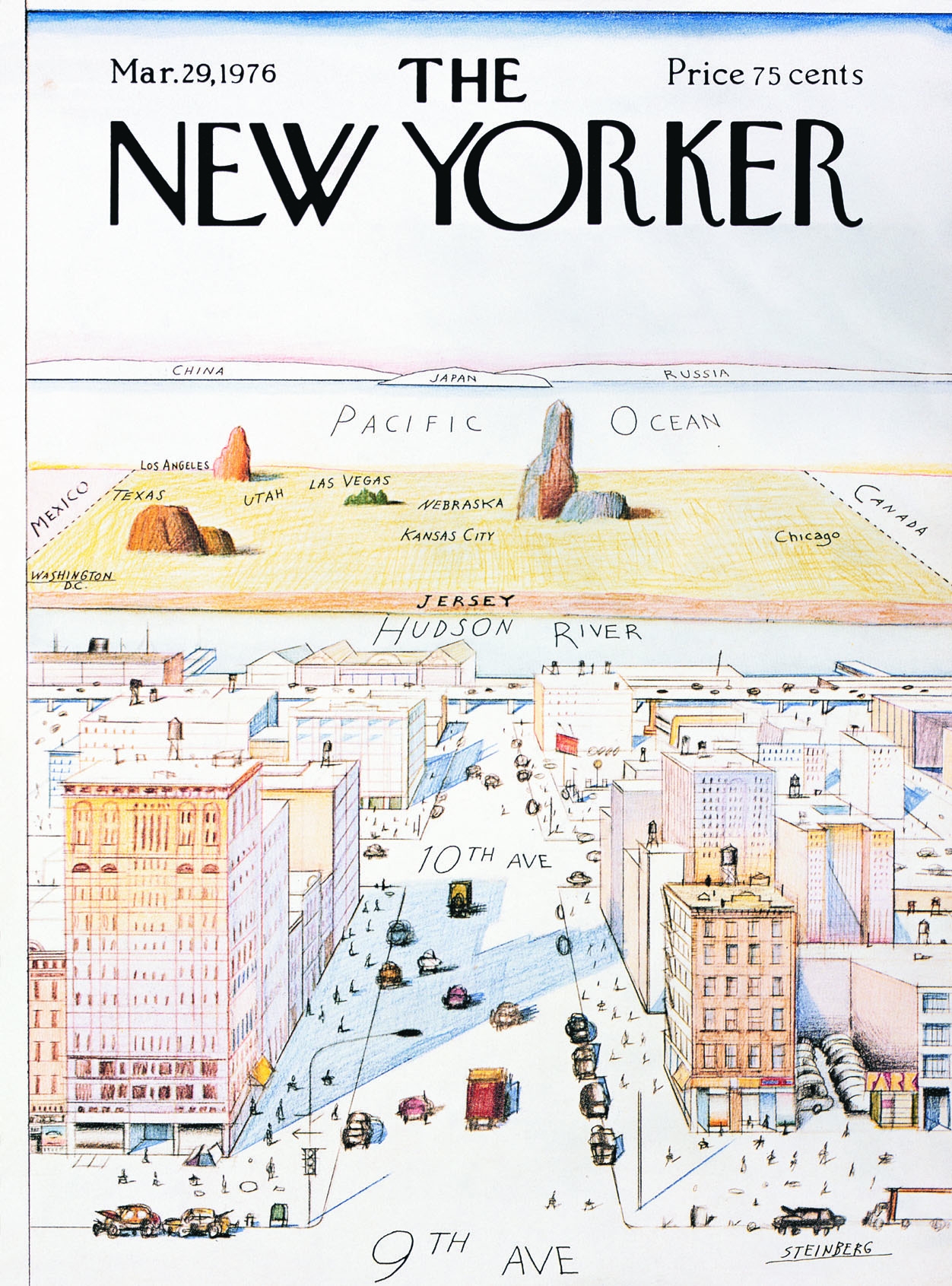
I was raised in New York consuming and absorbing its cultural products, trained there to work at the pinnacle of professionalized theatrical production, and having done so, on some level “made it in New York.”  But, can a culture that excludes the 99% through economy or geography or both, truly be the culture of “America” in all of its diversity? (I use “America” here to mean USAmerica, although I understand that the challenge sponsors wrote “North America.” I doubt very much if the denizens of Mexico City now or have ever considered New York to be their cultural capital.)  I grew up believing that Saul Steinberg’s famous 1976 New Yorker cover view of “America” was accurate.  I realized after three years of working on theatrical productions from the Bowery to Broadway, that there was an entire continent of arts and culture west of the Hudson River. And so, I moved west.

Relocating to the Midwest, I soon realized that I could do more meaningful work as a lighting designer in regional theatres than in New York where the economic exigencies of either commercial production or my own finances forced me into artistic compromises. I found pockets of extraordinary cultural richness in Milwaukee, Chicago, Kansas City, and even southern Utah.  I found American culture all around me.  Much of what I saw at first was “professional” culture – the finest LORT theatres, excellent regional museums (Mt Horeb WI’s Mustard Museum being a notably kitschy counter-example), and so on.  But as I shed my New York armor, the blinders came off as well.  I started to see people in neighborhood community centers taking art classes, children taking dance classes, and some extraordinary craft fairs featuring beautiful handmade objects from local and national artisans.

Today, I engage with the production of culture of far more breath and depth.  Having made a second move further away from New York, and to some extent away from lighting design, I find beauty – and excellence – in places I never would have expected to.  I wrote here recently, albeit briefly, of observing a dance class in what is usually termed an “inner city” high school.  The class was being led by a special guest, Cassie Meador, artistic director of Dance Exchange.  Cassie was helping 16 teenagers express their perspectives on what they see in the desert and what they don’t see there through movement.  The result was new material that the students will perform as a work in progress in April.  It was deeply moving.  Later that same day, I observed about a dozen adolescents at a Boys and Girls Club making beats about their streets in a session facilitated by a local spoken word artist, a music professor, and a graduate student.  These kids were expressing their culture in a form that is culturally theirs.  They may never get to hear an opera at the Met, but I would argue that their street performances are more American than the Met’s latest production of L’Elisir D’Amore.  And, I would further argue, it always has been.  It’s not that New York used to be the cultural capital of “America” and is no longer, it’s that people all over the country, professionals and amateurs alike, recognize that their local work has value.  This transplanted New Yorker thinks so too.

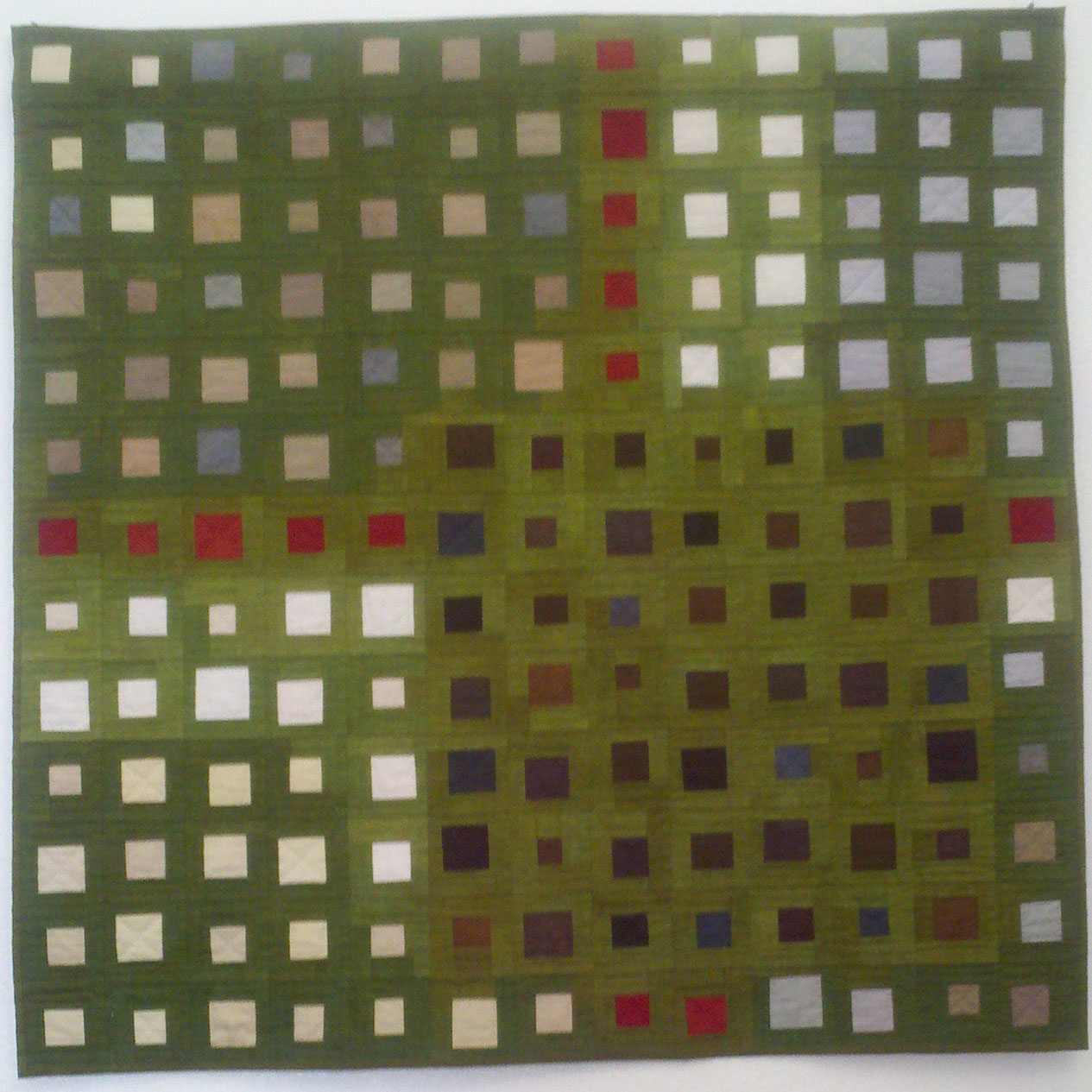
I recently brought an extraordinary craft work into my home.  It is a quilt by Diane Friedlander-Bowman from her Room for Squares series.  It is made up of 169 small squares, framed by 169 larger squares, making up 5 overlapping squares, within one larger square.  Each little tiny square of fabric is hand dyed, mottled, deep. This quilt is the quintessential metaphor for American culture – small separate discreet bits of a variety of colors and sizes, sometimes overlapping, all sewn together to make a whole, hand-made in America.

[You can vote for Creative Infrastructure here: http://springformusic.com/2012-great-blogger-challenge/]

Posted in arts infrastructure, Culture and democracy, Higher education, Uncategorized | Tagged , , , , , , , , , | 1 Comment

Ms. Placed

I usually reserve this blog space for thoughts and ideas directly related to infrastructure for the arts.  Today, I make an exception.  (If you want to, you can scroll down to a recent post on arts funding or click here.)  On the verge of 48 years old, I am a product of second wave feminism.  Thanks to Betty Friedan, Kate Millett, and especially Gloria Steinem, I grew up believing that a woman could have all that a man could have.  I went to high school with Geraldine Ferraro’s daughter. Back at that time, there was a “women’s section” in the newspaper that today is called the “Styles” section.  Serious people – men and women alike – didn’t actually read the styles section.  Important viewpoints were expressed on the opinion pages.  When I was a kid and there were still cigarette ads everywhere, the mantra of my childhood was “you’ve come a long way baby.” Apparently, Virginia Slims was as wrong about that as about cigarettes.

Women’s rights are now being attacked in a way they haven’t been during my adult lifetime.  Feminism, or the women’s movement — whatever you want to call it — desperately needs leadership and vision to lead us through this difficult time.  That is why I was shocked – really appalled – that the New York Times, a paper I deeply respect for its nuanced reporting on issues I care about, placed an article about Gloria Steinem and her possible successor as the symbolic leader of the movement in the Styles section and not in the Sunday Review. The article asks an extremely important question: “Where is the next Gloria Steinem and why . . . has no one emerged to take her place?”  An article that addresses this critical question for the women of this country in what most people consider the nation’s newspaper of record should be in the Opinion pages, not relegated to the Style sheet.  This is an issue of interest to the whole of the country, not just women.

Adding insult to injury, the article that touches on this succession is further devalued by the one that follows it about the young feminist organizer whom Steinem took in as a “roommate.”  If Shelby Knox could be the answer to the important question posed in the first article as is implied in the second, then a meaningful profile of her would be more suitable than a description of her “tiny but cozy first floor studio” in the West Village.

If you are a woman at risk of losing access to affordable contraception or at risk of having your rights and your body violated by mandatory invasive medical procedures, you don’t care about a feminist’s apartment.  You care about her (or his) ideas.  I wish the New York Times had covered that on the front page – and NOT the front page of the Styles section.


Posted in Culture and democracy, Uncategorized | Tagged , | 9 Comments

There’s Something Happening Here – 2

What it is ain’t exactly clear, but over on Arlene Goldbard and Barry Hessenius’s art clout blogfest, Diane Ragsdale suggests that the NEA should be “disintegrated and it’s components set free” in response to Arlene and Barry’s prompt: “With a blank slate and all your powers of social imagination, redesign it.”  There is too much symbolic capital in our federal and state arts agencies to disband them and start from scratch.  In the absence of financial capital, we should retain as much of the symbolic kind as we can. Yet, the system can and should be re-designed.  Doing so may get us that much closer to achieving Bill Ivey’s “Cultural Bill of Rights” as elucidated by Diane.   My redesign of the NEA and the state arts agencies would do the following:

1. Incentivize innovation.  Small arts organizations should not be considered in the same pool with large, highly-capitalized and well-staffed organizations.   The organizing principle of NEA grant programs is discipline-based: dance, design, music, etc.   Knock down these traditional – and I would add outmoded – disciplinary silos and replace them with grant programs to organizations delineated by size.   A grant of $10,000 means little to an organization with a $10M budget, but is transformative to one with a $150K budget.   Large organizations in particular would have to show how grants for innovation would be invested in something truly new.  Other grant programs (see #4 below) would support the ongoing production of mainstream forms. Further, the dissolution of the disciplinary silos removes the current disincentives for groundbreaking interdisciplinary work.

Get rid of the three-year rule.   Forcing an organization to have been in business for three years before it can apply for a government grant reifies the status quo by supporting only existing, stable organizations.  Yes, it’s riskier to put public money toward an organization without much of a track record, but without risk there will not be reward.

2. Reinstate individual artist grants. Art is made by artists. Support them.   How can a granting agency decide if an artist is “worthy?”  Don’t try.  Artists of all stripes apply to be in a pool and then individual artist grants are awarded by lottery.   Funding would be distributed quite literally as seed money without curation or reporting.  Any artist meeting some sort of minimum qualifications would have equal chance at securing funding as any other artist.  No reporting necessary – unless that artist wants to go on to second round funding beyond the seed level, in which case some evidence of having produced something would be required.  The lottery system will attenuate the charges of elitism often ascribed to the granting process.  Who am I (or you) to decide that one artist is worthy and another not?  Would this system yield a lot of “bad” art? Maybe.  Offensive art? Probably.  But it would also yield a lot of amazing work that would not otherwise see the light of day.

3. Support community-based arts. My perspective on the value of community arts has shifted 180 degrees since I started out working in commercial theatre in New York.   At that time, I thought all that mattered was the highest level of “professional” work seen on the Broadway stage and in New York’s world-class museums.  That perspective shifted somewhat as I moved to the Midwest and embraced the idea of “regional” theatre, dance, and museums, and further still until I found myself last week in an urban high school dance studio watching some 17-year-olds exploring, through dance, what it means to live in the desert. The work was honest, moving, and beautiful. It was not “professional.”  Government funding should be specifically targeted to the heart of communities, both rural and urban, where artmaking is done not by what we usually think of as “professionals” (although perhaps in collaboration with them), but by the people who live there. (see Home in the Desert for more information on this project, which happens to be funded in part by a grant from the NEA)

4. Preserve cultural heritage. While supporting innovation and the development of new work in communities is critical, so too is preserving our existing culture.  I envision this area of support to have two threads, support for mainstream arts/arts institutions (eg symphony, ballet, etc) but also support for cultural heritage forms, from the hoop dancing of Arizona’s indigenous people to the bluegrass music of Appalachia. New Zealand provide good models for this in its support – and respect – for the cultural products of its indigenous peoples.

Organizing public funding along these four priorities would promote cooperation over competition and artistic production over organizational complacency.

Posted in Arts funding, arts infrastructure, Arts policy, Culture and democracy | Tagged , , , , , , , , , , | 12 Comments

There’s Something Happening Here – 1

What it is ain’t exactly clear, but there seems to be a growing questioning of the status quo, or rather the stati quos.  Perhaps it’s a response to shrinking arts funding, declining audience numbers, exponentially growing means of distribution, or all of the above and more, but the ground is shifting.  I could list the many blogs postings I’ve read (and a few I’ve written) that address, for example, the concentration of “wealth” in large institutionalized predominantly white nonprofit arts organizations or the democratization of creative production and criticism or the need for artists to be more entrepreneurial and arts organizations to develop new business models, and on and on, but I will refrain from doing so and point instead to a blog conversation going on this week on Arlene Goldbard’s site.

Arlene and Barry Hessenius are having a conversation about the political clout of the arts sector and they’ve invited several other interesting writers/thinkers/bloggers to join in. (The beautiful thing about the blogosphere is that I can jump into this conversation on my own initiative, no invitation needed.)

I’ll start with the first prompt that Arlene and Barry provide, and perhaps over the next several days I’ll pick up some of the other threads:  “The way we’ve been doing arts advocacy for the past thirty years isn’t working.”  True that, or at least for the last ten years since I’ve been consciously paying close attention.   Barry suggests that artists and advocates be more truly active in election politics, in organizing into PACs, in campaign finance specifically targeted at the arts. Arlene argues for cultural equity that is trumpeted not only by the grassroots in small communities but also by the heads of large nonprofit arts institutions.  These are, of course, excellent suggestions from people who have more knowledge and experience than I.  But in addition I would say that the arguments we’ve been making are just all wrong – we have to change the discourse.  We have to break out of the classic iron triangle of agency/legislature/ advocacy group and find a new way to communicate what is important about the arts directly to people.  The arts sector needs to do so cooperatively, not competitively; not as one voice, but as the rich fabric of American culture.

We need to look at the whole of the arts ecology.  The lack of stability in the world economy affects the arts. The disparity of wealth in the US affects the arts.  When there is a lack of access to affordable healthcare it affects the arts.   What is so amazing to me about the arts is the power art itself has to communicate the interconnectedness of these issues. Perhaps what we need to do to have more clout is to make more art and to make art that matters, that communicates, that screams, “Hey, the arts are our culture.” Without it, all we have is football.

Posted in Arts funding, Arts policy, Culture and democracy, Uncategorized | Tagged , , , , | 1 Comment

Shifting the Level of Analysis

Adrian Ellis wrote a thoughtful and well-reasoned essay for the Grantmakers in the Arts website recently on supply and demand issues in the nonprofit arts sector.  His essay provides enough fodder to feed several months of blog posts, and I am likely to return to it again.  He focuses, as so many writers about arts funding do, on the organization as the unit of analysis.  The essay’s topic of interest is whether or not the supply of nonprofit arts organizations exceeds demand for the arts produced by them, a concern raised by NEA chair Rocco Landesman at the New Play convening at Arena Stage held January 2011.

Is the organization the appropriate level of analysis? Ellis notes that the increase in size of the nonprofit arts sector has outpaced demand for the sector.  Yet, demand for artistic opportunity for individual artists is higher than the supply of jobs for individual artists (rather than cite a specific study, I cite the prevalence of artists with “day jobs”).  Because artists make art for reasons far removed from the economic, they will likely make art whether they are paid to do so or not, often going deeply into debt in the process.  And when they hit bottom, they will, by necessity, stop.  Ian David Moss wrote somewhat indirectly about this issue a year ago, “I believe it’s critically important that, as we seek to impose structure and sanity on this world, we do not cut off the flow of new ideas and new voices in the name of triage.” The economics of supply of and demand for organizations risk doing just that.

What would happen if we reframe the funding conversation around individuals making art rather than around organizations presenting it?  There was a flurry of discussion in various social media outlets recently about the crowd-sourced funding platform kickstarter.com being likely to provide more funding for arts than the entire NEA budget.  Here we have the marketplace working directly in the funding space to assist individual artists.  Does it replace public funding for the arts? Absolutely not.  It does, however, fill a function that, in most other developed economies, is filled or at least supplemented by the government.  Although not referring specifically to kickstarter, as a comment on Ellis’s essay notes, the private funding system “leaves the arts starved so by just about any measure, we will have an “over-supply” of arts organizations.”

Ellis reminds us of Musgrave’s term “merit good,” as a way of describing the arts.  While there is much intrinsic good in a work of art and in the arts more generally, there is not anything intrinsically meritorious about the organization itself.  Rather, the organization is what provides the extrinsic benefits we’ve heard so much about in recent years: job creation, community economic development, etc.  Intrinsic benefits are, by definition, individual.  So again, I ask, what if we shift the focus to the individual creators and find a way to fund them directly?

(I have a wild idea about doing this via a lottery system, which you can read about here)

Posted in Arts funding, arts infrastructure, Arts policy, Uncategorized | Tagged , , , , , , , | Leave a comment