
Hey, Where’d Your Creativity Go? Part II

One of my earliest posts on this blog was in response to the question “Hey Linda, where’d your creativity go?” I wrote, “To a little orange room in a repurposed dorm in Tempe, Arizona” where I was creating curriculum for our new arts entrepreneurship classes.  I could also have written at that time, and even more so today, “to my kitchen.”  Over the course of years, I’ve learned to be a pretty good cook, using John Dewey’s time-tested pedagogic tool, experience.  In the kitchen, I try out techniques, recipes, ingredients. Failures are not infrequent, but if you want to make your own fresh mayonnaise, you have to be willing to throw a few batches of un-emulsified goo into the trash.

A few times a year, I make my cooking into something of a food event for friends, colleagues, or, occasionally, a visiting artist.  I’ve done a midsummer event for the last couple years and this year was no exception. I decided to make the food, and eventually the whole environment, around the theme of Shakespeare’s play “A Midsummer Night’s Dream.”  As I thought about it, it became more of a production, in the theatrical sense. I did dramaturgical research (for example, what does Egeus mean when he talks about “sweetmeats” in Act I?), developed  the “text” (the menu), and a design motif (twinkly lights, blue organza). I gathered images and text to accompany each of the dishesThe twenty or so people who showed up didn’t just have dinner and drinks.  I’d like to think they had a meaningful experience.  One of my friends wrote to me the next morning:

I LOVED not only the food, but the wonderful theme of the dinner.  The quotes were fantastic. I just finished this book called The School of Essential Ingredients by Erica Bauermeister.  Your dinner, as well as that book have encouraged me to savor food more, pay attention to texture and smell (as well as taste), and give it a try, so I’m dusting off my kitchen utensils. I’m inspired. I am going to try to make some good things.

This was the highest praise I think I have ever received (during a week when there was also a very positive review of my book, Lighting and the Design Idea, in Lighting and Sound America).  My event inspired someone, caused them to make connections between other aspects of their life and undergo some kind of change. Hey, that’s what art does!

ARTS PARTICIPATION

I am not a professional chef and never will be, but there is an analogy to be drawn here between arts participation and my kitchen-bound creative outlet.  Many people achieve creative excellence (or what Abraham Maslow would call self actualization) through “amateur” arts participation: painting in their free time, joining a community chorus, or playing in a garage band.  These “amateurs” in their studios, like me in my kitchen, practice, sometimes for years, to achieve a high level of excellence.  And, they appreciate the work of professional artists with a level of sophistication non-participants do not posess, just as I appreciate well-prepared food in a multitude of contexts (Phoenix has some of the the yummiest taco stands and the finest haute cuisine and everything in between).   By encouraging –even supporting – participation in the arts for all, the entire arts ecosystem can benefit.

APPENDIX: The text and the menu

I, 1: Egeus:  Knacks, trifles, nosegays, sweetmeats, messengers. [the nosegays were little bouquets of asparagus wrapped in phyllo dough (this dough was the only pre-prepared food); the sweetmeats are what they would have been, sugarplums, dried fruits, nuts, flavors, rolled in silvery sugar]
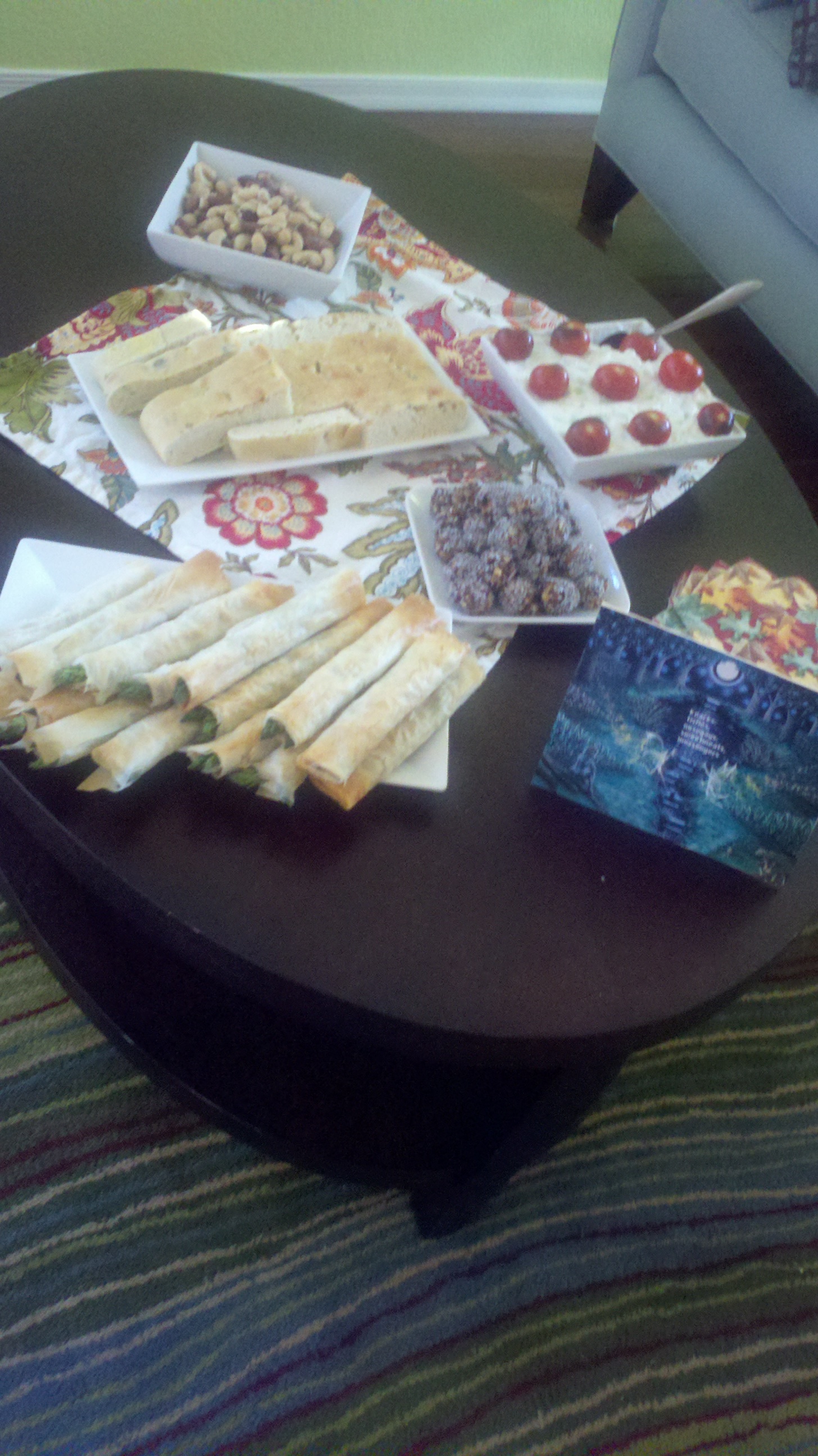
II, 1: Oberon: I know a bank where the wild thyme blows [thyme focaccia]

Fairy: are not you he/That frights the maidens of the villagery; Skim milk, and sometimes labour in the quern/And bootless make the breathless housewife churn [Themed cocktail: coconut milk cooler – my own recipe developed after some experimentation – served spiked or not, to taste]

Puck: And sometime lurk I in a gossip’s bowl,/In very likeness of a roasted crab,  [Thai style crab salad]

And when she drinks, against her lips I bob
And on her wither’d dewlap pour the ale. [An assortment of ales]

III, 1 BOTTOM: I pray you, commend me to Mistress Squash, your mother, and to Master Peascod, your father. [Salad of baby greens with cardamom roasted squash]

left to right: thyme focaccia, crab salad, leek and celery pie, baby greens with roasted squash

IV, 1: Bottom: Truly, a peck of provender: I could munch your good dry oats. [chocolate cherry oatmeal cookies]

Titania:  I have a venturous fairy that shall seek
The squirrel’s hoard, and fetch thee new nuts.  [OK, for this I just threw a few bowls of mixed nuts around the place]

Vi 1: Thisbe: These My lips, This cherry nose, These yellow cowslip cheeks, Are gone, are gone [see cookies, above]

Lovers, make moan: His eyes were green as leeks. [Leek and celery pie]

Related post: The Synthesizing Mind, or Why I Like Cooking

Posted in arts infrastructure, Uncategorized | Tagged , , , , | 3 Comments

It’s Not the Economy

For years I’ve said that the economic impact argument doesn’t work for the arts and arts advocacy.  We keep making it, but it’s not working. A comment by John Shipley on Ian David Moss’s Createquity blog brought into clear focus the reason why.  Shipley wrote:

When you make an argument on economic territory, you don’t win by proving that your activity creates economic vitality. You win by proving that your activity is the BEST way to create economic vitality. You don’t have to prove a return on the investment you propose – you have to prove a return superior to every other investment that could be made.

Yes, the arts have positive economic impact, but that positive economic impact is a byproduct of artmaking and can’t really compete with the economic impact of, say, Motorola, relocating to your town.  To paraphrase and adapt something Adam Huttler wrote about recently, the arts are in the artmaking business not the business business.  The business that artists and arts organizations do is done to make art, not the other way around. (And I obviously think the business side of the arts is important.)  We can make an advocacy argument more effectively if we, as Shipley wrote, “fight on the ground we can win.”

6/21/12 UPDATE/CLARIFICATION: The arts do indeed have a significant economic impact, as evidenced in the recently released report from Americans for the Arts, Arts & Economic Prosperity IV.  The ground on which the arts can win, I think, is in the positive social impacts they make by their ability to question, illuminate, beautify, transform, and so on.  Susan Seifert and Mark Stern of the Social Impact of the Arts Project at UPenn are doing important work in this area.  Check it out.

Posted in Arts entrepreneurship, Arts funding, arts infrastructure, Arts policy, Uncategorized | Tagged , , , , , | 9 Comments

Culture Shock

I recently returned from another conference (my previous post was also inspired by conference attendance).  The topic of this one was Creativity in Higher Education.  My presentation, snippets of which can be found in other postings, was entitled “Teaching Habits of Mind for Creative Entrepreneurship: Three Action-Oriented Pedagogies.”

My colleague Alex Zautra presented an overview of the importance of social interaction in improving executive function and various ways in which we can develop the social connections that improve executive functioning in support of creativity.   One of the concepts he discussed was that de-objectifying others enhances executive function.  He suggested that spending time in other cultures could improve executive function and, by extension, creativity.  He didn’t need to explain this concept using lab results and multi-variate regression, because he was making his presentation in Chengdu, China.  The positive effects of culture shock were apparent to everyone in the room.  “Everyone” included Chinese from at least four regions of that vast country, westerners from the U.S., U.K., Australia, and The Netherlands, as well as the deputy education minister of Tanzania and her colleague and students from Sichuan University and other Chinese institutions of higher education.

For three days, we were immersed not only in each other’s scholarship, but also in each other’s company.  Executive functioning can be understood as “the cognitive processes that are involved in sustained attention, problem solving, verbal reasoning, and mental flexibility.” Being with such a diverse group necessitated a different kind of verbal reasoning than I practice in an English-speaking group (although, thankfully, my own presentation was in English), sometimes requiring me to find multiple ways to express myself in order to be understood.  Mental flexibility was exercised because not only were we from many different countries, but also from an equal diversity of disciplines: psychology, education, public policy, law, medicine, literature, the arts.  Unlike U.S. conferences where there tend to be concurrent sessions and one can pick and choose what to attend, at this conference, all sessions were plenary.  The sustained attention required to understand the arguments being made across the diversity of disciplines and language (with simultaneous translation) is another component of my colleague’s definition of executive function.

Having, for the most part, recovered from the jet lag incurred by two 27-hour journeys in a week’s time, I need to find ways to maintain that higher level of attention and focus so that I can apply it to the projects back here at home.

AN OBSERVATION

Almost exactly a year ago, I was fortunate to have attended the Prague Quadrennial of Scenography. While I “participated” in the exhibits there, I did not experience, as I did in China, the kind of culture shock that boosts one’s executive function. I adored Prague, but I did so in part because I felt comfortable there; I was not recognizably different than the inhabitants, could sound out the letters on street signs and maps, and heard my own language spoken everywhere.  The cultural distance between The U.S. and Europe is so much smaller than that between the U.S. and China.

Another concept Zautra discussed as foundational to executive functioning is one well known to artists, especially theatremakers: empathy.  My brief experience in Asia has consciously increased my empathy for “others” — those not like myself.  I hope that effect is permanent.

I am very fortunate that I’ve been able to make these international trips and hope to continue to be able to do so.  I highly recommend a little culture shock for you too – it very likely could improve your creativity.

Posted in Culture and democracy, Higher education, Uncategorized | Tagged , , | Leave a comment

Takeaways: Arts Administration Educators Conference

I attended the annual conference of the Association of Arts Administration Educators for the first time, having now taught arts entrepreneurship for three semesters and seeing a course in arts management and another on arts policy on the not-too-distant horizon.  This was not only an opportunity for me to share the work we’ve been doing on arts entrepreneurship in the Pave Program, but a far larger opportunity to learn what colleagues across the country (and some internationally) think about what is important to teach, learn, and research in arts management and administration and cultural policy.  Here are some highlights from the formal programming:

At the first of three plenary sessions, Janet Brown of Grantmakers in the Arts discussed the organizational need for operating reserves and the implications for funders to provide enough general operating support to enable organizations to build that reserve.  She reminded us to remind our students to:

  • Take a long view on budgeting
  • Don’t underestimate overhead and fixed costs
  • There’s no guarantee that if you build a building people will come to it
  • Boards are not saviors
  • And finally, “Strong balance sheets make for artistic freedom”

Maria Rosario-Jackson of the Urban Institute discussed her work on arts and culture indicators of community vitality.  Upon finding a gap between what the cultural sector was getting in terms of data and what people in communities thought important, she asked the important question, “WHO GETS TO DECIDE?”  Margaret Wyszomirski, in the same session, discussed the challenge of operationalizing a definition of “vitality,” and observed that the indexes that use vitality as an outcome tilt significantly toward the nonprofit sector.  The implication being that by discouting or not counting what in Europe is generally understood as “The Creative Industries,” vitality is not being measured accurately or effectively.  Jessica Cusick shared how outcome measures are used on the ground in the municipal policy space via the Santa Monica Sustainable City Plan.

A session on arts management pedagogy chaired by Ximena Varela focused on case study methodology, which will be an important component of our graduate management curriculum currently under development.

A report from the SNAAP data project indicated that the employment rate for people with arts degrees is the same as for all college degrees, but job satisfaction, at 87%, exceeds that of the national average for all college grads. Drilling further into the data, there was a startling and unfortunate statistic about salaries of arts administrators.  There is a very large gender gap such that the average salary of male arts administrators is in the $60-70K range whereas female arts administrators earn an average salary in the $40K-$50K range.   The implication appears to be that there is a glass ceiling for women in arts administration executive positions rather than unequal pay for equal work.

Doug McLennan of ArtsJournal delivered the second plenary entitled “Engage This!” in which he reminded us that “we don’t engage with products…we engage with ideas” and that the arts sector should “stop waiting for things to happen and go out and make them happen.”  If 80% of all the content on the Web was created in the last two years, then people are making stuff (web content) like crazy.

Brea Heidelberg, a newly minted cultural policy PhD from Margaret Wyszomirski’s program at OSU shared her research on the NEA funding “seal of approval” and Roland Kushner shared some preliminary results from the data mining he is able to do through the Local Arts Index related to the crowding in and crowding out of private giving by federal funding.  This is a rich source of data that I will no doubt be turning to in the future.

One of the highlights of the conference was the hour I – along with 80 other attendees — spent in one of James Turrell’s skyspaces, “Dividing the Light.”  It seems fitting that my professional transition into the community of arts management educators was marked by an experience combining light and public art.

James Turrell, Dividing the Light, 2007 (images from the Pomona College Museum website; click on image for link)

Posted in Arts education, Arts entrepreneurship, Arts management, Arts policy, Higher education, Uncategorized | 1 Comment

Theatre Binge: Trends

Last month I spent 72 hours in New York immersing myself in the kind of theatre and visual arts not readily available in Phoenix. It was a whirlwind: four shows, one of which was an eight-hour affair, plus the Cindy Sherman and Print/Out exhibits at MoMA.  Somehow I also found time to visit with family and friends, and stroll along the Highline too. Three of the four shows had recently opened on Broadway, Clybourne Park, Once, and Peter and Starcatcher, while the fourth, the one that drove my travel dates and scheduling, was the return of Gatz to the Public Theatre.  In seeing all four, I noticed or was affected by several trends.

FORM: All four of the shows I saw were ensemble in nature.  I’m not sure if this is a trend in the theatre generally, or a reflection of my taste.  I’ve never really enjoyed theatre that features a “star” over an ensemble.  Although Once clearly has two leads, the rest of the cast, also the band, also the townspeople, are on stage almost throughout the entire production.  The transitions they made between characters, like those made by the actors in each of the other shows, were done in a transparent, or in some cases, foregrounded manner.  Granted, the character shift the actors make in Clybourne Park happens primarily, though not exclusively, at intermission.

I’ve always enjoyed ensemble-based work and seeing four extraordinary and diverse examples thereof gave me hope that such work is more broadly accepted by contemporary audiences.  But who is that audience really?

AUDIENCE:  I was struck that at least three of the four audiences of which I was part included a large number of other theatre people.  Maybe it was because the shows had recently opened and, being the last week of April, it was Tony voting season.  My fear, though, is that even though there are a large number of insiders seeing these shows, there won’t be the general audience needed to sustain them.  The audience at Once (a matinee) included several actors I recognized but do not know personally. Following that, I ran into playwrights Tony Kushner (with whom I went to grad school) and Craig Lucas, who was himself seeing Once evening.  The next day, in the smaller Newman Theatre in which Gatz was playing, I knew four other audience members.  Intermission conversation revealed that this really was a significantly insider audience.  Theatre people seeing extraordinary theatre people doing extraordinary work.

PRICING: Gatz was also, seemingly, the hottest ticket in town. Or, at least for me, the most expensive by almost a factor of two.  I was a victim of dynamic pricing.  My trip was scheduled in large part to catch the penultimate weekend of this show, which I had missed in its orginal incarnation.  Two hundred ninety-nine seats move fast and I got the last one – literally, the availibility chart showed only the one last seat on the end of the last row. I paid dearly for it; almost twice as much as each of the Broadway shows, where I had reasonably good seats.  Not everyone seeing Gatz had paid what I had because the Public Theatre has a dynamic pricing system in place, prices go up as the seats fill and performance date approaches.  Dynamic pricing is the law of supply and demand in action. Fortunately, the very kindly usher moved me to a far better seat when there was a vacancy in the middle of the fifth row.  Having seen ¼ of the show from the back corner, I can tell you that the experience is substantially different (not better or worse, but different).  I’m not sure I would have minded the higher ticket price for the much better seat, had I in fact paid for it.  What I found interesting about the experience (of ticket buying) was that I was paying the highest price for the ticket at the nonprofit theatre.  One could argue, I suppose, that at six hours (without intermission), one should pay three times what one pays for a two-hour production, but theatre is not usually priced by the hour. Ultimately, to be clear, I do not regret buying my ticket to Gatz, it was one of those transformative theatre experiences that don’t happen all that often.

NEW YORK:  A native New Yorker, I visit at least once or twice a year.  This time, the city was CROWDED! I don’t just mean in the theatre district, which I ceased to be able to walk through about ten years ago; the whole city seemed crowded.  Not a good thing or a bad thing, just a thing. [Pictured at left, Clybourne Park is set in Chicago, not New York.]

Posted in Arts management, Uncategorized | Tagged , , , | 6 Comments

I Met a Guy at a Bar

I met a guy at a bar.  No, this isn’t one of those stories.  It was a sushi bar, and he was getting takeout while I was getting something to eat on the way home.  A few minutes of chatting revealed that J was an “arts worker.” He earned a BS (that’s bachelors of science, not the other kind) in Art from UW-Madison, where, coincidentally, I had been on the faculty for umpteen years.  After studying sculpture and painting as an undergrad, he moved into digital art and now writes, storyboards, and sometimes directs visualization and training films for public and private clients, the largest of which is the US Army. He said he really enjoyed his work, and was sincerely happy to share his story.

The story of J is a good example of a person who uses his talents, skill and training in the arts to build a career, albeit not one he would have envisioned as an art student.  Students enter study in the arts with many dreams and aspirations.  When I was a student, I had a clear and very narrowly focused professional goal in mind that, in hindsight, blinded me to other opportunities.  Today, I advise students to work toward their most ambitious goals, but to do so with their eyes open to the many alternative ways in which their talents and training can be used to support a fulfilling work life.  If J had kept his head down, looking only toward the world of studios and gallery shows, he might not have seen the opportunities that have led to what became an enjoyable and sustainable career.

Posted in Arts education, Arts entrepreneurship, Higher education | Tagged , , , | 3 Comments

University R&D

This post was originally commissioned by and posted on the 2am Theatre blog (#2amt)

Somewhat by accident, I stumbled into a weekly twitter conversation about new play development (hashtag #newplay) despite the fact that I am not a playwright. What I am is a university professor who for six of the ten years I spent in academic administration led a large theatre/film school whose mission includes the development of new work.  Most of that new work is developed by students, some by faculty, and once during my tenure, by commission.  I provide this brief biographical excerpt to give some weight to the following statement: the field can do a better of job of using universities as laboratories for new play development.

There are several university programs that, in similar fashion to mine, nurture young playwrights enrolled in MFA programs.  There are also several programs that have deep connections with LORT theatres that sit resident on their campuses (LaJolla Playhouse, The Huntington, for example).  There are several large LORT theatres that develop and present new plays (Actors Theatre of Louisville, Arena Stage, to name two).  What we’re not seeing, but which would exist in my utopian view of better connections between academic and professional theatre, is a systematic effort to engage universities in the research enterprise that is new play development.

My university, like any research intensive university, has an infrastructure devoted to contracted research.  These offices exist primarily to facilitate research by faculty in university labs sponsored by an outside organization.  This could be a pharmaceutical company sponsoring drug research, a municipal government contracting with the university to undertake policy research, or the department of education contracting with the university on curriculum development.  What if a theatre that is interested in a playwright contracts with a university to develop their work through the sponsored research mechanism?

In such a scheme, LORT Theatre X says, “we’re really interested in the work of playwright Jane Doe, but can’t devote the staff time or space or even the actors to see her new play through the early phases of development.”  So, LORT Theatre X approaches Research University Y and says, “we would like to enter into a sponsored project contract with you to develop Jane Doe’s next play.  We will pay an amount of money to the university [say, enough to cover a reasonable stipend for the playwright] and your faculty dramaturg and his graduate students work with the playwright; your graduate acting students take part in readings and a workshop, and then at the end, if we like the play, we’ll put it on our season next year.  Further, if there is commercial interest in the play, Research University Y gets to retain Z percentage of any commercial production.”

It seems that in such a scheme, everybody wins.  The theatre reduces its play development costs because it is not shouldering any of the infrastructure of the development process.  The playwright gets a stipend, development time, and, potentially a full production, the faculty and students benefit from the research/teaching/learning experience, and, ultimately, the field benefits from having a new play in the world and a class full of MFA students skilled at developing new work.

This structure has advantages to a university commissioning the piece outright because it includes an organizational partnership with the LORT Theatre that is mutually beneficial; it has advantages for the playwright because there is more infrastructure available.   Emerson College recently recruited David Dower and Polly Carl away from Arena Stage’s new play development center.  The field is watching the developments there, but that scenario is somewhat the reverse of that described here.  Universities have been investing in the recruitment of theatre professionals for 25 years or more.  The structure described here is the reverse; it involves the theatres shifting their perspective on universities away from a pipeline for new talent and toward viewing universities as potential laboratories, as research and development units with which they can contract for new play developments.  Because universities have indeed been recruiting faculty from the professions, the talent is there and the facilities are there. What is needed is a vision and a structure for organizational partnership that is symbiotic, the kind of partnership between research universities and the private sector that has fueled innovation in almost every other sector.

Perhaps such a scheme already exists.  If so, it needs better PR.

Posted in Arts education, arts infrastructure, Arts management, Higher education | Tagged , , , , , , | 2 Comments

Deep Impact

“Audience development,” “impact,” “arts participation,” are catch phrases of conversations I read and sometimes take part in in the social media universe of arts advocates, managers, and producers.  I am blessed to be playing some small part in a project that is achieving significant impact through deep participation and co-creation.  This project, At Home in the Desert, has taken me about as far from where I started in NYC commercial theatre as one can get without leaving the US.  Thanks to this project, I have found myself in a south Phoenix high school  observing a dance class or in a central city Boys and Girls club watching sixth graders move to a track of spoken word beats they created themselves.

Will this project result in increased audiences at the city’s LORT theatre or its symphony? Unlikely.  But for the 40 or so students involved, the impact on their lives is profound. At a recent showing of work in process (we decided recently that the co-creative process would BE the product), the spoken word performer/artist who works at the Boys and Girls Club said, “For most of these kids, this is their first experience doing something where people are watching them perform.  The confidence this is building in them is awesome.”  Meanwhile, at the high school site, members of Dance Exchange (formerly Liz Lerman Dance Exchange) help 17 teens create a movement vocabulary that expresses their complicated perspectives on living in a city in the desert.

I don’t know if any of these kids are going to make dance or music or theatre their career.  What I do know is that they are learning to trust themselves and to trust the arts as a viable way of understanding and communicating about their world.  The project is having a deep impact on them – and on me.

Posted in Arts education, Culture and democracy | Tagged , , , | 3 Comments

Of Missions and Diversity

But at the end of the day, and let me be very clear about this: at the end of the day, the job that I am entrusted to do is to find plays that I believe as artistic director will serve the mission of the Guthrie and do so in a way that is commercially viable and artistically satisfying

So said Guthrie Artistic Director Joe Dowling in an interview with Minnesota Public Radio, explaining why the 2012-13 season looks the way it does (predominantly white and male).  My intention is not to criticize Dowling’s choices specifically, that has already been done by myself and others, but rather to look at the relationship between mission and diversity more generally, and to relate the situation Dowling has created at the Guthrie to a piece from a few years ago by Michael Kaiser on the Huffington Post about diversity in the arts in which he wrote, “But I do not think I believe anymore in forcing Eurocentric arts organizations to do diverse works”

The “forcing” comes in the form of incentives in the funding pipeline.  In part because those incentives exist (and with good reason), many arts organizations have evolved to include a commitment to diversity, variously phrased, in their mission statements.  Not all large performing arts organizations are acting on that mission, however.  The Guthrie situation, with its mission to present “both classical literature and new work from diverse cultures” is only one example of such a disjuncture between mission and programming.  In the MPR interview, Dowling refers repeatedly to diverse “stories,” but does not claim they are from diverse “cultures.”  There is a difference between the two, illustrated, for example, by the variety of creation stories one finds in diverse cultures from the Judeo-Christian Bible story to the Popol Vuh of the Maya to the Vedic hymns of the Hindu.  These are examples of diverse cultures, the literatures of which the Guthrie is bound by mission to draw from.   The mission statement of the Goodman Theatre, to cite a counter example to the Guthrie, states that it is guided by the principles of “quality, diversity, and community,” and it appears to be acting on those values  with gusto in its programming.

What does this have to do with Kaiser’s statement? What if a theatre like the Guthrie, that presents excellent work from a particular point of view embraced a mission to do just that?  For half a dozen seasons or more, I designed for the Utah Shakespeare Festival.  Its mission statement gets right to the point, “The Utah Shakespeare Festival presents life-affirming classic and contemporary plays in repertory, with Shakespeare as our cornerstone.”  Even as a lighting designer, the mission statement guided choices – not too dark, has to work in rep, classical approach.  A Euro-centric arts organization can have a mission that says it is Euro-centric or, if it is male-centric, a mission that says that, just as companies devoted to the work of women playwrights say so in their mission statements.

The nonprofit status of these theatres is a social contract. The government exempts the theatre from having to pay taxes, provides a tax deduction for donors thereto, and in return, the nonprofit organization serves a social mission, providing a social good.  Fiscal responsibility is an important task of both the management and the board of nonprofit organizations, but there is a difference between being fiscally responsible and commercially viable.  When off-mission programming is justified by the need to make “commercially viable” choices, then it seems that the social contract is broken.

Posted in Arts funding, Arts management | Tagged , , , , | 5 Comments

1100 Seats

If you are a stakeholder in the American nonprofit theatre community, you probably heard about or took part in the heated discussion last week about the announcement by the Guthrie Theatre in Minneapolis of its 50th anniversary season, a season that has symbolic weight for being the 50th, and a season that consists of 11 plays written by white men.  Don’t look for any juicy Shakespearean roles for women either; the two-play Shakespeare repertory is being performed by an all male company.  The current 2011-12 season does not include a single play by a woman either.  Much has been said about the exclusivity of the Guthrie’s programming philosophy. I call you attention, especially, to Polly Carl’s piece about the construction and representation of gender on American stages.

I want to hone in here on Dowling’s purported excuse for programming a season in this way.  In an interview in the Star Tribune he said, “It is a very stern task to direct on a stage of our size.”  The new Guthrie opened in 2006. It is very much Dowling’s project. Yet, he complains about it.  There are 1100 seats surrounding the Wurtele Thrust  Stage.  If it is so challenging to fill those seats, why build them? The hallmark of the Guthrie’s actor/audience relationship has always been intimacy.  The original Guthrie stage famously maintained that “intimate” relationship.  But, if 1100 seats are hard to fill, why not achieve intimacy the old-fashioned way, by building a smaller theatre.

It seems disingenuous to build a temple of institutional theatre on the banks of the Mississippi River and then complain about the challenges of programming it. (I considered inserting comments about the visual symbolism of the famed cantilevered lobby over the river, but I restrained myself).  There is a history of arts organizations being eaten alive by their new facilities.  I hope that doesn’t happen to the Guthrie.

The mission statement is:

The Guthrie Theater, founded in 1963, is an American center for theater performance , production , education , and professional training.  By presenting both classical literature and new work from diverse cultures,_ the Guthrie illuminates the common humanity connecting Minnesota to the peoples of the world.

This “American center” will present a season heavy on British playwrights and directors – all male.  Perhaps if the Guthrie produced works of   “classical literature or new work from diverse cultures,” it would be easier, rather than more difficult, to fill the hall.  Dowling indicated in the Star Tribune interview that he’s responsible to the board of directors for the season that is presented, although the board itself does not take part in season planning.  I hope the board takes Dowling to task for not effectively fulfilling the organization’s mission.   His colleagues across the country already have.

Posted in Arts management, Uncategorized | Tagged , , , , , , | 1 Comment