Who Benefits?

AP photo

AP photo

Last week, a triptych by Francis Bacon, “Three Studies of Lucian Freud,” sold at auction for $142.4 million, a record auction price.  The seller, an unnamed collector in Rome, gains significantly from the transaction as does the auction house and the agent for the buyer.  There’s no benefit to the artist who died in 1992.  To give the $142.4 million value of this work some sense of scale relative to the way art is experienced by the public, the amount is more than 15 times the annual budget of the Phoenix Art Museum and six times the value of its entire endowment fund.  When art is sold at these prices, the only classes of people who don’t benefit are 1) artists and 2) the general public.

So here’s a “what if” scenario, similar to a “what if” scenario I proposed for blockbuster commercial theatre hits: what if auction houses and agents paid a small percentage (say one half of one percent for the sake of argument) of the sale of blockbuster works of art into a fund that supports individual artists and free access to art museums.  Unlike the theatre idea in which producers are asked to return some profit for the good of the system, in the high-dollar visual art market, the product is already produced – and the artist may very well have not benefitted during his or her lifetime. Those who do benefit could be contributing to a system in which artists – the living breathing kind who are actually making work – and mseum attendees would benefit.  Last week’s sale at Christie’s totaled $691.5 million. Think about what an extra $3.5 million could do in your arts community.

Another entry in the “wild idea” category.

Posted in Arts funding, arts infrastructure | Tagged , , , , | Leave a comment

Arts Entrepreneurship: New and Not New

My colleagues teaching courses or whole programs in “arts entrepreneurship” often categorize the discipline as “new,” “nascent,” or “emergent.” I too have used those descriptors. It is useful, however, to remember that while teaching specific courses, offering certificates and degrees, and building a body of scholarship in “arts entrepreneurship” is relatively new to the academy, artists acting as entrepreneurs is as old as artmaking itself.   Ruby Lerner, founder and director of Creative Capital notes in a recent talk “We have always thought of artists as entrepreneurs in the cultural area.” She sees artists as innovators and change agents.  (I encourage you to watch her talk at the recent EmcArts “Innovation Summit.”) What is happening at universities across the country is, it seems to me, an aggregation of practice and the development of new theory to explain what has been going on for decades: artists creating, innovating, and making their own opportunities.

AE conversation word cloud

Posted in Arts entrepreneurship, Higher education | Tagged , , , , | 8 Comments

Lifelong Learning at STP+A

I have just returned from my first STP+A conference.  STP+A stands for Social Theory, Politics, and Arts – an itinerant conference loosely connected to the Journal of Arts Management, Law, and Society, but without any other fixed institutional affiliation.  I applaud my colleagues at Seattle University for taking on the challenge of producing the event.

It may have been a result of the sessions I chose to attend, but my impression is that the focus of the conference was far more on the last two – politics and arts – than on the first – social theory.  Many if not most sessions had a cultural policy or arts infrastructure focus.  And although the purported conference theme was “Arts and Culture: Creating Community in a High Tech World,” the emphasis seemed to be less on creating community and more on using data in a high tech world.    Putting these together – cultural policy, arts infrastructure, and data – were what made the conference such a positive experience for me.  In stark contrast to the USASBE conference where my research on arts incubators was shoehorned into a session with a presentation on micro-lending in India, I was fortunate to present in a session devoted to organizational practices in the arts along with my colleague Andrew Taylor (The Artful Manager), whose presentation on theories of capital drew a standing room only crowd.

The policy focus of the conference was most fully on display at the opening plenary panel which included arts agency representatives from every level: federal, regional, state, county, and city.  My reading of the theme of that session – a welcome theme indeed – is that there needs to be a more investment in arts research infrastructure and that research that extends beyond the economic impact of the arts would be most welcome. St Ignatius Chapel Seattle UBecause the vast majority of the attendees are arts researchers, this was a very welcome perspective, although the panel was preaching to the arts research choir. (Speaking ofchoirs, a highlight of the conference was a short concert by Seattle University’s choir in their beautiful Chapel of St. Ignatius.)

The last session of the conference was particularly interesting because of my interest in arts entrepreneurship and arts business models.  Stephen Preece presented a bricolage frame around an arts entrepreneurship case study, Serge Poisson De Haro explained the evolving business model of the Montreal Museum of Art, and Jean Hamilton traced the legislative and judicial history of nonprofit tax-exempt status back to a 1601 Elizabethan definition of charity.  It was a rich 90 minutes that served to remind me of why I attend conferences and also why  I’ve remained in academia for so long: doing so both requires and enables a lifetime of learning.

Posted in Arts entrepreneurship, Arts policy, Higher education, Technology and arts, Uncategorized | Tagged , , , , | 1 Comment

Create Dangerously!

Albert Camus, 1957Albert Camus gave a speech entitled “Create Dangerously” at Uppsala University in December 1957. He did not mean the title as a directive with an exclamation point at the end, but rather as a description: “To create today is to create dangerously.”  In the speech, Camus writes of the impact of art and its relationship to its audience:

“Of what could art speak, indeed? If it adapts itself to what the majority of our society wants, art will be a meaningless recreation. If it blindly rejects that society, if the artist makes up his mind to take refuge in his dream, art will express nothing but a negation. In this way we shall have the production of entertainers or of formal grammarians, and in both cases this leads to an art cut off from living reality.”

I came across this speech on, of all places, my twitter feed.  Someone had quoted just the opening question and first sentence of the excerpt: “Of what could art speak, indeed? If it adapts itself to what the majority of our society wants, art will be a meaningless recreation.” Taken out of context, the implication is obvious: popular art = bad art.  But in the context of the paragraph and the speech as a whole, Camus meant something very different: art must connect with present reality and when it does so, it is dangerous — for the artist personally and, potentially, for the states and other power structures depicted therein.

As I learn and teach about art, its impacts,  the evaluation of arts programs, and about the need to engage audiences, artists and arts supporters have on occasion responded, “but art is an end in itself” or, “art is for art’s sake.” Camus refutes that point:

“Art for art’s sake, the entertainment of a solitary artist, is indeed the artificial art of a factitious and self-absorbed society. The logical result of such a theory is the art of little cliques or the purely formal art fed on affectations and abstractions and ending in the destruction of all reality. In this way a few works charm a few individuals while many coarse inventions ·corrupt many others. Finally art takes shape outside of society and cuts itself off from its living roots.”

Finally, Camus depicts the danger artists face, positioned as they are, on a narrow ridge:

“Art advances between two chasms, which are frivolity and propaganda. On the ridge where the great artist moves forward, every step is an adventure, an extreme risk. In that risk, however, and only there, lies the freedom of art.”

Thus, to create art, art that remains attached to its living roots, is to create dangerously. To the artists who read this blog, and especially my student artists, I would like to make Camus’s title a directive: “Create Dangeously!”

Posted in Arts education, Arts policy | Tagged , , , , , | 4 Comments

An Open Letter to the Cave Creek School District

An Open Letter to the Cave Creek Unified School District

Debbi Burdick, Superintendent

Dear Ms. Burdick:

Your district recently initiated policies in reaction to concerns over the teaching of a play with some sexual content that go beyond mere teacher oversight to censorship and, I argue, are an abrogation of the school district’s responsibility to educate its students and prepare them for college.  I write to you from my dual perspective as the parent of a high school student and a theatre educator. (Fortunately for us, we reside in a different district.)

Goat-Sylvia-Playbill-03-02According to the newspaper reports about the reinstatement of Andrew Cupo, the district has adopted a policy in which “no plays that include suggestive sexual information, excessive profanity, suggestive sexual undertones, or that would be considered controversial in a high-school setting will be used for any reason.”  Are you aware of the suggestive sexual information and suggestive sexual undertones in plays that YOU no doubt read in high school, or that you would currently consider to be fahrenheit-451100% appropriate for your district’s curriculum? Will you also be banning novels and other books that contain such material? Perhaps, as in Fahrenheit 451 (a text required in the Tempe Union HS District), such books should be publicly burned?  If so, the plays in that pile of burned banned books would include:

  • Romeo and Juilet:  Mercutio teases Romeo about his desire for Rosaline’s “open arse,” Two teens discuss their sexual longing and act upon it. Juliet explicitly pines for the loss of her maidenhead
  • As You Like It: There’s quite a bit of Renaissance trash talk in the Forest of Arden, including a description of the “copulation of cattle,” used as a metaphor for copulation by more human creatures
  • A Midsummer Night’s Dream: The playful banter between Oberon and Titania is not about their kids’ soccer game
  • Greek classics like Oedipus Rex, in which incest is a critical plot point that propels the moral dilemma of the play forward.

R and J coverThe job of an educator in an honors-level dramatic literature class, a class for which college credit is available, is to teach critical reading and critical analysis skills. It is the educator’s job to give learners the tools they need to understand the text that they are reading and to analyze the choices the characters make, often best accomplished by reading the text aloud as the playwright intended. In this way, in a partnership between school and home, young people learn to make choices both about the text and about their own lives.  By forbidding teen learners access to complex literature in which characters are faced with difficult choices, the skills development of those teens will be stymied. They will instead develop analysis and choicemaking skills in situ, under the bleachers, behind the garage, and in the basement rec room, because they won’t have learned about making complex decisions and smart choices in schools. Furthermore, they will be far less ready to engage with the complex texts they will encounter in college. If you are concerned with college readiness, let kids in honors classes read plays. Out loud.

Teaching teens to make good choices doesn’t come from limiting access to choice, but by opening access to works (including dramatic literature) that challenge both their values and their intellects.

Yours sincerely,

A concerned parent and teacher

Posted in Arts education, Arts policy, Higher education, Uncategorized | Tagged , , , , | 1 Comment

The Double Bottom Line of Arts Entrepreneurship

Tania Katan, kicking off our annual Pave Speaker Series, opened her talk with a quote from the Merriam Webster online dictionary:

en·tre·pre·neur noun \ˌäⁿn-trə-p(r)ə-ˈnər, -ˈn(y)u̇r\: a person who starts a business and is willing to risk loss in order to make money

It was obvious from the context that neither Tania nor anyone in the audience (including me) agreed with this narrow conception of an entrepreneur.  Instead the arts entrepreneur looks at a double bottom line of art and money. Perhaps we can adapt this definition to read:

arts en·tre·pre·neur noun: an artist or other creative person who starts something and is willing to undertake some risk in order to make money to make art.

For the arts entrepreneur, money is necessary but not sufficient.

Photo of Herman Melvile, artist unknown

Soon after the talk, I came across Herman Melville’s poem Art in which art itself is a fusing of unlike forces, like the double bottom line of art and money:

In placid hours well-pleased we dream

Of many a brave unbodied scheme.

But form to lend, pulsed life create,

What unlike things must meet and mate:

A flame to melt—a wind to freeze;

Sad patience—joyous energies;

Humility—yet pride and scorn;

Instinct and study; love and hate;

Audacity—reverence. These must mate,

And fuse with Jacob’s mystic heart,

To wrestle with the angel—Art.

As Andy Warhol wrote, “Making money is art, and working is art and good business is the best art.”380px-Andy_Warhol_Autograph


For more on arts ventures see this post.

Posted in Arts entrepreneurship, Uncategorized | Tagged , , , , | 2 Comments

Dinner Conversation

On September 6, twelve arts and culture activists/leaders/thinkers gathered at the Djerassi Artist’s Retreat at the invitation of Barry Hessenius to discuss the following question:

Traditional audiences are declining and participation patterns are shifting seismically, which is having a deleterious impact on arts organization’s traditional revenue streams. How can we address this pattern on a macro scale? What would a new movement around the arts look like?

One of the attendees, Clayton Lord, has been blogging about the experience this week and he closed his series with a particularly thought-provoking post co-created with three other attendees, Laura Zabel, Margy Waller, and Devon Smith. Because my thinking was provoked by this post (as it often is by this group) and because I’ve had some professional interactions with each of them[1], I hope they won’t by mind if I (virtually) drop in on their blogfest to offer my own thoughts on the six bullets in Clay’s post:

  1. We need to stop over-preferencing the artist over the point of the arts institution.”  Like Laura, I find this wording challenging, in large part because the category “artist” is itself stratified.  From my perspective working with early career artists – some of whom are trying to start an arts organization — I often see the opposite happening. Or, rather, I see arts organizations overlooking the talent of people who don’t carry the star cachet that might draw in traditional audiences.  What I don’t see are a lot of arts organizations that preference the development of new work and the support of lesser-known artists.  We do indeed see some art “stars” in every arts discipline who overshadow the mission of the organization(s) with which they are affiliated, but in general, I’m not seeing artists being preferenced by much of anybody at the grass roots level.
  2. We need to stop creating institutions built to generate social capital that are instead preoccupied with creating actual capital.”  I’m with Devon on this one, especially regarding the B-corp model. An organization that is generated to build social capital or — more to the point – cultural capital, needs financial capital to do so.  What would be key here to enabling arts organizations to more effectively focus on creating social and cultural capital would be funders who are wiling to provide the financial capital needed to do so.  I don’t mean private giving for bricks and mortar, but the kind of capital investing Janet Brown has been talking about to shore up the sector against the vicissitudes of the larger economy.
  3.  “We need to stop shouting about innovation and new outreach without recognizing either the instability that goes along with that or the length of time necessary to test out new approaches before they should replace the old ones.”  Innovative artists are going to make innovative work.  Established institutions can embrace that work and support that work or, eventually, be left in the dust. Laura points out some of the institutional barriers to change.  Perhaps someone can conceive of a network of institutions across the country that are designed for change – that serve as laboratories for innovation – whose innovative products can then get picked up by both commercial and nonprofit “distributors” as appropriate. Maybe, our university-based arts programs can fulfill that function more effectively than they do now (see University R&D).
  4. We need to stop being so selfish about how much we like our forms, our circumstances, the nuances of ritual that are draped all around them–and to stop being oblivious to how difficult those things together make carrying forward.” Yes, and as Laura notes, this is already happening.    Change is a constant and culture is constantly evolving. The rituals of what we think of as traditional arts organizations are traditionally Euro-centric and elitist.  But that’s been changing for a while now both from within these organizations and from organizations beyond that are not.  Street performance, for example, including the street performances one sees here in the Southwest around this time of year, are spontaneous (or spontaneous-seeming) and extra-institutional.
  5.  “What is our chance for change when our funding models don’t allow for flashpoint innovations, runways, security in the face of risk?  What is our chance for change when even within small communities the stakeholders can’t get on the same page, pulled between short-term and long-term desires, and in which there is no arbiter both strong enough and willing enough to exert strength to make a change?” “Strong enough” implies that the change would come from the top down via organizations like AFTA and GIA. Change there is important. But change also comes from the bottom, from the grass roots, and is sometimes more effective.  The generation that I see entering the arts and culture sector are not committed to nonprofit institutional models. They are committed to making art happen and will use whatever organizational tools are best suited for them to do so. For some it means joining a large established arts organization, for another it might mean incorporating their storefront theatre company as an LLC, and for another launching a nonprofit community-based arts organization. My point, again, is “change is gonna come.”
  6. …they pitch and someone gets seed funding—the ability to actualize on an idea that hadn’t been articulated a few days before—and there’s the understanding it might not work, or that it might not be the end product, or that it might not completely solve anything.  There is a celebration of creation, of creativity, that we, as a field of creatives, seem to feel shy about embracing.”  I see this occuring often in the burgeoning field of “arts entrepreneurship” and in events like Ignite or other fast pitch competitions.  Even some state arts agencies are getting on board with the idea of creating, pitching, and then seeding innovation.  Seed funding should be thought of the same way seeding a garden is – some seeds will grow into strong plants that last long and provide beautiful flowers, and some won’t even begin to sprout, but unless the seeds are sown, nothing at all will grow.

I so wanted to be a fly on the wall at your dinner table on September 6. Thanks to Clay Lord and friends, I now feel like I was.Fly_on_the_wall


[1] Laura Zabel returns to ASU in the spring to talk about “Making a Living and a Life” as part of our biennial Pave Speakers Series; Devon Smith was a speaker on the series in 2011; Clayton Lord authored an article in the very fist issue of Artivate: A Journal of Entrepreneurship in the Arts published by the Pave program; Margy Waller and I have discussed at some length the excellent report she authored on “The Arts Ripple Effect,” which is required reading for my Arts and Public Policy course.

Posted in Arts entrepreneurship, Arts funding, arts infrastructure | Tagged , , , , , | 2 Comments

Hip Hip Hooray for the ACA

ACASome may remember today’s date, October 1, 2013, for the temporary government shutdown that resulted from political posturing in Washington.  If you work in the arts and culture sector, however, it is a day to shout “hip hip hooray,” because today the Affordable Care Act went into effect.  There are over 3 million arts and culture workers in the US, many of them uninsured free-lance/self-employed artists. The Affordable Care Act will give this group access to health insurance coverage that it has never had access to before.  For over a decade, Fractured Atlas, the arts services organization, has provided health insurance coverage to over 3000 artists.  Now artists can be part of a health insurance pool that is millions strong – making their insurance coverage even more accessible, and no longer subject to the market vicissitudes Adam Huttler describes in his joyful and nostalgic announcement about the end of the Fractured Atlas program.

Many artists have faced difficult choices about their art-making because of the inaccessibility of health coverage.  In a guest post here in 2011, Deputy Commissioner of the Arizona Commission on the Arts Jaime Dempsey called healthcare “the elephant in the room:”

access to affordable health care and some modicum of professional security can now literally mean the difference between life and death, for artists and everyone else.

Access to healthcare was certainly part of my own decision calculus to enter academia 25 years ago. The Affordable Care Act will, eventually, make it possible for artists to make more art (and as I like to say, “more art is better than less art”).  When David Dower interviewed me for one of his Friday Phone Calls, I suggested that an artist needs three types of infrastructure to be truly creative: the physical bricks and mortar of space and place, organizational infrastructure to support the creation and distribution of art, and personal infrastructure.  The Affordable Care Act shores up an important part of that personal infrastructure, not just for artists, but for all Americans.

Posted in Arts entrepreneurship, arts infrastructure, Arts policy, Culture and democracy | Tagged , , , , | Leave a comment

When Either/Or Hits Close to Home

I concluded my recent refutation of Peter Singer’s “Good Charity/Bad Charity” with the assertion “I believe that altruists don’t choose between, they choose both.”  A subsequent experience seemingly refutes but then supports that statement.  A friend, not a particularly close friend, fell on some hard times, some of his own doing, and some out of his control.  Evicted, his belongings stolen from a vehicle on the street, he had nothing: no money, no place to stay, and eventually no food.  I learned of these problems second-hand over the course of two months. He wanted to travel to another region where he had family who could support him while he gets back on his feet. Eventually connecting directly, I offered to buy him food to last the week and a plane ticket for the end of that week.

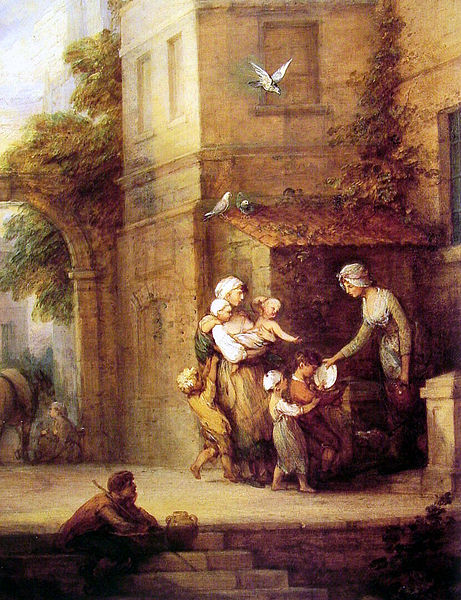
461px-Charity_relieving_DistressThis was a friend in desperate need. I didn’t think about it, I didn’t rationalize it, and I certainly didn’t think about the opportunity costs – at least not until I was standing with him in a grocery store parking lot with four bags of groceries and a receipt from the airline.  Then, my rational thinking kicked in and I considered what I wouldn’t be able to do because I had done what some might call a “good deed” (or what I explained to my own family as the enactment of Jewish ethics). My list of things I wouldn’t be able to do included: buy a plane ticket for myself to go see my own extended family, register my son for an extra-curricular educational opportunity, or give to the theatre companies I usually support annually with small gifts, the combined size of which just about equals the money I had spent helping a friend.  That’s when it hit me: without realizing it, I may have made an intuitive “either/or” decision — the very kind of either/or decision I argued it was not necessary to make.   Instead of basking in the warm glow of charitable giving, I felt the heated charge of hypocrisy.  Hence, the refutation. But, my rational side saved me (for now) from being overwhelmed by guilt.  I am but one person, one of the ten thousand donors I referenced in the earlier post.  In the aggregate, that group can give to both, both the charity that will save a life (even if it’s the life of one individual friend) and the charity that will enrich the lives of many.

[Thomas Gainsborough: Charity relieving Distress]

Posted in Arts funding | Tagged , , , | Leave a comment

Academic CV – Arts and Humanities

CV_Academic_LetterI was invited by our School of Film, Dance, and Theatre graduate student organization to talk about putting together a CV for academic job searches.  I get asked to do this kind of thing fairly often because I’ve worked in higher ed for a long time as a faculty member who is both a practioner/artist and a scholar, and have been a department chair, a school director, and served on the tenure and promotion committees of two large universities. At long last, I’ve decided to write down a CV outline that I think works for artist/scholars in academia; it also could apply to the humanities and some social science disciplines more generally.  If there is a category that doesn’t apply to you, just ignore it. This is not a definitive or all inclusive outline and you would need to craft your own CV based on your own unique skills, your discipline, and the requirements of the job search, but this outline works for me and has worked as well for assistant professors I have (successfully) mentored through the tenure process over the years:

Name

Title (if applicable)

Contact Info

Education

[highest degree first; if PhD list title of diss]

Academic appointments

[for those starting out, this is where you would list TA and RA appointments, lecturer appointmens, any adjunct appointments you may have held, etc. Again, list in reverse chonology – note use of the word “list,” the CV is should not include long explanatory narratives; if the position isn’t clear from the job title, explain with one simple sentence.]

Grants, honors, and awards

[list funded research here only if you are PI or co-PI, working on a funded project as a grad student is not sufficient. Grad students seeking their first job can list grad school scholarships here—these would drop off once you’re in a tenure-track post (again “list” not narrative)]

Research and Creative Activity

[sub1] Publications [in proper bibliographic format, depending on discipline]

[sub2]Books [indicate if peer reviewed]

[sub2]Book chapters

[sub2]Juried articles

[sub2]Articles [not juried]

[sub1] Creative Activity

[sub2]TYPE OF ACTIVITY [for example, an actor who is also a fight choreographer would have acting credits separated from choreography credits]

[sub3]International venues

[sub3]National venues

[sub3]Regional/local venues

[sub3]Academic venues

[for visual artists, seperate solo shows from group shows, juried from non juried]

[repeat TYPE OF ACTIVITY as needed]

[sub1] Conference presentations and master classes

[use bibliographic format for conference papers]

[sub2]International conferences

[sub2]National

[sub2]Local

[sub1] Other [as appropriate; for example, consulting in field of expertise would go here]

Teaching

[sub 1] Courses taught

[sub1] Advising

[this would include thesis or capstone advising, production advising at home institution, and so on]

Professional affiliations

[list memberships in professional societies here]

Service

[sub1] Professional service

[Service to professional organizations, conference organizing, manuscript reviews, etc, would go here]

[sub1] University service

[service on campus-wide committees would go here; even as a grad student, there may be some of this, particularly if you’ve been active in student government or have organized events]

[sub1] Department service

[if you’ve been a student rep on a search committee, organized events within your department, etc, list that here]

[sub2] Community service

[if you use your professional expertise in a local service context list it here]

— that’s it – not all inclusive – not applicable universally, but hopefully of some help to some of you.

[image courtesy of Wikimedia commons]
Posted in Arts education, Higher education | Tagged , , , | 2 Comments