The Ouroboros Last: Good Business Practices and the Arts

I was honored to be invited to deliver the keynote remarks at the UW-Madison Bolz Center’s Arts Business Research Symposium March 13-14.  I previewed those remarks here and have posted the full text serially over the last several days. The talk was originally titled “Not about the Benjamins: Arts Entrepreneurship Research, Practice, and Education.” Here’s it’s just called “The Ouroboros.” This is part 7, the last.

Before I wrap up, I want to take a little sidebar back to something I mentioned at the beginning – see: the Ouroboros metaphor is even manifest in the structure of this talk – the idea that good business practices support the arts

Slide18

This is true at both the organizational and individual artist level.  That is why, to support good business practices at the individual level, we at Pave are producing something we’re calling “The Arizona Arts Entrepreneur Toolkit.”  Too often, artists don’t have access to the business planning tools they need, or if they do, they are scattered across the Internet and in multiple textbooks, rather than right there in front of them, thus creating a barrier to entry for artists.  Some of the organizations I mentioned earlier, and I think specifically of Springboard for the Arts, provide similar services to their local or regional constituencies; thus our current project is new to Arizona, but, I freely admit, not new in concept.  One of the things we all can continue to do, as these toolkits do and this symposium and the ones we hold biennially at ASU strive to do, is demystify business practices so that individual artists can use them and, yes, exploit them, in the creation of art.

At the organizational level, the arts sector – especially the nonprofit arts sector — needs to be realistic, transparent, and accurate in its reporting.  Arts organizations need to disclose to their boards – and the public – what it really costs to produce and present art. A few companies are starting to do that.  However, I became incensed recently when American Theatre Magazine published an article titled “ZACH Theatre reveals all in its budget for August: Osage County.” The budget that was published was deceptively simple and deceptively low.  In a letter to the editor, also posted as a comment online, I pointed out that the first step toward solvency for an individual theatre or for the sector as a whole is really understanding what it costs to make art happen.  The article may have costed out most of what was visible in the photo that accompanied the article, but like the iceberg that sank the Titanic, the real costs are below the surface. Good, accurate, transparent accounting sounds boring and tedious, but it is a necessary business practice that supports the health of all of the arts.

So, to return to arts venturing and our Ouroboros:  is the creation of a business a means? Or an end?  I remind you of the distinguishing feature of arts business and our Ouroboros.  What distinguishes the arts business from tech businesses or manufacturing?  When it comes to arts-based businesses, it’s not about the Benjamins, it’s about the art.
Slide19

With that provocation, I would like to open the session up for discussion.

If, like the Ouroboros, you would like to return to the beginning, you can do so here or download the full text  with citation.
Posted in Arts entrepreneurship, Arts funding, arts infrastructure, Arts management, Technology and arts | Tagged , , , , , | Leave a comment

Ouroboros 6: Landscape of Arts Entrepreneurship Education (and a research agenda)

I was honored to be invited to deliver the keynote remarks at the UW-Madison Bolz Center’s Arts Business Research Symposium March 13-14.  I previewed those remarks here and am posting the full text serially over the next several days. The talk was originally titled “Not about the Benjamins: Arts Entrepreneurship Research, Practice, and Education.” Here’s it’s just called “The Ouroboros.” This is part 6.

Where is this stuff being taught? And by “this stuff” I mean arts business, and specifically arts entrepreneurship.  There is robust interest within arts disciplines:

Slide14

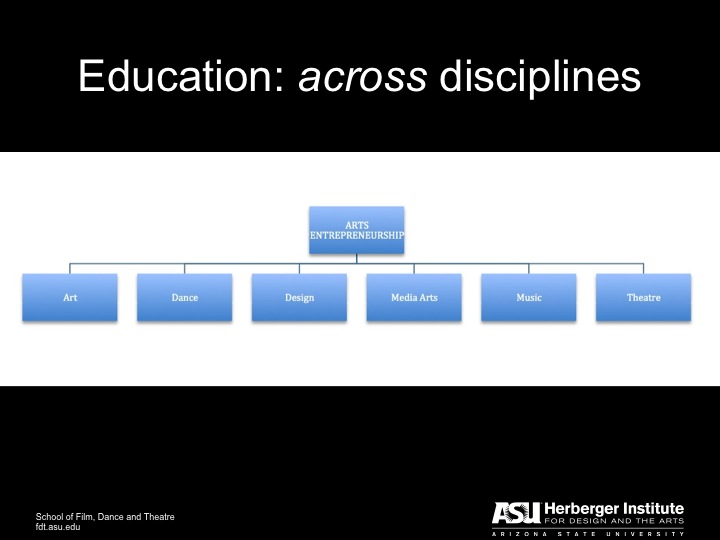
Music schools have been particularly active in this area.  Eastman School of Music sponsors a business plan competition, for example, and Julliard’s music entrepreneurship program has been widely publicized.  But there are also programs and courses housed in arts management, arts administration, and arts leadership programs that have been around even longer, and they are teaching arts entrepreneurship across disciplines.

Slide15

Individual courses in arts entrepreneurship or arts business are at well over 100 colleges and universities across the country. I thank Jonathan Gangi, now a graduate student at North Carolina State, for putting together a pretty long list of where arts business education is happening.  As one might expect, courses and programs within disciplinary departments or conservatories seem to focus on the “entrepreneurial artist” model while those in business schools tend to focus on the “new venture creation” model. The definition of arts entrepreneurship when taught transdisciplinarily in arts schools seems, and this is only my anecdotal observation, to be most broadly construed.

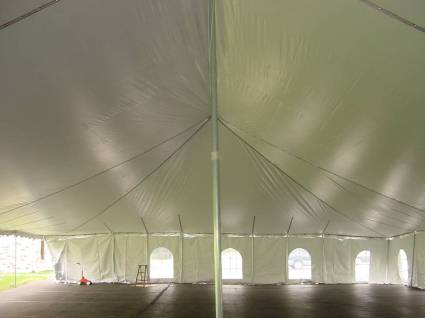
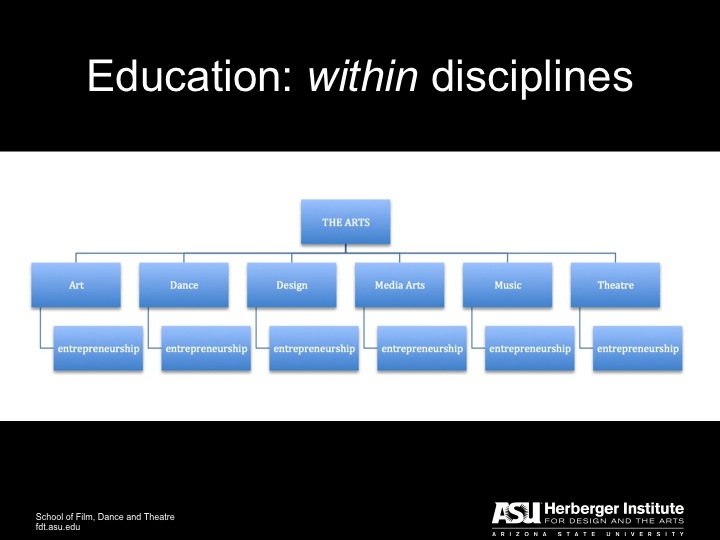
As an example, one program I’ve studied, housed in a business school, focuses almost exclusively on business ownership – the content of the art is unimportant – while another, housed in an arts conservatory, focuses instead on “new ways of thinking” about artistic production. The program I lead has a transdisciplinary undergraduate certificate in arts entrepreneurship and then an MFA concentration in Arts Entrepreneurship and Management.  There is a broad range or, as I like to put it, a big tent.

maxfields_tent_inside

As arts entrepreneurship develops as an academic field, care needs to be taken to avoid dividing the field into programs that are nurtured within individual arts disciplines versus programs that cross disciplines. I conceive of arts entrepreneurship and arts business education as a transdiscipline.

While arts entrepreneurship and arts business education may be relatively new to academia, it is not new “in the world.”  There is A LOT of arts business education that happens outside of the university or academy setting that has been happening for a long time.  New York Foundation for the Arts has been offering arts business training since the early 1970s and Creative Capital has done so since its inception in the 1990s.  Other organizations like Springboard for the Arts and Art Home mentioned earlier, or the for-profit Institute for Arts Entreprenuership in Chicago also deliver arts business education directly to artists. Some public agencies also provide business training for artists. Montana’s Artrepreneur program is a good example.

What is needed as these educational initiatives move forward – especially within academia — is a connection between the research and the education.  I had a conversation with a colleague about this recently. He is concentrating his research and research dissemination efforts on arts entrepreneurship in the context of higher education. I reminded him that when he trained for his PhD in musicology, he didn’t study musicology in the higher ed context, but rather he studied musicology.  Similarly, if arts entrepreneurship is to move forward in the academy as a discipline of “practice and inquiry” we will need to build up our knowledge of arts entrepreneurship itself so that we are teaching arts entrepreneurship to our students and not merely teaching pedagogy, or teaching people to teach.

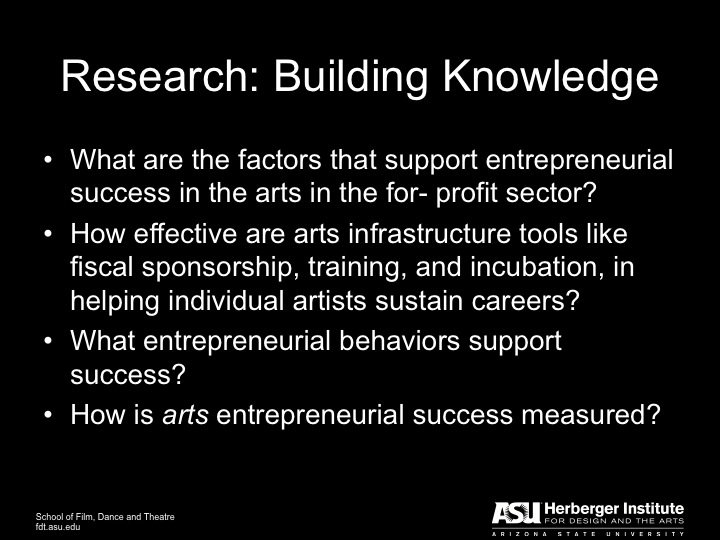
Slide17

There are a lot of areas where more research is needed. Here are just a few questions on my mind:

  1. What are the factors that support entrepreneurial (that is, new venture) success in the arts in the for-profit as well as nonprofit sectors?
  2. How effective are arts infrastructure tools like fiscal sponsorship, training, and incubation, in helping individual artists sustain careers? (if somebody could do a longitudinal study to tell us that, it would be terrific)
  3. What entrepreneurial behaviors support success?
  4. And how is arts entrepreneurial success measured – financially? Artistically?

Next installment (the last): good business practices and the arts.

Posted in Arts education, Arts entrepreneurship, arts infrastructure, Higher education | Tagged , , , | 3 Comments

The Ouroboros 5: Landscape of Arts Entrepreneurship Practice

I was honored to be invited to deliver the keynote remarks at the UW-Madison Bolz Center’s Arts Business Research Symposium March 13-14.  I previewed those remarks here and am posting the full text serially over the next several days. The talk was originally titled “Not about the Benjamins: Arts Entrepreneurship Research, Practice, and Education.” Here’s it’s just called “The Ouroboros.” This is part 5.

Slide13

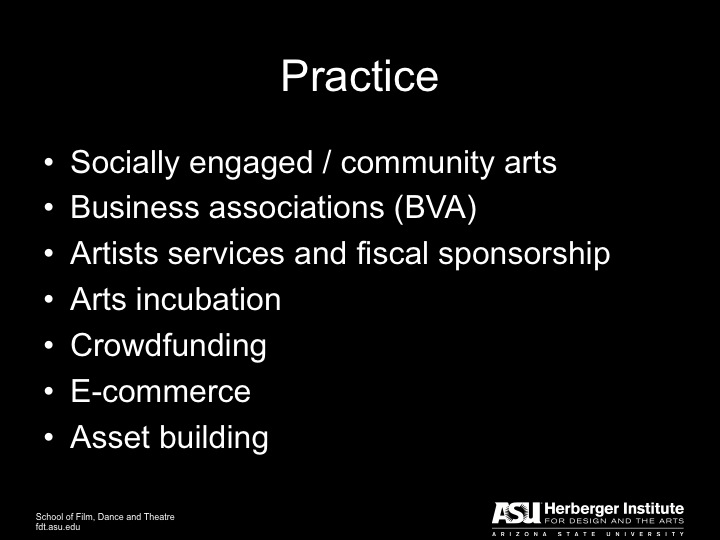
Where does the actual work of arts/business interaction happen?  Once we accept that the end result of such relationships is art rather than money, we see these interactions happening in new and interesting ways in the domain of socially engaged practice. I’m delighted to see Sonya Manjon on the program here, because I want to hear about her work as an artist/researcher who both undertakes community collaborations and studies them. 

There’s a long history of arts/business associations like “Business Volunteers for the Arts.”  I don’t know if where you are is anywhere like Phoenix, but our local chapter dissolved three years ago during the height of the recession.  Its signature “business on board” program is being administered by a state-wide arts advocacy organization, but I wonder if that particular incarnation of arts/business relationship is waning elsewhere.

An important aspect of arts business practice is the infrastructure afforded for undertaking and launching an arts-based venture.  Fiscal sponsorship and arts services organizations that provide other kinds of shared business services are a critical part of that infrastructure.  Fractured Atlas is well-known for providing that kind of support for individual artists and fledgling arts organizations.  I’m delighted that Noah Keesecker is here from Springboard for the Arts, an organization that provides arts business infrastructure support for artists in Minneapolis and elsewhere in Minnesota, making, to paraphrase their executive director Laura Zabel, “a living and a life” possible for artists.

My own research touches on the infrastructure for arts venturing.  There are over forty arts venture incubators in the US, some focusing more on the incubation of art and others focusing more on the incubation of creative industry businesses, but all of them are part of the landscape of arts business activity. In that context, one observes the full spectrum of arts entrepreneurial activities – from individual artists learning sound business practices, to new businesses forming in the creative industries.

And then there’s crowdfunding, and its cousin e-commerce. It’s been a widely tauted statistic that kickstarter distributed more funds to arts projects than did the NEA over the last two years.  I view kickstarter and the other crowdfunding platforms (indiegogo, Rockethub, etc) as another – and very useful — tool for artists and arts orgs to feed the Ourobos – to get more money to generate more art.  But we may be starting to see a saturation point there as well – with so many projects to fund, will the dollars for funding continue to grow? Time (and maybe a PhD dissertation in cultural economics) will tell that story.

Related to this area of support services for artists and small arts organizations is the area of asset building. Art Home, for example, helps artists build their asset base through savings and even homeownership so that they can sustain their lives as artists.

Next: The Landscape of Arts Entrepreneurship Education

Posted in Arts entrepreneurship, Arts funding, arts infrastructure, Arts management, Uncategorized | Tagged , , , , , , , , | 4 Comments

The Ouroboros 4: Landscape of Arts Entrepreneurship Research

I was honored to be invited to deliver the keynote remarks at the UW-Madison Bolz Center’s Arts Business Research Symposium March 13-14.  I previewed those remarks here and am posting the full text serially over the next several days. The talk was originally titled “Not about the Benjamins: Arts Entrepreneurship Research, Practice, and Education.” Here’s it’s just called “The Ouroboros.” This is part 4.

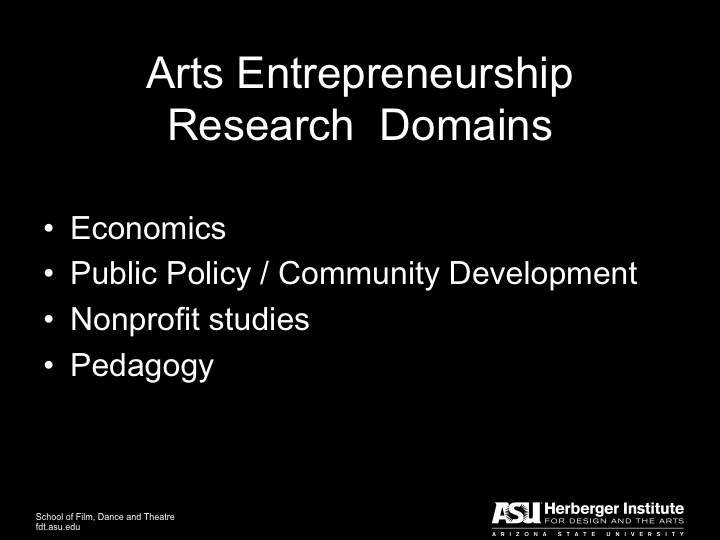
Research on arts entrepreneurship – arts AS business and arts AND business happens in several domains. I’ll discuss four of those domains, but it is not an all-inclusive list.

Slide12

First is the realm of economics in which folks like Michael Rushton are theorizing on the price mechanism in the arts and Roland Kushner is tracking the longevity of start-up arts organizations. I would like to see more economics-oriented research in the for-profit arts sector, but that data is harder to come by and funding for primary data collection is scarce.

Community resources and development (or community economic development) is another area of research that looks at art and business, often, as alluded to earlier, on the effects of arts-based businesses on community development.  We can also understand this domain to be at the intersection of arts entrepreneurship and public policy.  Spurred by the NEA “Our Town” program and its partner ArtPlace initiative, there is a lot of interest on the ways in which arts and culture businesses can enhance what is called “community vibrancy.”  Rhonda Phillips and my ASU colleague Gordon Shockley work in this area, primarily from a theoretical perspective, and often drawing examples from Europe and the Commonwealth countries where the concept of “creative industries” is more fully developed.  Working at the intersection of art, economics, and policy, research on arts enterprise and community development also includes the work of Ann Markusen, consultant Anne Gadwa Nicodemus, and others. My own research on arts venture incubators could perhaps be considered under this umbrella domain as well.

Related to both the economics and community development domains is the nonprofit studies realm.  I’ve already referenced Stephen Preece and his work on nonprofit arts venture creation.  Mark Hager, another ASU colleague, also works in this area, often on the relationship between nonprofit arts organizations and tourism. Andrew Taylor (who I believe is here today), is following the money – specifically capital – in nonprofit arts organizations.

Finally, there is research about arts entrepreneurship in higher ed, both the content and the pedagogy of arts entrepreneurship, much of which is theoretical. My own work in this area involves developing a framework for teaching students to develop those entrepreneurial habits of mind that support both creative and financial success using three different pedagogies of collaborative projects, mentorship, and experiential learning.

Frameworks Figure 5

My Artivate co-editor has been working on disseminating information about learning outcomes for arts entrepreneurship educators within individual artistic disciplines.  A recent article in Artivate from Australia advances the field, extending the “habits of mind concept” to develop teachable means for developing an “arts entrepreneurial mindset”   including  “Creative, Strategic, Analytical and Reflective Thinking,”  “Confidence” (or what I would call self-efficacy), “Collaborative Abilities, “Communication Skills,” and “Understanding of Artistic Context.”

I would like to see more research on how to teach to the other end of the arts entrepreneurship continuum – new venture creation — and I will be presenting later this year with my Drexel colleague Neville Vakharia on arts venture incubation as a tool for such pedagogy.

NEXT: A Landscape of Arts Entrepreneurship Practice

Posted in Arts entrepreneurship, arts infrastructure, Arts policy | Tagged , , , , , | 2 Comments

The Ouroboros 3: A Field of Practice and Inquiry

I was honored to be invited to deliver the keynote remarks at the UW-Madison Bolz Center’s Arts Business Research Symposium March 13-14.  I previewed those remarks here and am posting the full text serially over the next several days. The talk was originally titled “Not about the Benjamins: Arts Entrepreneurship Research, Practice, and Education.” Here’s it’s just called “The Ouroboros.” This is part 3.

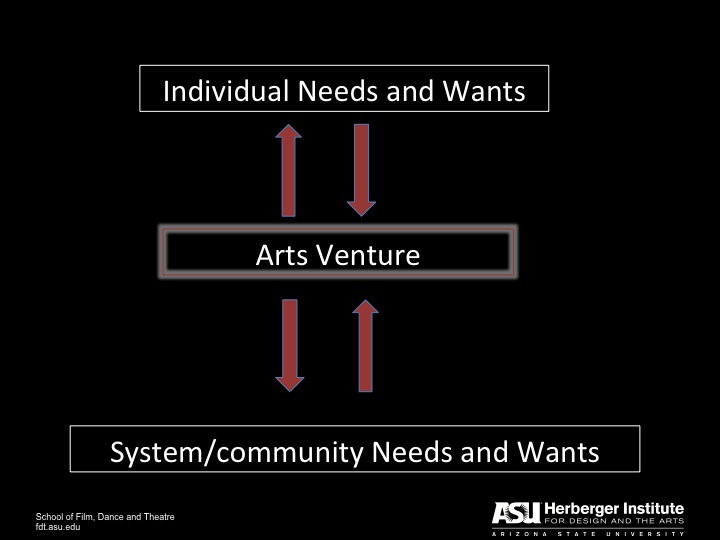
My students begin their entrepreneurial journey by looking for opportunities in their own communities; by assessing the needs and wants there – where they live.  The arts venture that results from that assessment can meet the needs of both the community and artist in a different kind of bi-directional relationship:

Slide09

THIS is how business helps the arts: by the creation of ventures that meet both the needs of artists and the needs of communities and by good business practices employed by both individual artists and organizations that connect artistic innovation with money so that money can feed the artistic process, connecting art to audience.

There’s a long history of thought around the idea that money will taint art.  Immanuel Kant said that the aesthetic is an end in itself – and I agree.  But Adorno said that art as commercial entertainment is suppressive and Hans Haake made a bit of a fuss when he said that when artists participate in galleryexhibitions, they trade their aesthetic and symbolic capital for financial capital.  But when we see money as nourishing art, as the product of arts entrepreneurship feeding the making of art itself, which is an end unto itself as Kant said, then that taint is diminished if not done away with all together  — money is not the ends, it is the means.  In arts entrepreneurship, It is not about the Benjamins.

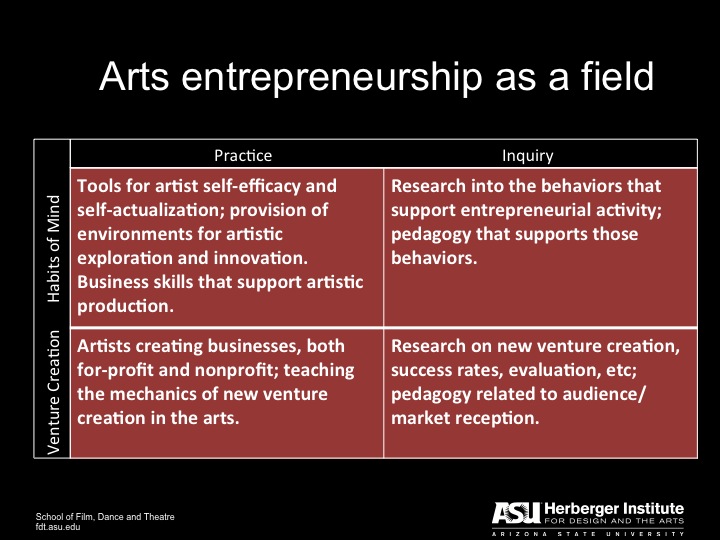
In that introductory Artivate article I mentioned earlier, I posit a summary of arts entrepreneurship as a field of inquiry and practice that I add to a bit now, 18 months later. And, being trained in social science as well as artistic practice, create a 2X2 grid

Slide10 The “practice” column encompasses both practice in the field and what might be taught, while the “inquiry” column refers to research and to pedagogy (how practice is taught). The y-axis is the continuum of arts entpreneurship discussed previously.  It is not all-inclusive, but illustrative of what could happen and, perhaps most importantly, where more research is needed. 

But what IS happening? In Research, Teaching, and Practice? In the Pave Program in Arts Entrepreneurship, we’ve been working across all three of these areas since 2006 so in the next installment I’ll be using examples from the work we’ve done there as well as bringing in examples nationally to start to see what this landscape looks like.

For an inventory and analysis of the arts entrepreneurship landscape in higher education, you can download our 2016 report commissioned by the Alliance the Arts in Research Universities: https://herbergerinstitute.asu.edu/sites/default/files/a_landscape_of_arts_entrepreneurship_in_us_higher_education_0.pdf

NEXT: A Landscape of Arts Entrepreneurship Research

Posted in Arts education, Arts entrepreneurship, arts infrastructure | Tagged , , , , , , , | 2 Comments

The Ouroboros 2: What IS arts entrepreneurship anyway?

I was honored to be invited to deliver the keynote remarks at the UW-Madison Bolz Center’s Arts Business Research Symposium March 13-14, 2014.  I previewed those remarks here and am posting the full text serially over the next several days. The talk was originally titled “Not about the Benjamins: Arts Entrepreneurship Research, Practice, and Education.” Here’s it’s just called “The Ouroboros.”

That business practices can support the arts is at the foundation of arts entrepreneurship as a practice, as a field of inquiry, and even as a subject to teach at universities.  So I’m going to talk about what arts entrepreneurship IS, why arts organizations form, and what I observe to be the landscape of arts entrepreneurship in research, practice, and pedagogy.

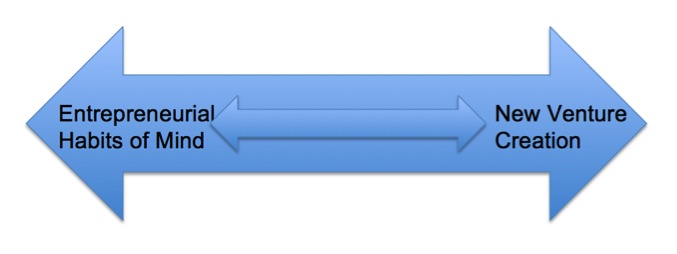
What IS arts entrepreneurship anyway?  I posit in the introductory article to Artivate, the only research journal in the field, published out of the Pave Program in Arts Entrepreneurship at ASU, that Arts Entrepreneurship exists on a continuum from the individual artist adopting entrepreneurial habits of mind in their practice at one end to new venture creation in the creative industries at the other.

AE continuum

The former is the “Self Employment in the Arts” model employed in educational settings or conferences (like the “Self-employment in the Arts” conference that comes out of Amy Rogers program at North Central Illinois) the goal of which is to teach individual artists to manage their own careers.  It’s also the concept behind some artist-serving arts incubators.  The other end of the continuum is the creative industries entrepreneurship model where artists and arts organizations form firms in order to……well, to do what exactly?

In the literature of entrepreneurship, there are several complementary or even contradictory theories about the relationship between the means to and ends of entrepreneurial action, understood in this context to be new venture creation.  Shane and Ventkataram would argue that entrepreneurial opportunity involves the discovery of new means and end relationships.  That is probably true in the arts.  That concept, however, is an expansion of one developed by Austrian School economist Ira Kirzner who, along with his neoclassical brethren believe that profit maximization is the only reason to undertake entrepreneurial activity.  For Kirzner and his buddies, the only viable reason – the only viable end – to entrepreneurial activity is the discovery of a new way to profit.

But, let’s be honest, does anyone undertake a new venture in the arts to maximize their financial gain?  My colleague Stephen Preece points out that “In the absence of profits, entrepreneurs in the not-for-profit performing arts are necessarily motivated by self-fulfillment within the execution of an artistic organizational mission.”  While I don’t disagree with Preece, I offer a slightly different perspective.

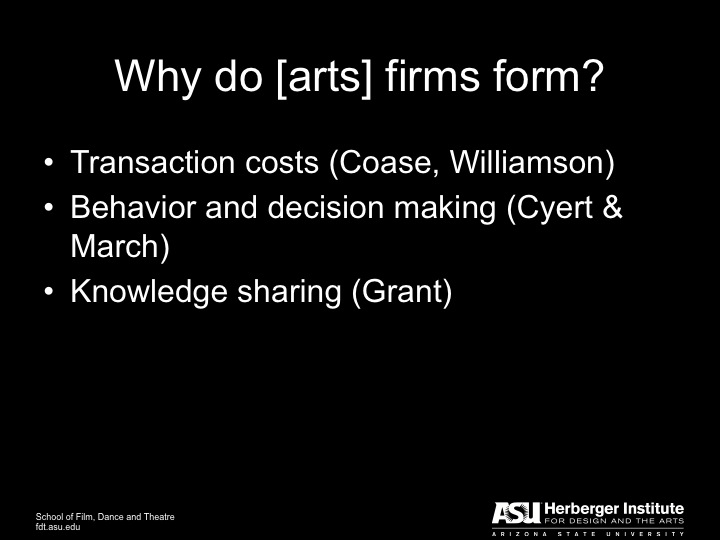
Slide07We can look at several “theories of the firm” to see why arts ventures form.  Coase’s theory of the firm focuses on firm formation as a way to decrease transaction costs – especially the cost of bringing a product to the market.  Cyert and March took a behavioral approach and asserted that firms form as decision-making structures. Grant asserts that firms form to share tacit knowledge.  There are examples throughout the arts and culture domain of firms that form to minimize transaction costs, make effective decisions, and share knowledge.  For example, Key Brand Entertainment, and its subsidiary Broadway Across America was formed to minimize the transaction costs that would be incurred by an individual producer touring independently; an arts services organization or even an arts incubator forms in order to reduce the transaction costs incurred by its individual members;  a municipal arts agency forms in order to more efficiently and effectively make decisions about who and what to support; any dance, theatre, or opera company forms in order to share tacit knowledge between artist specialists like choreographers, dancers, designers and so on.

Ultimately, however, firm formation itself is only a means to a greater end, and as I’ve already stated, in the arts and culture sector, that end is NOT profit maximization.  People – artists and those who support artists – undertake entrepreneurial activity in the arts and culture sector, both for profit and nonprofit in order to MAKE ART and to make art available to its audience in new and innovative ways.

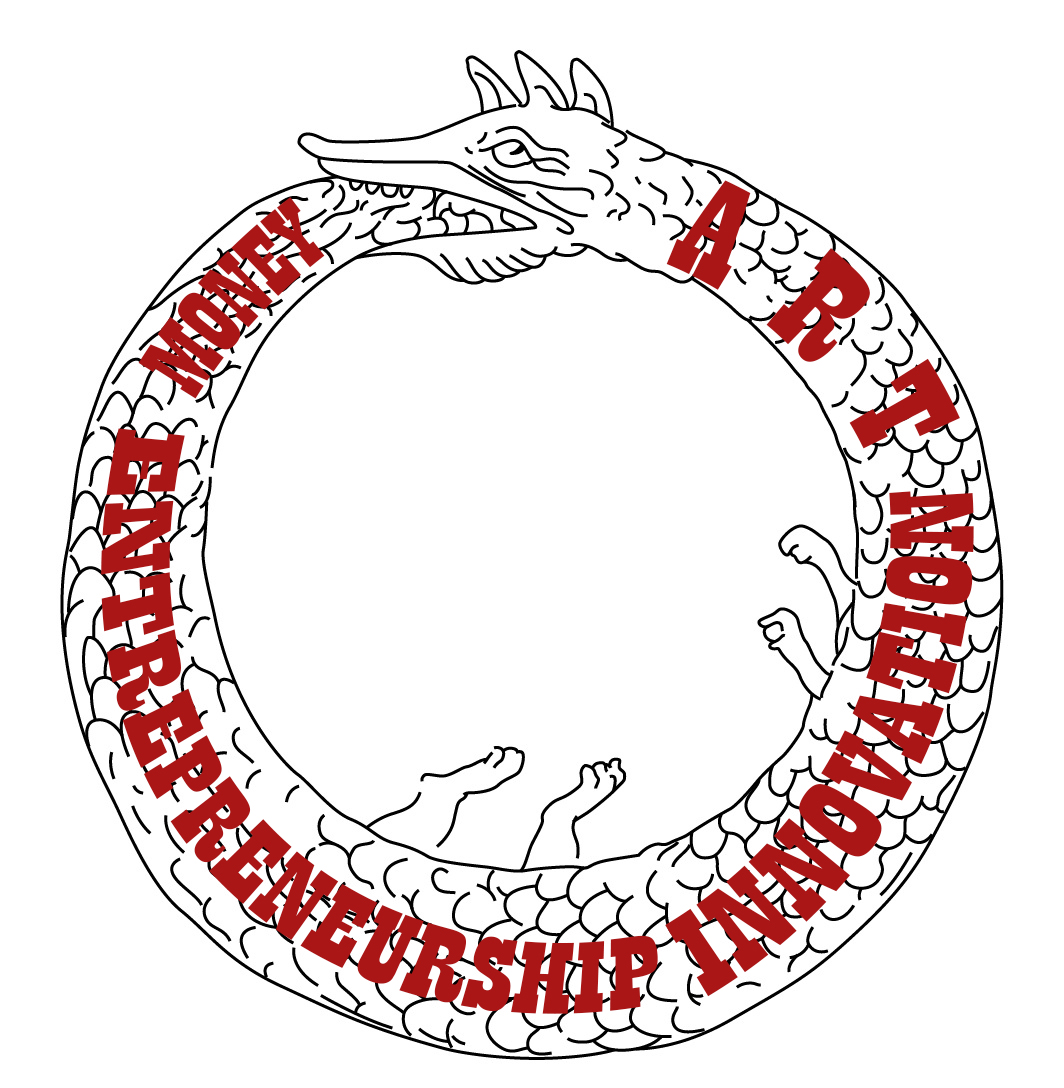
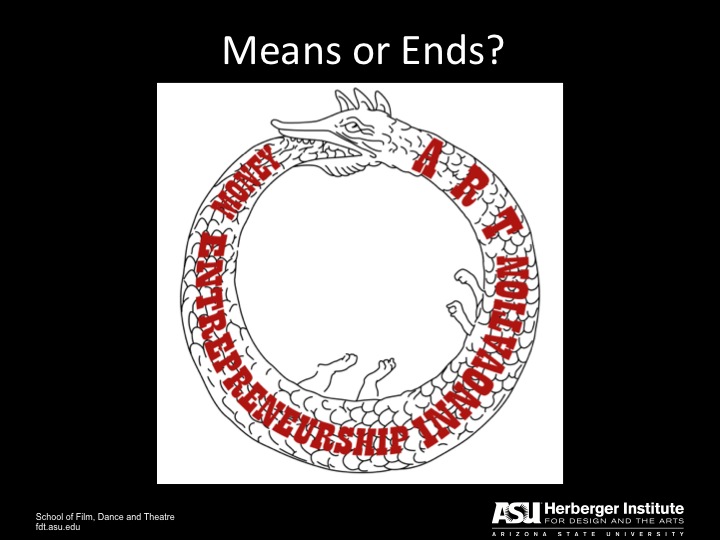
“Entrepreneurship” or “entrepreneurial behavior” is itself the means and ART is the end. The entrepreneurial behavior generates money that in turn feeds back to the art.  Lets return to our Ouroboros:

Ouroboros with textArt that is innovative must find its market. To be an innovation, according to Mihaly Csikszentmihalyi, the creative product must influence its domain – it must have an impact.  Entrepreneurship then – in the form of new venture creation – is the tool, the means, by which the art and the audience connect.  That new venture generates money that, like the Ouroboros’s tail, feeds the creation of more art.

So, in order to connect the innovation – the creative artistic product — to the money that will feed it, requires knowledge and understanding of entrepreneurial action. What does it take for, at one end, an artist to manage her own career effectively and at the other, start a venture that will generate enough money to keep the circular flow going?  I often tell my students that the “discipline” of entrepreneurship is opportunity recognition and, in the arts, opportunity creation.  When artists and those interested in advancing the arts recognize the opportunities to generate revenue, to create new businesses that support the arts, then we have arts entrepreneurship.

For more on defining arts entrepreneurship, see “Explaining Arts Entrepreneurship” and for a formal expansion of these ideas, see my 2015 article in The Journal of Arts Management Law and Society, “Means and Ends: A Theory Framework for Understanding Entrepreneurship in the US Arts and Culture Sector” -http://www.tandfonline.com/doi/abs/10.1080/10632921.2015.1103673

NEXT: Arts Entrepreneurship as a Field of Practice and Inquiry

Posted in Arts education, Arts entrepreneurship, arts infrastructure | Tagged , , , , | 10 Comments

Preview: The Ouroboros

Next week, I will be delivering the keynote or “framing” remarks at UW-Madison’s Arts Business Symposium, in advance of which I offer my opening thoughts:

The title of the event includes the word “Bi-directionality” and promotes the excitement over the potential for the positive impact the arts can have on business.  Much attention is paid to the positive, instrumental effects of the arts on business  — not just here at this conference, of course.  Americans for the Arts, for example, recently published its fourth edition of Arts and Economic Prosperity.  The “Creative Placemaking” concept has arts and culture activities shaping the nature of neighborhoods, towns, cities, and regions for the better.  But to be truly bi-directional, we need to expand, or perhaps even initiate, the conversation about the instrumental benefits of business on the arts.  I see the relationship between arts practices and business practices not to be linearly bi-directional, but rather to be — borrowing a visual metaphor from the great entrepreneurship theorist Joseph Schumpeter, a circular flow. schumpeter flow Schumpeter viewed that as a flow between households and businesses through the markets of resources and products. I use  a more specific metaphor  — that of the Ouroboros, the serpent or dragon eating its own tail, to illustrate the circular flow of arts and business as they feed off one another.

Ouroboros1

We can view that relationship as devouring… or nurturing, or both, in an endless cycle of renewal, a cycle that Schumpeter described as “Creative Destruction” followed by “equilibriation.”

….more on arts firms and arts entrepreneurship research, practice, and education after the talk next week. Stay tuned.

(Ouroboros by Abake, public domain)

Posted in Arts education, Arts entrepreneurship, Culture and democracy, Higher education | Tagged , , , , , , | 7 Comments

Assets, Tangible and Not

Poet, performer, and critic Claudia La Rocco said at a recent Pave event, “Not everything can be monetized; not everything should be.”  There are, indeed, many ways to consider “value,” and monetization is only one metric.  However, some things that we would generally consider intangible may show up on a balance sheet.  I was reminded of this paradox for two reasons: first, I was preparing to teach a unit on fiscal literacy to my undergraduate arts entrepreneurship class and second, I spoke with Esther Robinson of Art Home at the urging of our mutual friend Aaron Landsman.

Regarding the first, it is generally accepted accounting practice for a company to include “goodwill” as a line on their balance sheet.  This item encompasses intangible assets such as reputation, brand loyalty, or even employee satisfaction. The Walt Disney Company, for example, lists more than one third of its total assets as “intangible assets” ($7.4 billion) and “goodwill” ($27.3 billion)[1].   Nobody can deny the value of Disney’s brand, and they quite literally account for it financially.  To what extent should an individual artist do the same?  As one of my students astutely noted, “Why lie to yourself about your financial situation? Relying on branding and customer loyalty is something that becomes a true asset down the line when there is financial/statistical proof that the loyalty exists, not something you just hope for.”

Ducks in RowAnd then there was my conversation with Esther.  Her mission in life seems to be to teach artists to build their tangible asset base, primarily through small incremental savings plans and home ownership, so that they can live sustainable lives as artists.  Ironically, these tangible assets have a value that is both financial and extra-financial.  The financial value is easy to determine, but there is also intangible value in having tangible assets: the value of “peace of mind,” or a “fallback plan.”  How freeing of the imagination is it for the artist to know that there is a small amount of money in the bank or that the studio in which they work has “real” value that can be borrowed against or even sold in the event of an emergency? How useful is it to artists’ creative practice to be able to project their cash flow so that the lean times and fat times are predictable, rather than a surprise?  Artistic risk becomes more feasible when artists don’t have to worry about money in the act of creation — because they’ve “worried” about it in advance.


[1] In this context “goodwill” also refers to the difference between purchase price and book value of an acquisition, which accounts for some, but not all, of the goodwill on Disney’s balance sheet. [Disclaimer: I am not a CPA]

Posted in Arts education, Arts entrepreneurship, Arts funding, arts infrastructure | Tagged , , , , , , | 2 Comments

Pave’s Arizona Art Tank Pitch

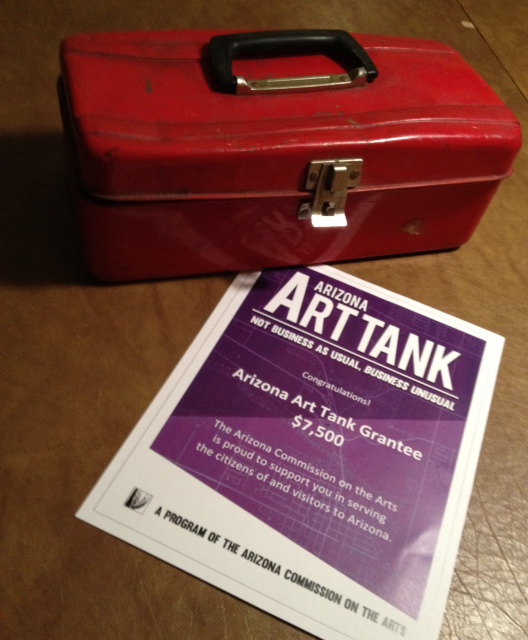
I recently participated in “Art Tank,” an innovative funding initiative from the Arizona Commission on the Arts.  Barry’s Blog provides some excellent coverage of the program, which is designed to fund “business unusual” arts projects throughout the state.  On January 27, I took my battered red toolbox to the Chandler Center for the Performing Arts to explain the “Arizona Arts Entrepreneur Toolkit.” In the toolbox was a hammer, a wrench, and a USB drive. I’m happy to say that the Pave Program came away with a $7500 seed grant for the project.

toolbox

Here’s my pitch:

Imagine you want to build a sustainable artistic practice in Arizona –

Do you need this hammer or this wrench?

Neither, you need this USB drive, because on this USB drive could be a one-stop shop for entrepreneurial Arizona Artists. 

I’m Linda Essig, director of the Pave Program in Arts Entrepreneurship, which I’ll tell you more about later. 

We envision the development of the Arizona Arts Entrepreneur Toolkit.

The Arizona Arts Entrepreneur Toolkit will provide information you need to build your sustainable artistic practice in Arizona or start up a small arts organization.  Let me give you a few examples:

  1. Maybe you’re a painter, and you need to build your studio budget? You don’t need a hammer, you need easy-to-use templates and Arizona specific information on pricing.
  2. Are you a musician? Not sure how to send a press release about your next concert? The toolkit will include not only instructions for crafting an effective press release, but a list of Arizona media outlets so that you can start building your own contact list.
  3. Thinking about developing a social media strategy? You can start with our guidelines.
  4. Want to set up an Etsy shop or other e-commerce portal? We’ll provide you with step-by-step instructions.

Creating an Arizona Arts Entrepreneur Toolkit isn’t just an entrepreneurial idea, it’s a DOUBLE META entrepreneurial idea. 

Huh?

It’s an entrepreneurial idea to help artists be more entrepreneurial (meta-entrepreneurial) but what makes it double-meta entrepreneurial is that the proceeds from the sale of the toolkit will go to support the Pave Arts Venture Incubator, which has supported over two dozen arts ventures, thus providing the incubator with an ongoing revenue stream.

Right now, Pave provides public programming for the general public, research for the academic community, and courses and a venture incubator for ASU Students

We need your help to move forward, and make our expertise available to artists across the state.

Our incubator is limited to ASU students, but Pave will make the Arizona Arts Entrepreneur Toolkit available to all artists and small arts organizations in the state.  And, annual updates will also be available at a discounted rate.

 I know from my work with student artists, from talking to artists who attend our free public programming, and from artists I have met via my own consulting with NEDCO-Mesa who you heard from earlier tonight that artists in Arizona need this resource, and the Pave Program in Arts Entrepreneurship has the skills to develop this comprehensive tool. 

Organizations such as Rising Youth Theatre, Opera Revolution, UrbanSTEW, Simply Three Trio, and Dancers and Health Together as well as many individual artists have all benefitted from our expertise. We want to share that with the broader Arizona Artist community – and especially its individual artists who may not have an organization behind them.

The comprehensive set of tools we envision requires planning, research, development, and (eventually) production, all of which can begin only with the help of funding from the Arizona Art Tank.  We need you to kickstart us.  Thank you.

At the intermission, a lot of folks came up to me asking for the USB drive — it’s not developed yet! Our next step is to survey individual artists and small arts organizations to make sure we’re including the tools that you need.  If you’re an artist, especially an artist in Arizona, what would YOU like to see included in a resource like this?

Posted in Arts entrepreneurship, Arts funding, arts infrastructure | Tagged , , , , , , , , , | 3 Comments

Gatekeeping and Board Diversity

Gatekeeper_(8633805365)I don’t like being in a “gatekeeping” position but often find myself there, as a journal editor, as a member of my university’s promotion and tenure committee, even as a teacher.  I find the position troubling and try – especially when making decisions that may keep the proverbial gate closed – to consciously consider the ways in which my particular perspective or even subconscious biases affect those decisions.  There are gatekeepers at every level of artistic production and distribution.  From the play selection committee in a university theatre department to a grant panel at the National Endowment for the Arts, people are making “go/no go” decisions about what gets produced, where, and by whom.

This concept weighed heavily on mind as I was prepping for next week’s grad seminar topic, board governance, especially in light of Francie Ostrower’s recent report on board diversity in which she finds “Arts and cultural boards of all sizes were extremely homogenous with respect to race and ethnicity” and “boards were overwhelmingly composed of white members.”  I am not at all suggesting that white people are more biased than non-white people, but rather that boards that are predominantly or all white do not have access to the perspectives of people of color in their decision making – including the ultimate gatekeeping function of hiring the executive and artistic leadership of an arts and culture organization.  A 1992 study (McLoed and Lobel) found that groups that were heterogeneous with respect to the ethnic backgrounds of their members produced higher quality ideas in  brainstorming than homogenous groups.  I could list several others that draw similar conclusions about the positive impact of heterogeneity on group creativity (and there’s Keith Sawyer‘s prodigious research on group creativity as well).  The nonprofit arts board, working in a generative mode, brainstorms ideas through strategic planning processes that create the very gates that include or exclude the organization’s leadership, staff, and even audience.  How much richer in creative capital would our arts and culture organizations be if they had greater diversity on their boards?  Ostrower suggests some simple ways in which organizations can open the gates of their boards. You can read her report, rich in descriptive statistics to back up her conclusions, here.

(photo by flickr user Luca Sartoni, under Creative Commons attribution license)

Posted in arts infrastructure, Arts management | Tagged , , , | 3 Comments