Bricks and Mortar

An article in yesterday’s NY Times about Arena Stage’s new “Cradle” for new play development and a tour I had this morning of the newly renovated Chandler Center for the Arts are reminders that sometimes infrastructure for the arts is literally infrastructure – bricks and mortar supporting the creative work of artists and community members.  These two facilities and their missions could not be more different, but both are needed for a sustainable future for the performing arts.

Arena artistic director Molly Smith explains, “…we’re trying, in a big way with a new building and with money, to see that new plays have a home here.”  That money comes from a strong subscriber base and significant private donations from individuals.  The mission of the Cradle,  “developing new American plays and cradling artistic risk,” is called “an act of some theatrical audacity.”  Arena is not the first theatre to try to build an artistic home for playwrights, but given its location in the nation’s capitol, has symbolic significance.  Ultimately, support for playwrights is needed if new plays are to be written, and new plays (preferably good new plays) need to be written for the future health of the art.
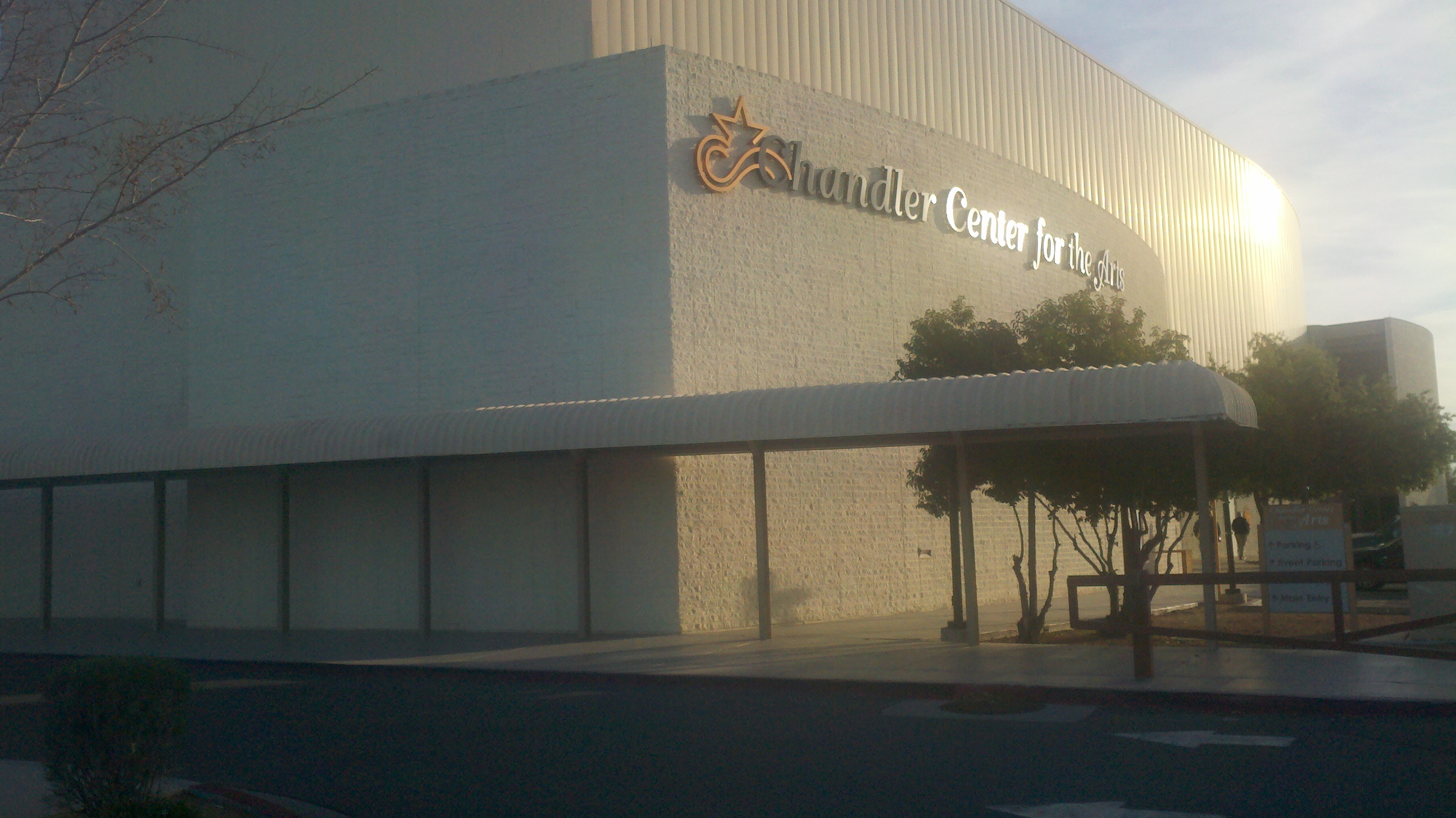
Arizona has gotten a lot of bad publicity recently, but it’s not all bad news here.  2100 miles from Washington D.C., the City of Chandler and the Chandler School District are doing their part to create a sustainable infrastructure for the arts.  Built in 1989, the Chandler Center for the Arts is a partnership between the city and the school district.  The facility is not only the Phoenix suburb’s cultural hub, presenting everything from Golda’s Balcony and Dancing on Ice to community orchestra concerts and jazz, the center also serves as the performing arts venue for the local high school. City and school district bonds funded the $6 million upgrade to the rigging, seating, lighting, and ADA compliance.

This is not a theatre where the most innovative new play will be developed and written.  However, it is a place where the most innovative new playwright may get to have his or her first experience as an audience member or a performer (the high school’s spring production is Grease). Its bricks and mortar  — paid for with public money – are as important to the future health of the performing arts as Arena’s Cradle.

(later this week: a followup on why Arena stage needed private funding and Chandler used public money)

Posted in Arts education, Arts funding, arts infrastructure, Arts policy, Uncategorized | Tagged , , , , , | 5 Comments

Realignment

Today, I was re-viewing Ben Cameron’s* fabulous TEDTalk of last fall because I’m requiring my arts entrepreneurship students to see it.  Cameron makes several important points, among them (and forgive the paraphrasing) that the arts are in a period of fundamental reformation, including a profound realignment of traditional business models for arts organizations.  The re-alignment of business models for the arts is also a theme running through the unfortunately titled, but otherwise excellent book, 20Under40.  Several of the collection’s authors offer business or organizational ideas that diverge from the traditional nineteenth century (to use Cameron’s descriptor) institutional model we over-40s were trained for.  This realignment is, perhaps, the theme for the new decade.  Time-limited organizations, collective leadership, open-source distribution, micro-funding, and more are all nascent ideas brewing in the literature, at the conferences, and in the meeting rooms.  If the arts sector can proactively develop institutional models that meet the needs of our rapidly changing, diverse, ambiguous, and technologically connected world, it will not only survive the reformation, but be stronger, more flexible, and more responsive for it.

*(Ben Cameron will be the keynote speaker at the second bi-annual p.a.v.e. symposium on entrepreneurship and the arts: Creating Infrastructure for Creativity and Innovation)

Posted in Arts entrepreneurship, Arts funding, arts infrastructure, Arts management, Technology and arts | Tagged , , , , , | Leave a comment

Mama LaMaMa

Sometimes, a person singlehandedly builds the infrastructure for artistic creativity and innovation.  We lost such a person yesterday.  I only met Ellen Stewart once, in the mid 1980s.  I was working with Paul Zimet’s company, The Talking Band, and we were producing at LaMama. When an older African American woman with long white/blond hair came in I knew immediately who she was.  She was friendly, a little loud, and after greeting us, left us to get on with our work.  Stewart’s contribution to the development of experimental theatre and to the kind of downtown east Village culture in which I was lucky enough to mature can’t really be catalogued. The NY Times notes that “For Ms. Stewart a vast number of [more than 3,000 productions of classic and postmodern drama, performance art, dance and chamber opera] were leaps of faith, arising from her instinct and belief that what artists need more than anything else is the freedom to create without interference.”  She was unique.  Nobody will fill her shoes, but perhaps our next generation of arts leaders will have the courage to take the Ellen Stewart style leaps of faith needed to provide innovative artists with opportunities.

(PS. Randy Gener has written a lovely, and lengthier, tribute on his blog, if you’d like to read more)

Posted in arts infrastructure, Arts management, Uncategorized | Tagged , , | Leave a comment

“Peaceful Assembly”

President Obama delivered a tender, inspiring, and thoughtful speech last night in memory of the victims of the recent shooting in Tucson.  At first blush, one might wonder what the speech has to do with infrastructure for the arts. It has everything to do with it, because it was a speech about, more than anything else, the principles on which our democracy are based.

Early in the speech, the president noted that the victims had gathered at the strip mall in the desert to exercise their “right to peaceful assembly and free speech.”  Where would the arts be without the right to peaceful assembly?  We have an answer to that question in the case of the Belarus Free Theatre. 

Many of us have been following the story of BFT over the last several weeks, as described in the pages of the Guardian and the NY Times. Larry Rohter wrote “The notion of artists struggling against an oppressive state is always attractive and inspiring, especially for those democratic societies where artists are not subjected to such intimidation.”  We’ve read about audience members being driven to performances by cast members after being texted the location of a meeting place minutes before.  Catherine Coray notes that audience members are “advised to bring your passport, because you never know when the police are going to show up and haul everyone off to jail.”  Aren’t we lucky that we don’t have to do that here in the US? Oh, wait – Arizona’s immigration bill, SB 1070, requires something very similar, so it may be that in the future we won’t be so lucky after all.

Posted in arts infrastructure, Arts policy, Culture and democracy, Uncategorized | Tagged , , | 1 Comment

A Performance — and a Shooting — in the Desert

I live in Arizona.  I’m a transplant to the desert from the east coast by way of Wisconsin.  I mention this because, like each of us, I have a unique reaction to the events of Saturday.  There are 300 million unique American reactions to this event.  Mine is informed in part by the fact that it occurred less than 100 miles from my house at a Safeway not unlike one that is 1/4 of a mile from my home, in a strip-mall built on desert rock.

I went to an event last night described as a “multidisciplinary performance” combining “live video, music, and movement to create an immersive, interactive experience.”  The first section was called “No Water,” or at least included a projection of the words “NO WATER.”  It consisted of narration and a dancer/mover in a bathing suit splashing in a small plastic bin of water in the aisle of the theatre.  The narration was full of images of the desert as a dry place –essentially a rock with no water.  The dry rock image was repeated frequently.   As I listened to the narration, I was struck by how inhospitable this place really is, made more inhospitable, it seems, since Saturday.  As I listened to the narration, I thought about the shooting, and about how it could have happened anywhere, but it didn’t – it happened here, in this inhospitable place with no water.  Although the piece was conceived and in rehearsal long before Saturday, my perception of the performance was informed by the shooting, and my perception of the shooting informed by the art.  Such is art’s power and its purpose.

For the closing section of the performance, the audience found itself onstage participating in an improvised soundscape.  The musician performers were there to set the tone, but the audience, at first reluctantly but then with more vigor, joined in using some simple instruments: the keys in their pockets, their tapping feet, or, in my case, their program scraping across the stage floor.  The sound was eerie and beautiful as my neighbors and I looked around the space at one another for subliminal or overt cues and listened to the sounds each was making individually and collectively. Group improvisation only works if people really listen to one another.  There were a hundred people on that stage quietly listening for what was missing, making sound only when it seemed appropriate.  People listened hard and respectfully to one another, waited patiently, and participated when their contribution was needed.  Perhaps the nation as a whole will heal if we can all do the same.

Posted in Culture and democracy, Uncategorized | Tagged , , | Leave a comment

Experiential learning at PHX:Fringe

Most entrepreneurship educators will agree that experiential learning is a critical component of the education of the young entrepreneur.  I’m fortunate to have been involved with the Phoenix Fringe Festival since its inception (with the help of a seed grant from the p.a.v.e. program). This year I am coordinating internships (i.e. experiential learning opportunities) for the Fringe.  If you’re in the Phoenix metro area and are interested in working with an innovative nonprofit start-up, the opportunity outlined below may be for you.

PHX:fringe 2011 Internship Opportunities

Phoenix Fringe Festival is currently seeking interns to work in all areas of Festival operations including artist services, web design, graphic design, production management, fundraising, marketing & public relations and administration.  The Festival takes place April 1 – 10, 2011, Internships are available immediately with increased activity during (and leading up to) the Festival dates.

Benefits of internship include possible academic credit (consult with your home institution) as well as hands-on experience working in a fast paced, entrepreneurial environment.  PHX:fringe board members and senior staff will serve as mentors. Interns will have the opportunity to take on responsibility for independent projects from start to finish.  This is a great opportunity to work side-by-side and learn from the experienced professionals on the Fringe board and staff while advancing the PHX:fringe mission to bring cutting edge performance to downtown Phoenix.

Internships are available in following areas:

Technical/Design – Work closely with and learn from the Technical Director and operations staff to oversee the technical logistics at each Fringe venue.  Participate in load-in, rental procurement, budget oversight and strike for each venue.

Marketing and Public Relations – Work with board and staff to get out the word about PHX:fringe.  Coordinate press contacts, online resources, social networking and word of mouth to market PHX:fringe in the community.  Plan and execute events, programs, activities and partnerships that will engage and grow audiences for PHX:fringe 2011 and beyond.

Web & IT Management – Manage website to maximize Fringe resources and deliver vital messages through high quality text and graphic content.  Assist with managing electronic ticketing software as well as PayPal, constant contact, and other electronic content.

Volunteer Management – Assist with and learn about recruiting, training and organizing more than 50 volunteers to operate Fringe venues during the Festival.  Oversee safety and logistics training and scheduling for volunteers.

Artist Services– Participate in delivering direct services to participating Fringe artists.  Organize and plan events, transportation, accommodations, recognition programs, and partnership programs designed to ensure the artists at PHX:fringe 2011 have the best possible experience.

Administration – Administrative interns will plan and implement box office operations, Fringe Central activities, artist contracts and other aspects of business operations.

Fundraising – Learn the fundamentals of nonprofit fundraising by assisting with the process of engaging individual and institutional donors to support the Festival.  This is a great chance to take the mystery out of the fundraising process and get experience raising funds.

Email a letter of interest and resume to <linda dot essig at asu dot edu>. BE SURE TO PUT “FRINGE INTERN” IN SUBJECT LINE.  For more information about the Phoenix Fringe Festival, see http://phxfringe.org

Posted in Arts education, Arts entrepreneurship, arts infrastructure, Arts management, Higher education, Uncategorized | Tagged , , , , , , , | Leave a comment

A Moment of Silence

Posted in Uncategorized | 2 Comments

Siloing the Arts at a Young Age

A few days ago, I wrote, “To encourage [students] to be truly creative, we, as educators, need to give our students room to play, to explore, to experiment, and to cross traditional disciplinary boundaries.  Unless we do, we fail them.”  I learned this week that disciplinary siloing starts early. On Friday, my son, who starts high school next fall, came home with a publication called “Student Guide to Career Pathways.”  This guide is designed to help students, their parents, and their guidance counselors map out the best courses to take in high school to lead toward the most appropriate “career pathway” for the student.  I don’t doubt that years of research led to this document (but years of research has led to other ill-conceived education tools).   After completing various questionnaires and self-assessments, each student is given one of six guides to the following pathways: arts, communications, and humanities; business systems; engineering and industrial systems; health services; natural resources; and social and human services.  The student can’t bring home two pathway guides – they can only pick one – making it seem that if you choose the natural resources pathway (forestry, horticulture, et al.) you can’t also be interested in arts, communications and humanities (“do you like to write or draw?” “Do your friends tell you that you are imaginative and creative?”)

My son likes to take things apart so he ended up bringing home the guide to the “Engineering and Industrial Systems” pathway. But, my son has also played piano for six years, French horn for three (and he’s pretty good), started an a cappella group with four classmates, and tests ten percentile points higher on language than on math on standardized tests. He’s thirteen years old.  I don’t want him – or any bright, engaged teenager – to be forced to choose to sequester the arts as an “extra” curricular activity if he’s interested in gizmos.   When I asked him why he answered some of the questions the way he did, he responded, “I wrote what they wanted me to…they don’t want you to do two.”

The productive citizen of the future will need to manage ambiguity, change, and multiple pathways.  Yet, at this young age, my son is being directed to choose one, rather than integrate many…what a shame.

Posted in Arts education, arts infrastructure, Higher education, Uncategorized | Tagged , , | Leave a comment

Arts giving: Tax deductions or tax credits?

One of my concerns about our very decentralized arts funding structure is that so much depends on the tax deduction for charitable giving.   This concerns me less because of rumblings about repealing the deduction and more because the beneficiaries of the policy, the “policy targets,” are those citizens who have a large enough income and large enough tax burden to itemize their deductions. (Which is why I’m not concerned about its repeal.) By targeting wealthy taxpayers who contribute to nonprofits, the tax policy indirectly incentivizes artists and arts organizations to produce work that will appeal to wealthy donors who have a disproportionate voice in the allocation of support.  How can policy instead — or in addition — incentivize participation by more arts supporters, including those with lower incomes?

One possibility could be tax credits. In a tax credit scheme, all citizens can contribute a portion of their taxes directly to the arts.  My friend the brilliant Shelley Cohn (former director of the AZ Arts Commission) suggested I look at the Oregon Cultural Trust as an example of the implementation of a tax credit program to support the arts.  In this program, a supporter can receive up to $500 in state tax credits if they contribute the same amount (on a tax-deductible basis) to a qualifying arts organization.  The majority of the funds (58%) go toward building a permanent endowment) with the remainder (42%) going toward 3 targets: the counties and indigenous tribes for program expansion, the five largest cultural organizations in the state (such as the state arts council and state humanities council), and other arts and culture organizations via a competitive grant program.

On the one hand, I’m glad that the program requires direct matching contribution to an arts organization of one’s choice because it incentivizes such contributions, but on the other hand, that requirement targets the same privileged group described above.  Would it be possible to give directly to an arts org of one’s choice through a tax credit?  It’s a complicated question, and one I hope to explore in greater depth.  In the meantime, I’m watching the controversy over Arizona’s tuition tax credit scheme closely to see if how that plays out may have some applicability to this question of interest.

Posted in Arts funding, arts infrastructure, Arts policy, Culture and democracy, Uncategorized | Tagged , , , , | Leave a comment

Design training and an uncertain future

I got into a facebook discussion yesterday with Randy Gener, senior editor of American Theatre Magazine about a piece my colleague Richard Isackes wrote about theatre design curricula.  While I agree with much of which Richard writes, he – and I, and our design education colleagues – have been saying much the same thing for years.  The problem, as I see it, is that that piece of conversation just doesn’t go far enough.  There is so very much I can say on this topic, that I need to focus and edit both for the purposes of this site and for my own time management.  So, my comment today focuses on theatre design education as it relates, or could relate to my more recent teaching focus, arts entrepreneurship and to my earlier posting on Howard Gardner’s “disciplined mind.”

Isackes rightly points out that we need to consider “for what destinations are these students prepared?”  The market has not yet brought into balance the number of MFA theatre design programs with the amount of actual professional work designing for theatre/opera/dance.  Isackes explains that many students finishing an MFA will matriculate back into the academy as teachers, perpetuating the insular practices of many undergraduate theatre programs.  There are alternatives.  MFA training could, for example, teach the disciplinary mind of the theatre designer in ways applicable to many other areas of work from theme park to video game, from the opera stage to the small business owner.  In all likelihood, as my colleague Ruth Bridgstock writes, such arts workers will have “portfolio careers,” not one job or job title, but many, sometimes simultaneous, experiences throughout the creative industries.  This makes for an uncertain future.  Entrepreneurship theorists talk about “managing uncertainty.”  One way to manage uncertainty, according to Gardner, is to develop the disciplined mind.  Thus, I implicitly connect the dots between entrepreneurship training (how to manage uncertainty, among other areas) and design training (the discipline).

Managing uncertainty is just one area of entrepreneurship. Another – and it’s a biggie – is innovation.  Here is where I think design programs, and theatre programs more generally, really fall short.  [Full disclosure – I’ve written about this before on the entpreneurthearts blog and talked about it at an ATHE plenary last summer.]  Do most theatre program encourage real innovation and collaboration? Do they provide a space – both actual space and psychic space – in which students can create something new? Or, are programs, by design or accident, just reifying the work that has come before when MFA-holding faculty, as Isackes points out, “teach what they were taught – namely how to put on a college play.”  To encourage them to be truly creative, we, as educators, need to give our students room to play, to explore, to experiment, and to cross traditional disciplinary boundaries.  Unless we do, we fail them.

Posted in Arts education, Arts entrepreneurship, Higher education, Uncategorized | Tagged , , , , | 2 Comments