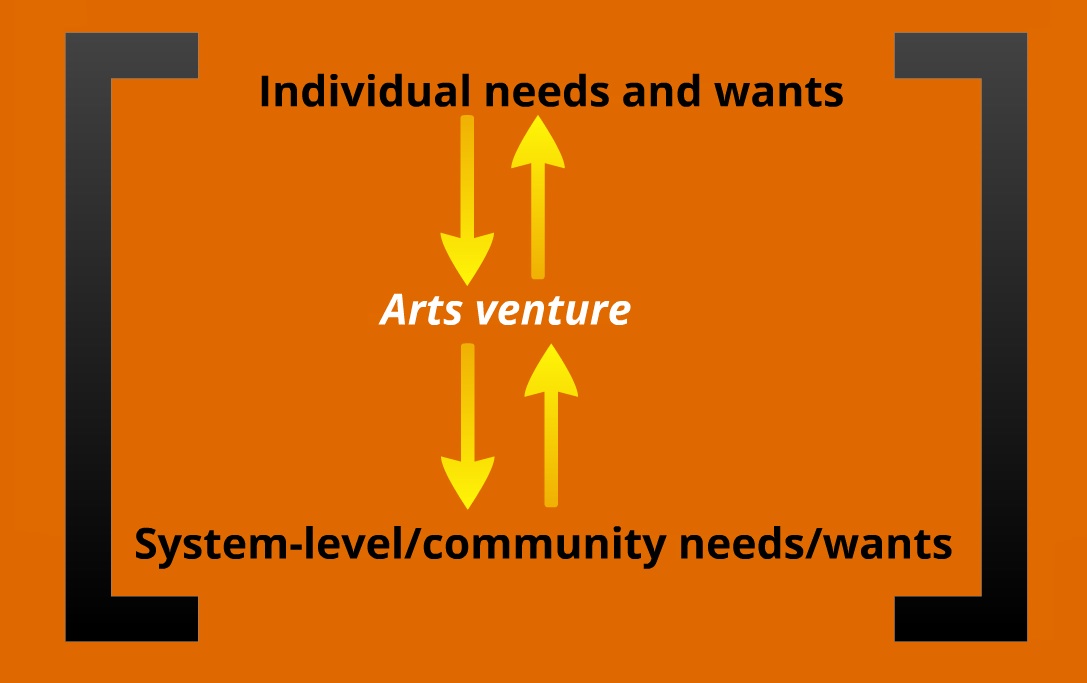
I thought I would share the graphic I use in my class to explain that an arts venture can satisfy both the individual needs/wants of the artist and the needs/wants of a community:
For more, see “Why Arts Entrepreneurship“
I thought I would share the graphic I use in my class to explain that an arts venture can satisfy both the individual needs/wants of the artist and the needs/wants of a community:
For more, see “Why Arts Entrepreneurship“
[An edited version of this material was originally published in Symposium Magazine under the title “Slow and Fast Learning in the Digital Age“]
 “Meta-cognition,” or thinking about thinking, is one of the habits of mind[1] that I encourage my arts entrepreneurship students and coaching clients to practice as they examine their decision making processes. Daniel Kahneman, in Thinking, Fast and Slow identifies two primary modes of cognition, which we can understand to be the intuitive (fast) and the rational (slow) or, put another way, the networked and the linear. How does the way we think affect what we think about? What we choose to teach and learn? And what education policies we adopt? This post looks at the contrast between linear and networked thinking (or rational and intuitive thinking) and how that contrast impacts our approach to knowledge acquisition and knowledge sharing across three different higher education contexts: a professional development workshop at a large US university, a guest lecture at a university in Beijing, and the development and implementation of a new online course in arts management.
The way in which these two modes of thinking relate to academic disciplines and their epistemologies (ways of knowing) was made obvious to me while “lecturing” in a professional development workshop for graduate students of all disciplines. I was asked to talk about “Teaching Effectively and Efficiently,” the subtext of which title is, “how can you teach well while maintaining time for your research agenda.” I have participated in this program three times, each time following a material science colleague from the engineering faculty. My colleague addressed the group of 15-20 PhD and MFA students with the aid of a PowerPoint presentation. Each slide was carefully organized with topic headings and three or four bullet points. He stood behind the table at the front of the room and described how he teaches, using a textbook, quizzes, and multiple-choice exams. He explained how he uses a real world example of the Hawaii Airlines crash of 1988 to explain key concepts of material science. There were no questions following his presentation. In contrast, when my turn came, I sat on the edge of the table rather than standing behind it and asked the students about themselves, their areas of study, and what they hoped to learn from that day’s session. They wanted practical advice, which I gave by sharing several personal experiences, and asking them if they had had similar experiences. I connected an experience an engineering student shared with an analogous experience from an art student. I could literally see students making connections with one another and the information.
On leaving the room, I realized that the difference in our delivery and our teaching style was both a disciplinary one and a cognitive one. Material science has a basis in fixed knowledge. If a plane makes too many take offs and landings, its steel skin will fail. An engineer can calculate that failure point with a certain degree of accuracy. Artistic creativity does not rely on such a fixed base of knowledge. Discoveries are made by intuition as much – or more – than by linear experimentation. The synthesis and application of knowledge via the Socratic method develops and uses the cognitive skills of instructor and students in ways that are not as applicable to disciplines that lead to one right answer.
Nowhere is the emphasis on “one right answer” more pronounced than in the Chinese system of education that culminates in that country’s National Higher Education Entrance Examination. I lectured recently in Beijing to a group of education policy graduate students on the topic of creativity and pedagogies that support it. The irony of doing so escaped neither myself nor a visiting colleague from the University of Toronto who was not surprised that none of the students had had an arts experience. With an entire secondary education system geared toward test preparation, it is no wonder that the kind of creativity supported by network thinking and intuitive cognitive skills is not emphasized. When I tried to engage the graduate students in a networked discussion, similar to that which I had led with the graduate students back home, I was met with silence (all the students speak and understand English reasonably well; so language alone was not the reason). Questions followed my lecture, but they were about the empirical research on which my lecture was based rather than on the connectivity between the ideas presented.
I thought a lot about the concept of fixed knowledge and the value of open-ended questioning while developing an online course in arts management from the ground up. The course designers pushed for multiple choice exams so that the assessments could be machine graded and the enrollment, therefore, unlimited by the need to have human evaluators (i.e. professors and teaching assistants). However, I want to give students opportunities to ask and answer questions, to help them learn to think both linearly and nonlinearly. In the unit of the course on strategic planning and when I lead strategic planning meetings, I emphasize the need to use both modes of thinking – to think synergistically and connectively in the brainstorming and idea generation phases of planning and linearly in the implementation phase. To execute this two-prong approach in the assessments for the online course, I settled on using a mix of linear problem-solving (e.g., analyzing budgets for specific information about an organization), fact-based multiple-choice questions, and open-ended writing prompts that require synthesis of reading materials with the students’ own experiences. In the end, especially given the online method of delivery, the students were responsible for exercising their cognitive muscles across both platforms. If grades are at all a measurement of learning, it would seem that the students who engaged with all of the material, who drew connections between the parts of the course content, and who also interacted with the instructor, learned more than those that did not.
A colleague who teaches online courses of 100-250 students remarked that he prefers teaching live to online because he likes to “talk, debate, and converse.” In a live class, he can stop and start video examples, discuss them interactively in the moment of teaching, and react immediately to student questions. When I employ similar techniques in my live classes, including digressions and tangential content, I can, as in the professional development class, literally see students making connections within and across the network of ideas. The linearity of online teaching may encourage students to make similar types of connections, but as an instructor, I don’t see that until it is expressed in a writing assignment or project. By then, the “thinking fast” moment, and the learning/teaching opportunity that comes with it, has passed.
Ultimately, to successfully navigate the world outside of the academy, one uses both types of thinking. Within the academy, thinking about thinking not only affects the outputs we request of students, but the actual learning outcomes that result from the way we teach and evaluate.
[1] See Costa and Kallick (2008) Learning and Leading with Habits of Mind, 16 essential Characteristics for Success.
I came across a website the other day of a municipally owned performing arts facility that describes itself as “the premier performance venue, arts incubator and advocate.” To actually be an arts incubator, an organization or program needs to function as such by nurturing the growth and development of artists, arts organizations, or arts enterprises (“enterprises” can be understood here to mean small businesses).
 For some time now, I’ve been focusing my research on arts incubators, first on university arts incubators, and now on those in the wider universe beyond. Given the potential for mis-use of the term, I am sharing a small section from a paper I’ll be presenting next month at the Social Theory, Politics, and Arts (STP+A) conference, adapted slightly for the Creative Infrastructure readership:
Arts incubators are considered by the National Business Incubator Assocation (NBIA) to be a subset of business incubators that specifically target “arts and crafts.” A 1995 article[1] on arts incubators examined six organizations that were “concerned with nurturing arts organizations by facilitating their organizational growth and development.” This paper notes that another type of arts incubator is designed to “provide artists with the business skills necessary to be successful in the marketplace.” A 2000 book[2], “Incubating the Arts” explains that arts incubators “equip nonprofit cultural groups and arts entrepreneurs with the skills, tools, and business environment necessary to meet short- and long-range objectives.” A more current and useful description is adapted from the Polish Art_Inkubator: “an arts incubator is an organization that supports future entrepreneurs, non-governmental organizations and artists by helping them to enter the creative industries sector. Arts incubators are a platform that empowers artists and organizations to implement their business and artistic ideas” (Art_Inkubator, 2013). This definition is particularly useful because it is inclusive of for-profit, nonprofit and individual client stakeholders, implies early stage development and market entry, thus distinguishing arts incubators from other artist services and support organizations such as residency programs. It uses the word “platform” rather than “facility” to be inclusive of both physical and virtual incubators. Organizations or programs are considered to be “arts incubators” if they provide some form of developmental assistance (i.e. a “platform,” the scope of which varies) to artists, arts organizations, or creative enterprises in early stages of development or change and call themselves or are called by others in published materials “arts incubators.” [3]
In other words, it’s not just a matter of saying it – the incubator has to be doing it.
[For more on this topic, see my articles: “Arts Incubators: A Typology” published in Journal of Arts Management, Law and Society 44(3), 169-180 and “Value Creation by and Evaluation of US Arts Incubators,” International Journal of Arts Management, 20 (2), 32-45.]
[1] Kahn, M. (1995). An Introduction to Arts Incubators. National Association of Local Arts Agencies Monographs, 4(3) pp. 1-16.
[2] Gerl, E. (2000). Incubating the arts: Etablishing a program to help artists and arts organizations become viable businesses. Athens, OH: NBIA Publications
[3] Essig, L. (2013). Arts Incubators: A Typology of Forms and Foci. Paper presented at STP+A, Seattle 2013 (forthcoming)
Members of the Phoenix arts community are, to put it mildly, a bit miffed about the cancellation on August 30 of a group show originally scheduled to open September 5 at the Herberger Theatre Center Gallery. Concerns were raised by the gallery on August 29 when it learned that one of the pieces by one of the four artists was titled “Sodomite.” The gallery is on the second floor of a municipally owned but independently operated performing arts facility. Rather than re-capping all that went on, I’ll point you to articles expressing first the curator Robrt Pela’s point of view and then that of the Herberger Theatre Center, via its director of development and marketing.
The situation raises a question faced by the managers of public exhibit space. Is the decision to limit content an act of censorship or stewardship?
“Censorship” is defined by multiple dictionaries as “the act of censoring,” to “delete in one’s capacity as a censor,” where censor is defined as “an official who examines books, plays, news reports, motion pictures, radio and television programs, letters, cablegrams, etc for the purpose of suprressin parts deemd objectionabe on moral political, military , or other grounds.” The Herberger Theater Center asserts that the cancellation “was not an act of censorship,” that “As an arts venue that caters to diverse audiences of all ages, we are not in a position to display artwork sight unseen,” and that due to the residency of Valley Youth Theatre, “thousands of kids and their families come through” during the month of September.
Stewardship, in the definitions most appropriate to this situation, means the supervision “of an event or proceedings in an official capacity” and administration of “the property, house, finances, etc. of another.” In both these senses, the HTC officers are stewards. Perhaps the administration thought it was exercising responsible stewardship. The Phoenix Performing Arts Center (the official corporate name for HTC), was originally organized to manage the city-owned facility known as the Herberger Theatre Center. I bring this up because, in a sense, the HTC management is an agent of the city, complicating the issue of both stewardship and censorship.
I have seen theatrical productions in the building that feature full frontal nudity (“Hair”), incest/pedophilia (“The Pillowman”), and various other acts of violence. In those cases, I was warned in advance of the nudity or mature content and chose to attend anyway. A simple sign between the lobby area that all balcony patrons must traverse and the more separate gallery area to one side saying “This Portion of the Gallery Exhibit Contains Material that May Be Offensive to Some Patrons” or “Gallery Exhibit Contains Mature Subject Matter” would give the audience agency – which seems to me to be an alternative and effective way to be stewards of a public arts facility.
In case you’re curious, here’s a thumbnail of Mike Ford’s “Sodomite.” I don’t need (or want) an agent of government to “protect” me or my children from this image. 
The show will be mounted next spring at the curator’s own gallery, R. Pela Contemporary Art.
UPDATE: An hour or so after publishing this, curator Robrt Pela provided this update on the event’s facebook page (published here with his permission):
Robrt Pela writes:
I just left a conference call with Herberger Theater Center president Richard Bowers, and Brendan Mahoney and Ginger Spencer, both from Mayor Greg Stanton’s office.
They asked, individually and collectively, if there was some way to rectify this mess, although Bowers admitted he had no particular idea how to do that. I explained that I was no longer willing to risk working with an agency that treated artists and curators so badly, and which practiced censorship. Also, that I was not willing to place artists in harm’s way by asking them to work with such an agency in any capacity.
Mahoney did acknowledge that this is an issue of censorship. “No one likes censorship,” he told me at the top of the call. It’s a sideways commentary, but it was an unsolicited and important acknowledgement, all the same.
I asked Bowers, three different times, how the Herberger Theater Center is planning to substantiate Laurene Austin’s bogus claim (in this morning’s New Times) that she repeatedly asked me and the artists for images of their work. Bowers had no answer.
I suggested that something good needed to come from this bungle. I recommended that the Herberger make it very clear to future curators, in writing, that they want to see the work the curator has selected well before agreeing to display it. Bowers agreed.
Finally, I told both Mahoney and Bowers that I expected them to throw me under the bus by issuing a statement saying, essentially, “We tried to make amends but he didn’t want to work with us.” Both parties assured me that they would not do this.
I expect some criticism from others about refusing to work with the Herberger. Please understand: I’m not going to align myself with unprofessional, dishonest institutions like the Herberger. The Herberger had no solution in mind, and would certainly not consent to display work that its officers consider “inappropriate.” Finally, I’d never ask any artist to work with the Herberger, after its treatment of Suzanne Falk, Geoffrey Gersten, Ronnie Ray Mendez, and especially Mike Ford.
Make that two….or maybe three. This week brought news of the closures of Shakespeare Santa Cruz at the end of the calendar year and Coeur d’Alene Summer Theatre at the end of its current season. Dance New Amsterdam (DNA), which filed for bankruptcy in May will close Sunday night if it can’t raise $50,000. Statements from the organizations are telling:

photo: forbes.com
I don’t have any inside knowledge about these three specific organizations, but speaking in general terms, insufficient cash flow, insufficient liquidity, and debt are symptoms of structural problems. These structural problems may include the insufficient capitalization endemic to the arts and culture sector (a problem that Janet Brown has written about more eloquently than I could), as well as mission drift, ineffective business planning, and the design flaws of the not-for-profit arts economy that have been evident in my own community. I was struck by a statement from one of the Coeur d’Alene Summer Theatre’s board members:
“While we are a non-profit organization, we are not entitled to exist simply because we are passionate about what we provide. We must serve the needs of the people in our community. We don’t exist in spite of our audiences, we exist because of and to serve our audiences.”
Amen. (And lest you think this means the theatre should be providing more “popular fare” think again. This theatre has been offering its community a steady diet of big Broadway style musicals for years.)
“Arts Groups Struggle to Stay Relevant,” is the title of a recent column by Kerry Lengel, theatre critic for the Arizona Republic. In it, he summarizes the challenges facing the arts and culture community of the region due to significant leadership changes at major institutions, declines in private and corporate philanthropy, and competition from “digital entertainment options.” He notes, “Programming that appeals to a wide audience is a crucial part of the relevance question.”
Does art have to be popular to be relevant, and who decides? In one of its practical lessons, “The Big Picture: The Marketing Challenge for the Arts,” The National Arts Marketing Project asserts, “it is important to remember that the audience determines what is relevant to them, not the artist.” Does that mean that for art to be relevant it needs to be something the audience already connects with and understands? NO. It is useful to remember why nonprofit arts organizations have federal tax-exempt status. What is their tax-exempt purpose? If you guessed “art-making” you would be wrong. The exempt purposes listed in section 501c3 of the Internal Revenue Code are:
“charitable, religious, educational, scientific, literary, testing for public safety, fostering national or international amateur sports competition, and preventing cruelty to children or animals. The term charitable is used in its generally accepted legal sense and includes relief of the poor, the distressed, or the underprivileged; advancement of religion; advancement of education or science; erecting or maintaining public buildings, monuments, or works; lessening the burdens of government; lessening neighborhood tensions; eliminating prejudice and discrimination; defending human and civil rights secured by law; and combating community deterioration and juvenile delinquency.”
Many nonprofit tax-exempt arts organizations qualify as such because of the inclusion of “the advancement of education” in the definition of charitable. The “Art of Video Games” exhibit at the Phoenix Art Museum is inherently relevant to many people because video games are ubiquitous. But museum director Jim Ballinger, quoted in the Republic article, ties the exhibit to the educational mission of a museum: “the idea of game theory as an educational device is staggeringly powerful in a positive way…so how can we harness that at the art museum? Something tells me we’re on the front end of some pretty interesting things to keep ourselves relevant.” In other words, the museum – or any museum – can use game theory and digital interactivity to keep relevant those aspects of museums whose relevance is not inherently obvious. A museum educates people about how its collections are relevant; interactivity can be one element of that educational effort. Similarly, a theatre company can live up to its “advancement of education” mission by educating its audience, contextualizing the relevance of its work. If-you-build-it-they-will-come programming only works in baseball fantasy movies, not at civic performing arts centers. The community-oriented programming a generative artist might consider superfluous to the artistic product is there to engage and incite interest – to educate the existing audience and the potential audience about the relevance of the work.
Endnote: In reviewing the definitions of “charitable purpose” for this post, I was struck too by this: “lessening neighborhood tensions.” How can arts organizations lessen neighborhood tensions and in doing so become not only “relevant” but “necessary?” This could be the up-side of the creative-placemaking movement – arts and culture not (solely) for economic development but for true community development.
Several semesters ago, a discussion with my arts entrepreneurship students about barriers to market entry turned into a discussion about barriers to audiences – physical barriers. I commented that the fixed seating in a new performing arts facility with a large youth audience created a barrier to their engagement as audience members. A music education student said something to the effect of “but the kids need to be taught to sit down and be quiet when they go to a performance.” I responded (as I often do) with a question: “Why?” “To listen to the music,” Then another question from me – “When a six-year-old hears music what do they want to do?” “Dance” came the answer from another student. For many children, their first experience in a theatre or concert hall is being told to sit still and be quiet. They learn that their natural behavior is bad, joyful response is bad, and view their arts experience as just another authoritarian space – like school. They are barred from entering the audience by their own playful natures. But in that moment, the music student’s assumptions about what it meant to be a good audience member began to shift.
 I thought about this class discussion as I read Judith Dobrzynski’s opinion piece in the NY Times and follow up post on her Real Clear Arts blog. In it, she claims that the trend in museums toward interactivity, toward more experiential exhibits, is causing museums to multi-task too much. Perhaps she’s right about that part from a management standpoint. But she goes on to say that what she labels “visitor engagement” “changes the very nature of museums, and the expectations of visitors. It changes who will go to museums and for what” (emphasis mine). That, it seems to me, is a good thing. Arts organizations have for years been decrying their declining and graying membership and subscription bases. If visitors change and visitors change their expectations, perhaps the sound of membership rosters circling the drain will not be so loud. Dennis Kois responded on Slate with a “both/and” argument: museums that include the traditional contemplative experience Dobrzynski favors AND experiences like Big Bambu. [I almost always prefer the wisdom of the “and” over the tyranny of the “or.”]
For some people who go to the museum to “play” with Creed’s balloons in Cleveland or stand in line for hours to control the rain at MoMA, it is their first time at a museum. Which brings me back to my classroom discussion. Carl Jung would say that art connects to our inner child. If you want a first-timer to voluntarily return to the concert hall or museum year after year, for Pete’s sake, let the kid dance!
[If you are looking for my piece refuting Peter Singer’s either/or philosophy of philanthopy, click here]
“The academy,” “higher education,” “the university,” is stereotypically characterized as an “ivory tower” in which faculty in obscure subdisciplines of the sciences, arts, and humanitites develop highly speciliazed treatises to be read only by the denizens of other ivory towers on other campuses. In my 25 years in higher ed, I have felt this characterization to be both unfair and inaccurate – in other words, just plain wrong. Faculty, in general, are an engaged and thoughtful group. Now there is a venue for faculty voices in higher ed to share their interests with a broader audience but with more curatorial intent than the whole of the blogosphere provides. I was delighted to accept an invitation from Symposium Magazine (“Where academia meets public life”) to write an article on teaching and learning in the digital age for its second issue. I look forward to reading new content each month and being part of the civil discourse that is the foundation of a healthy democracy.
![False Dilemma-thumb-300x254-153811[1]](https://creativeinfrastructure.org/wp-content/uploads/2013/08/false-dilemma-thumb-300x254-1538111.jpg) “Opportunity cost” is a basic concept in economics in which one considers the cost of doing one thing as the cost of not-doing something else. It involves a binary decision: if I do X, I do not do Y. This kind of binary decision-making also underlies Peter Singer’s op-ed piece “Good Charity, Bad Charity,” in which he uses effectiveness analysis and opportunity cost to explain that giving to a museum is bad, while giving to a program that prevents blindness is good so one should give only to the trachoma prevention charity. As an arts advocate, my gut emotional reaction was “more people will see but they will have nothing to look at.” My considered response is a bit more nuanced.
“Opportunity cost” is a basic concept in economics in which one considers the cost of doing one thing as the cost of not-doing something else. It involves a binary decision: if I do X, I do not do Y. This kind of binary decision-making also underlies Peter Singer’s op-ed piece “Good Charity, Bad Charity,” in which he uses effectiveness analysis and opportunity cost to explain that giving to a museum is bad, while giving to a program that prevents blindness is good so one should give only to the trachoma prevention charity. As an arts advocate, my gut emotional reaction was “more people will see but they will have nothing to look at.” My considered response is a bit more nuanced.
Singer’s thought experiment is based on the choice of one donor with the capacity to give $100,000. Yes, each individual with the capacity to give must choose to whom or what to give. But must the $100,000 go to only one place and is there really only one donor? Could for example, $90,000 go to the trachoma prevention effort and $10,000 to the museum? Further, there are hundreds or hundreds of thousands of donors each giving of their wealth in some proportionally prioritized way. If 10,000 people each gave $90,000 to trachoma prevention and $10,000 to the museum, then 9 million (yes, million) people would be saved from blindness and the museum would have enough money to build the new addition and create an operating endowment to keep it running, using the numbers in Singer’s example.
Several times in his piece, Singer uses some variant of the phrase “choose between” as if “choose both” is not even an option. Several years ago, I was introduced to the concept of “the wisdom of the ‘and’ versus the tyranny of the ‘or’” in the context of a workshop on diversity in higher education. The phrase has stuck with me and I have applied it to a broad range of situations. Being forced to choose one over the other is indeed tyrannical. Carefully weighing the broad spectrum of possibilities between “or” and “and” is wise.
Singer call his evidence-based approach “effective altruism.” I believe that altruists don’t choose between, they choose both.
UPDATE: The New York Times published several other refutations of Singer’s logic.
In a post in June, I suggested that
Commercial productions that benefit from nonprofit development pay a certain amount of after-cost profit into a fund, perhaps administered by an organization like Creative Capital or Doris Duke or even an agency like the NEA (noted with more hesitation), that would in turn support artists creating new work at theatres across the country, theatres that in turn support local talent.
Several commenters both publicly and privately derided my notion of reducing investors’ ROI in this manner because doing so would be such disincentive to investment in the commercial sector that the sector itself could cease to exist. There is, however, precedent for a similar system: the Major League Baseball (or other professional sport) luxury tax.  MLB owners function as a cartel. The luxury tax was adopted by the cartel to keep the competition on the field both truly competitive and geographically dispersed. Everyone in the cartel benefits by having a playing field that is within some range of “level.” Thus, owners of wealthy teams with player payrolls that exceed the range set by the owners (the cartel) pay the league. The league then uses the funds for some specific purpose. In other sports, the luxury tax gets distributed directly to teams in smaller markets to supplement their payroll. In other words, New York subsidizes Kansas City. It doesn’t take much imagination to substitute “Broadway League” for “Major League” in this scenario. The existence of the luxury tax has not hindered investment in professional sports (although it has enabled some salaries to be inflated to obscene levels).
As to the commercial theatre sector ceasing to exist, as long as the potential for reward is great, there will be investors willing to take that risk. One such investor is Universal Pictures. On track to gross more than Jurassic Park and E.T., Universal Pictures highest 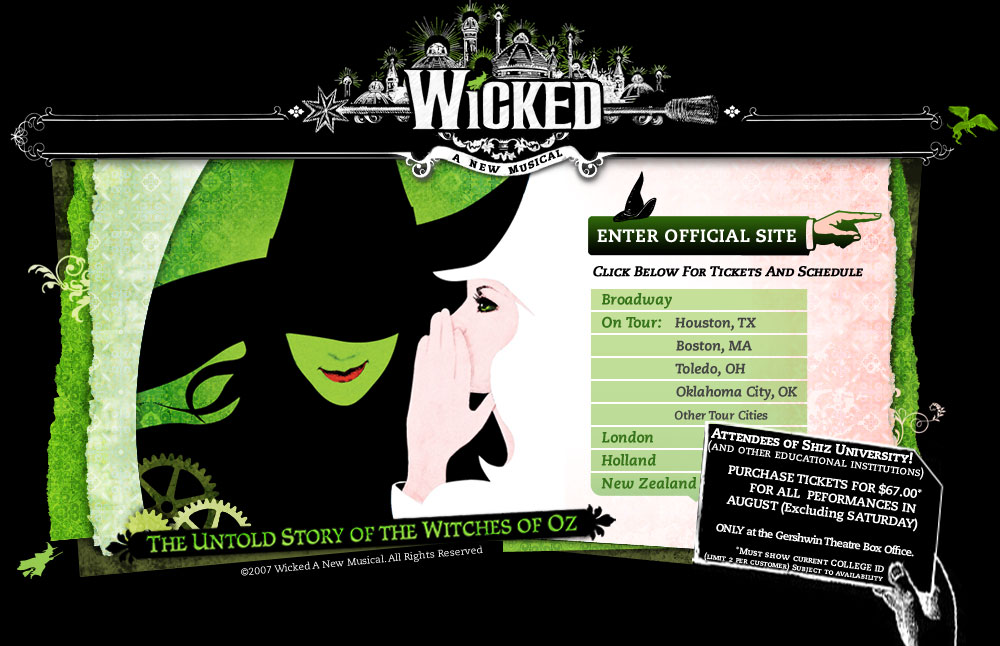 ROI property has been Wicked. That would be Wicked the Musical on Broadway, the commercial theatre production with a $3 billion gross. Lion King (the musical, not the movie) has grossed over $5.4 billion. With the potential for grosses like that, producers asked to contribute, say, 1% (a total random number) to support a geographically dispersed theatre R&D infrastructure “farm system” are unlikely to be deterred from investment.
File this in the “wild idea” category if you like (along with seed funding lotteries and nonprofit “ownership” stakes), but if there’s going to be some change, better to have a few wild ideas to toss around.


 Creative Infrastructure