What is the value of an ART degree?

Earlier this evening, I shared a small stage at the Chandler Center for the Arts with my colleague Adriene Jenik, director of ASU’s School of Art, as we accepted first and second place awards in the Arizona Art Tank Business Unusual Competition on behalf of the SOA and the Pave Program in Arts Entrepreneurship, respectively.  Seeing her reminded me of a wonderful piece she wrote to kick off the beginning of the academic year about why a degree in ART (I would say in any arts discipline) matters. With her permission, I repost it here.

As another academic year fast approaches, I am assisting faculty and staff with final preparations and composing my remarks to welcome new ART students to campus. I can picture their excited faces, and just as clearly, their parents’ worried expressions. With the excitement of college also come concerns about its cost. Majors and degrees that don’t seem to directly track into high paying jobs are perceived as less desirable. Since it is now almost impossible to complete a degree without incurring some student loan debt, the ability to pay off that debt is a factor in choosing a college major.

Given this, I’m not surprised that I am increasingly asked “What’s the value of an ART degree?” The question is popping up with more and more frequency, and this seems a good time to put my answer in writing.

It is important to know that pretty much everything we wear, sit on, look at, hear and touch was created with input from a creative professional, a field to which artists belong. The design on your t-shirt, the icons on your smartphone, the label on your peanut butter, the experience of your favorite amusement park ride, and even the effective TV advertisement encouraging you to study one of the STEM (science, technology, engineering and math) disciplines, engaged artists’ hearts, minds and hands in their making. With the growth of computer based social networks and applications as a throughput for all kinds of human exchange – including education, medicine, shopping and friendship – the computer interface mediates our lives. Artists and designers, in this way, will be framing our core life activity for decades to come. 

Sure, you might allow that “digital arts” (which happens to be my own field), have some use. But not painting and drawing, or sculpture – not to mention, ceramics or printmaking.

Although these may not translate into more traditional looking “jobs” for graduates, in fact, they prepare students exceptionally well for life in the 21st Century. Below are a few of the key proficiencies acquired by all ART students during the course of pursuing their degree – each of which is critical to success in navigating our future job market.

ART students learn to TAP INTO CREATIVE FLOW

The sketchbook-toting ART student may be a cliché, but that sketchbook (and the contemporary digital equivalent) is really a capture source for an outpouring of creative flow. Ideas for projects are sketched or notated, collaged and outlined – invariably each assignment yields more ideas than can be carried through at that moment – a surplus of visual and thought concepts exist that can be returned to again and again. Most importantly, having been required to brainstorm project ideas on a regular basis, students understand the conditions they need to maximize their creative energy and can readily activate this important 21st century skill. 

ART students learn to SYNTHESIZE

Unlike many undergraduate degrees which require students to analyze, interpret, deduce and breakdown a subject into smaller parts for closer examination – undergraduate artists are regularly asked to bring together complex and often contradictory ideas into a larger whole. The successful artwork is a balance between form and content, so artists bring in ideas and learning from other fields of knowledge and regularly transform them into something new, paying close attention to the historical, cultural and symbolic context of their chosen medium.

ART students do RESEARCH

A ceramics student, in order to create a contemporary figurative warrior sculpture takes time to study historical images and objects from indigenous cultures, reads historical and contemporary accounts of warriors and perhaps even composes written reflections on the meanings of a warrior, war, and resistance in her life. She considers appropriate materials, glazes, and firing methods that emerge from this conceptual process to emphasize her idea. In many educational fields, this type of original research is not expected of students until upper division undergraduate or even graduate classes. In an undergraduate ART degree, students are expected from the first day of their freshman year to develop original research projects – their artwork.

ART students learn DISCIPLINE and FOCUS

Once classes commence, I walk through the ART buildings every few weeks and look in on the classroom activity. The level of focus of the students as they work on their projects, especially as the end of the term nears, is intense. Students learn not just by looking or reading, but by experimenting, trying and trying again and then again to get better and better at their chosen medium or expressive process. They see progress occur in increments over time, as they accumulate techniques and iterate versions of an idea or object. For example, a printmaker might make multiple “proofs” of each layer of a multi-layer print – trying out different ink viscosities, pressures, and colors; different papers (colors, transparencies, textures) before the final finished product is ready to be editioned. By the time they are ready to exhibit their culminating artwork, they have not yet “mastered” their chosen medium (this can take a lifetime), but they have a visceral understanding of the time, tenacity and ongoing disciplined practice it takes to get really good at something.

ART students learn to GIVE AND TAKE CRITICISM

The primary pedagogical contribution of the ART classroom is known as the critique. Here, students and faculty critically discuss and analyze student work. This process can be both brutally soul-crushing and powerfully nurturing, depending on the philosophy and sensitivities of the faculty steering the discussion and the particular dynamic of the individual class. Regardless, students become familiar with exposing themselves to criticism, discerning what critical feedback is of value to them in their practice, and learning how to interpret and respond to the work of others. They also become comfortable with disagreement and debate and are capable of advocating for their ideas in a group. One can see how this would be of value in any work setting that involves team work.

ART students learn RESOURCEFULNESS

Many students become more resourceful during their college years – eating ramen noodles to sustain themselves on a limited budget – but ART students are guaranteed to learn this important life skill. Materials and class fees are expensive (considerably more than textbooks for an ambitious student), and time in a specialized studio must be planned in advance and then utilized to the fullest. A valuable shared resource like a laser cutter or large format photographic printer will be in high demand at the end of the term, and materials may be charged by the inch. Artists learn how to make the absolute most of what they have at hand, inventing new uses for common, cheap and even discarded materials, and learn how to maintain their tools and take care of equipment to last for years.

ART students learn how to see beauty and possibility in spaces that are considered derelict or are otherwise abandoned by others. Countless examples of “reborn” neighborhoods in cities around the world[i] are the result of artists moving in and making an area that was once considered uninhabitable into a special destination. ART students also learn the value of human resource and community as they regularly collaborate and support one another when a project outgrows the ability of the artist to make, move, or hang it themselves.

ART students learn how to SCOPE and SCALE

By the time they graduate, students understand the need to scope and scale their ideas to fit their time and budget and even a client. They learn these skills through the ongoing practice of transforming their ideas into realized projects. During their first years, ideas regularly strain the confines of the short assignment period, or can fall short of what is expected for a more ambitious end of term project. But by the time they receive their degree, students understand that most projects can be scaled way up or down (in response to a windfall commission opportunity or an unexpected added expense), and ideas need to be scoped with the audience and display context in mind. A display of work in a pedestrian traffic corridor allows for a different level of attention than an exhibition mounted in a more traditional exhibition space that supports contemplation. All ART students produce, as a requirement of their degree, a culminating exhibition of their work and learn the details involved in preparing, designing, mounting and publicizing a professional show. This involves attending to all details, including securing of specialized facilities, equipment, and permissions.

ART students learn in INTIMATE SETTINGS

ART students have SMALL CLASSES. Studio courses are regularly capped at less than 20 students due to equipment access and/or safety issues. Most upper division courses are taught by full-time faculty, caring active artists in their field. For the student who enjoys close interaction with and mentoring by talented professionals who are seasoned teachers – you can’t beat an ART major. As one ART student who recently graduated enthused, “I can walk down the hall and four professors know me by name and can talk to me about the work I just exhibited…who would have expected that in a big University?”

In writing this, I’m not trying to convince you that if your child is interested in engineering or business or medicine they should study ART instead. But I hope that if you or your child are genuinely interested in ART you will not be discouraged from pursuing this path out of concern you won’t be able to support yourself or that your child will end up in your basement for years afterward. Studying ART is serious preparation for the creative, critical, and resource demands of the 21stcentury environment and workplace.

If you can step back, take a deep breath and imagine what lies beyond the horizon of the current job market, I hope you might consider one final point. According to the Strategic National Arts Alumni Project (SNAAP)[ii], ARTs alumni have reported overwhelmingly that they are gainfully employed and content with their lives as contributors to the public good.[iii]If you ever said to your child that all you want is for them is to live a happy and fulfilled life, then I’m pleased to tell you that supporting their choice of an ART major will help them achieve this ultimate goal.

 – Written by Adriene Jenik, originally posted at http://herberger.asu.edu/blog/bid/317161/So-your-son-or-daughter-wants-to-be-an-ART-major

[i] In New York City alone there is SoHo, the East Village, Chelsea, D.U.M.B.O and countless other now sought after neighborhoods that were made special by artists moving in and getting busy.

[ii] http://snaap.indiana.edu/

[iii] 87% – a much larger percentage of contentedness than in most other alumni groups reporting
Posted in Arts education, Arts entrepreneurship, arts infrastructure, Higher education | Tagged , , | Leave a comment

What Makes Art Art?

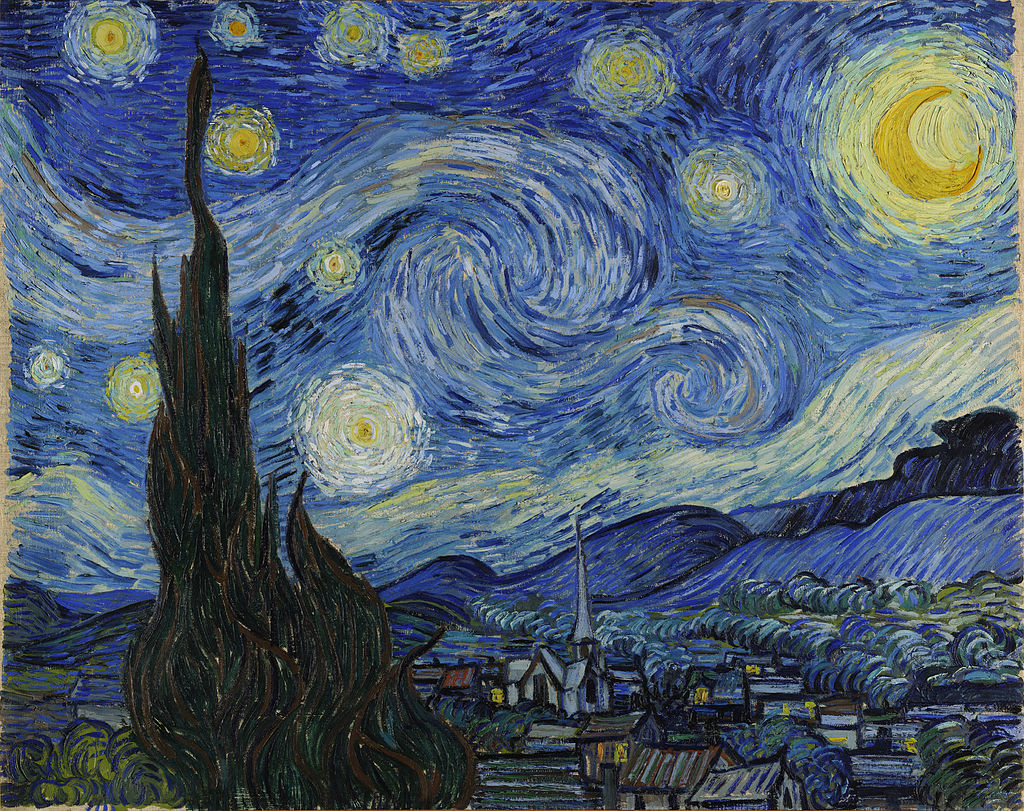
1024px-Van_Gogh_-_Starry_Night_-_Google_Art_ProjectIn a recent Facebook post, Clayton Lord, vice president of American for the Arts and “Counting New Beans” blogger, posed an interesting thought exercise regarding two different means of replication:

an app that lets you see and zoom in on fine artworks, and a 3D printing company advertising $20,000 reproductions of fine artworks that are accurate to the placement of strokes and thickness of paint. I somehow react differently to those ideas even though they’re both not-the-original…I wonder why. Is one a more appropriate use of new tech than the other for preserving the virtuosity of the art?

The online discussion that ensued happened to be coincident with the first week of the semester when I often find the class discussion focuses on the age-old question “what makes art art?”   In my arts entrepreneurship class, that question tends to focus on why artistic products are different from commodities in any other sector around which one might build a business. In the arts management class the question is similar: in what ways is the management of an arts organization different than the management of a shoe factory? Or any other firm that exists to produce and distribute its product?

I am passionate about this question because, to put it in non-academic terms, I feel deeply in my heart that the artistic process and artistic product is indeed different from an iPhone app or a pair of shoes. Fortunately,  there is academic study of this question in fields from philosophy (aesthetics) to pyschology to economics.  Yes, economics.  I am drawn repeatedly to Richard Caves’ 2000 study, Creative Industries. Unlike the construction of the “creative industries” as it is understood in the UK and Europe via industry codes and classifications, Caves focuses on the US and describes six characteristics of work in and of the creative sector, at least two of which are particularly relevant to Clay’s  thought exercise:

  1. Creative workers care about their product. “In creative activities…the creator cares vitally about the originality displayed, the technical prowess demonstrated, the resolution and harmony achieved in the creative act.”
  2. Differentiated products. “No two are identical”…“While creative possibilities are always abundant, creative realizations are not”

My initial response to Clay was, “It seems that the first (the iPhone app) is a way of closely examining and understanding the original while the second is a copy of the original and therefore a potential diminishment of it.”

Nina Simon, of the Museum of Art and History in Santa Cruz and the Museum 2.0 blog, suggested, “Our obsession with “the real artifact” is itself an artifact of its time,” and referenced plaster replicas of statues on display in museums in the nineteenth century.  I maintain that those replicas and the $20,000 replica in Clay’s example are an important means for distribution of art but is not the art itself.  I continued,

The issue is not one of scarcity, but of originality and intention. The display of plaster casts (some of which are still on display in museums) was driven by geogpraphy and lack of transportation. Viewers knew that they were seeing a plaster replica and appreciated it in the same way one appreciates a digital print of “Starry Night.” 3D printing will enable us to appreciate a better print, but the artist’s hand will still be missing.

What do you think?

(image: Van Gogh’s Starry Night via the Google Art Project)

Posted in Arts entrepreneurship, arts infrastructure, Arts management | Tagged , , , , , , | 5 Comments

Passion and Action

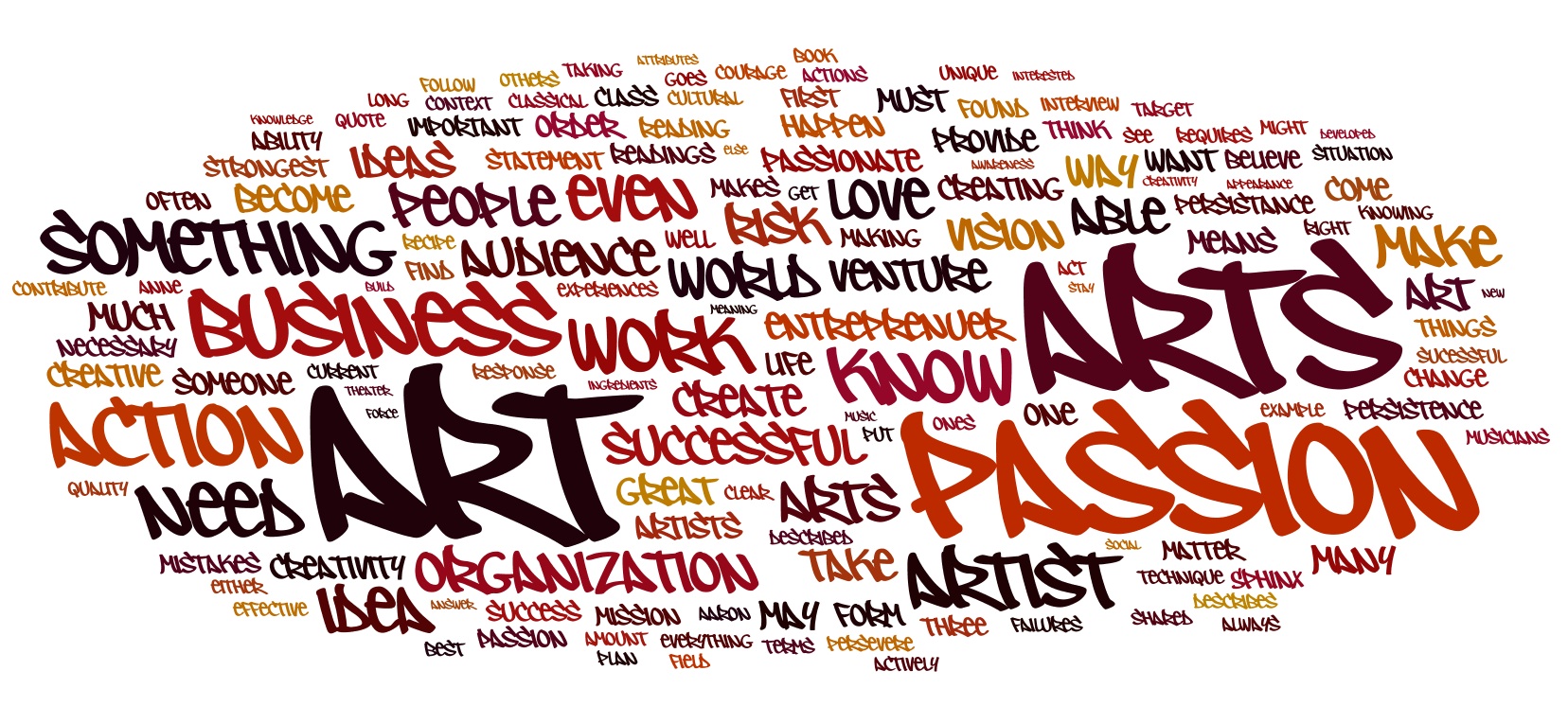
My undergraduate arts entrepreneurship class had its first meeting Tuesday, during which the students and I discussed the nature of entrepreneurial action.  Then they went off on their own to read the first chapter of Ann Bogart’s “And Then, You Act” and Barry Hessenius’s interview with Aaron Dworkin so that they could comment on our online discussion forum about what it means to be an “arts entrepreneur,” an actor in the cultural space.   The theme of “passion” ran, hmmm, passionately through their responses.  To summarize what they said, I aggregated their text, removed the names “Bogart,” and “Dworkin” and the word “entrepreneursip” to create the word cloud below, which again evidences that arts entrepreneurship keeps art and passion at its center. The writing prompt was as follows:

In our first class session, we discussed the nature of entrepreneurial action. In the first week’s reading, Anne Bogart discusses the artist as a cultural actor (i.e. one who undertakes “action”) and Aaron Dworkin serves as an example of such a cultural actor.  Combine these two concepts to describe what it means to be an “arts entrepreneur.”  There is no one right or wrong answer to this question, although some answers may be better than others – you’ll decide which in the context of in-class discussion.

Discussion Forum 1 Word Cloud

Posted in Arts education, Arts entrepreneurship, arts infrastructure, Higher education | Tagged , , , , | Leave a comment

Class Prep

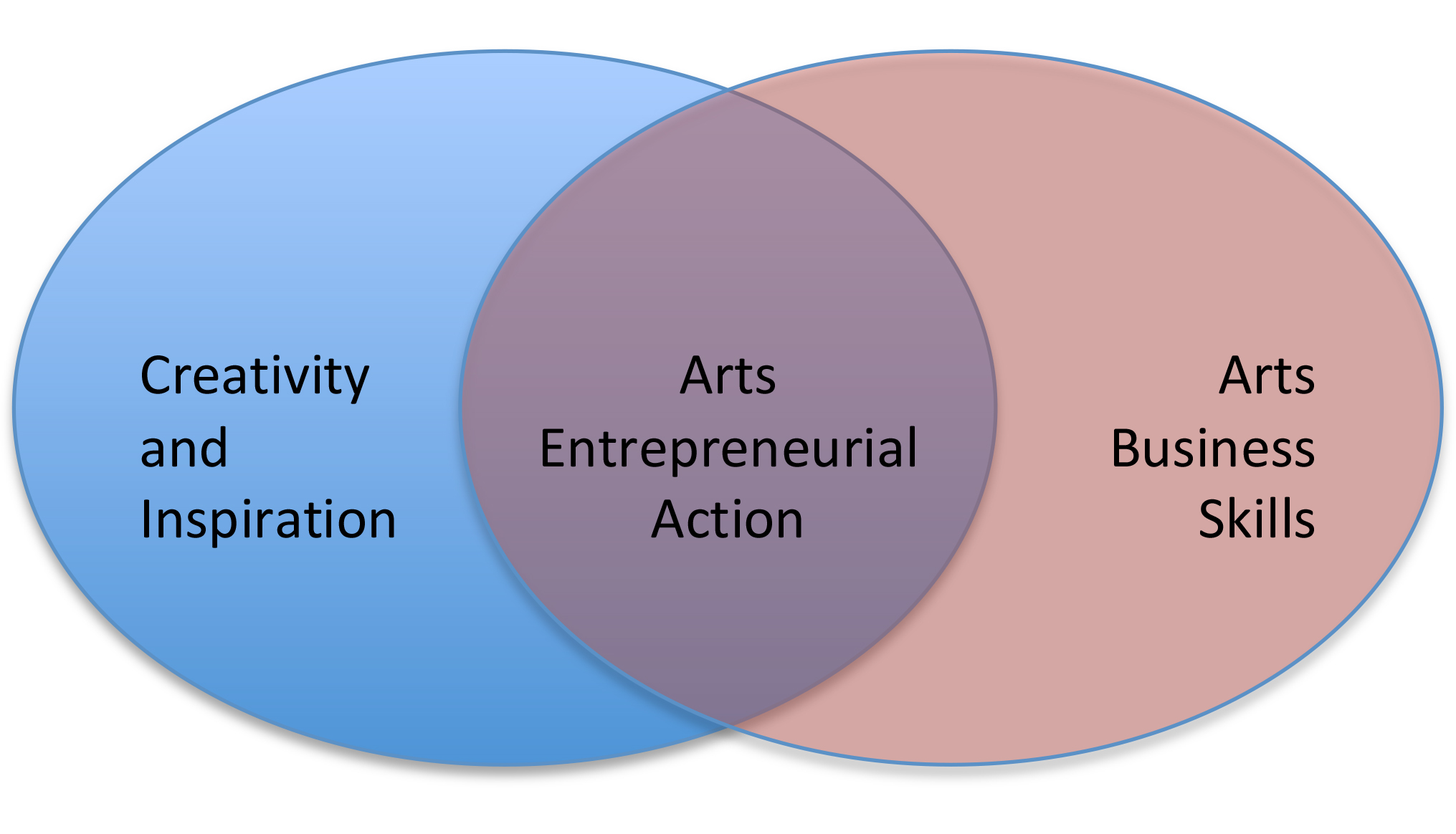
Spring semester classes begin next week. One of my courses is an undergraduate course in arts entrepreneurship that I teach every semester. Each time I teach it, I try to look at the topic and the way I teach it with fresh eyes. I’m always on the lookout for new texts and materials to use, interesting assignments that can be adapted for my ASU students, or new means of exercising student creativity and meeting the course objectives.  Ultimately, I chose to use the same books I used last semester (although I gave a lot of thought to a few others). I adore Anne Bogart’s book, And Then, You Act.  Although she would probably not call it an arts entrepreneurship textbook, her structured reflection on the role(s) of artists in society and the actions they take to advance culture is just that.  Many students (a bit more than half) find it to be truly inspiring.  I complement Anne’s inspiration text with NYFA’s how-to guide The Profitable Artist.  Many students (a bit more than half) find it to be truly useful.  As one might expect, students who can synthesize the material together are the ones that most fully engage with the concept of the “arts entrepreneur.”

Microsoft Word - Class Prep venn diagram.docx

Posted in Arts entrepreneurship, Higher education | Tagged , , , | 4 Comments

Quality, Diversity, and New Year’s Food

BlinismallToday is New Year’s Day.  For dinner last night, New Year’s Eve, I made blini with caviar and today I am making Hoppin’ John with black-eyed peas, a food traditionally eaten in the American south on New Year’s Day day to bring good luck.  While these foods are “traditional” New Year’s fare, they have not been traditions in my family or the cultures that I claim as my own.  Yet, I enjoy them thoroughly.

When I have written about audience engagement or about programming in a spirit of cultural inclusion and egalitarianism, I have sometimes included the phrase (or the spirit of): “if you want the world to look at your stage, the stage needs to look like the world,” meaning that the world on stage needs to reflect the diversity of stories found in the audience.  In saying this, I have been accused of advocating for “setting quality away on the shelf.”  Nothing could be further from the truth. My New Year’s culinary “programming” provides a good analog.  The food was delicious, using the highest quality ingredients.  If I were presenting this food professionally, I would have brought in a Russian chef for the blini and a Southern one for the Hoppin’ John to assure not just the quality of the fare (I humbly assert than I have that covered) but also its authenticity.  Most importantly, the excellent food can be enjoyed by all: Russians, Southerners, and everyone else.

Posted in Culture and democracy, Uncategorized | Tagged , , , , , , , | Leave a comment

Community Fellowship

Pamuk_in_the_Museum_of_InnocenceNobel laureate Orhan Pamuk writes a beautiful passage among many beautiful passages in his novel The Museum of Innocence that explains why the small screen, be it television, computer, or smart phone, will never replace the shared experience of being part of a community of audience members.  After describing the crowded Istanbul summer cinemas with “those big families, the mothers in their headscarves, the chain-smoking fathers, the soda sipping children, the single men, the barely suppressed fidgetiness of these people disconsolately [it’s a melancholy book] on their pumpkin seeds as we watched the film…” he writes:

“I crossed my legs and gazed at the stars, dazzled by the beauty of the universe. I had been drawn into this film, coarse as it was, by the audience’s hushed response. If I had been watching the film alone at home on television, it would not have affected me so, and had I been sitting with my mother, I would not have watched it to the end.”

Being in a “bond of fellowship with the audience,” as our narrator describes it a bit later, enriches his experience.  People seek community.  Both cinema and the live performing arts provide an experience of community fellowship that cannot be equaled by the solitary consumption of media.  And this gives me hope.

(Photo of Orhan Pamuk in his Museum of Innocence, creative commons license.)

Posted in Culture and democracy, Technology and arts, Uncategorized | Tagged , , , , , , | Leave a comment

Arts Incubators and Theories of the Firm

theory out of the boxSometimes we build theory by observing phenomena and sometimes we use existing theories to explain the phenomena we observe.  I’ve been reviewing “theories of the firm” recently and am beginning to form some ideas about how these theories can be used to explain the differences between small business incubators and arts incubators, a topic I study with some intensity.  This is a blog rather than an academic paper.  As such it is a rather blunt instrument for explaining theory, but enables me to do so in short and simple terms.  Thus, put bluntly, theories of the firm are of four types:

  1. Traditional theory of the firm: firms form to maximize profit
  2. Transaction cost theory of the firm (Coase, Williamson): firms form to minimize transaction costs
  3. Behavioral theory of the firm (March and Cyert): firms form as decision-making structures rather than for achievement of a specific goal
  4. Knowledge-based theory of the firm (Grant): firms form to share specialized expert knowledge

These theories are not mutually exclusive and some view them as complementary.

If we consider a specific firm type, the incubator, we can see some distinctions in the extent to which each theory applies to business incubators versus arts incubators.  All – or at least most – incubators offer shared business services. Cooperative marketing efforts, for example, reduce marketing transaction costs for incubator clients; the transaction cost theory can be applied across incubator type.  However, the extent to which profit maximization is prioritized versus, for example, knowledge sharing varies.  According to the National Business Incubator Association, a small business incubator “aspires to have a positive impact on its community’s economic health by maximizing the success of emerging companies.”  The success of such incubators is measured in jobs created and capital attracted, reflecting specific profit maximizing goals.  The goals of arts incubators, however, may very well not be profit maximization. In fact, I’ve found that more than half of all arts incubators do not focus on profit maximization but rather on the production of art or support for specific communities.  Sharing expert knowledge, however, is an almost universal activity in arts incubators, so a knowledge-based theory of the firm applies.

As my research continues, I hope to be able to develop a clearer theory of what an arts incubator – and by extension arts entrepreneurship – IS, rather than merely decrying what it IS NOT.

[UPDATE: A theoretical framework was published in 2015: “Means and Ends: A Theory Framework for Understanding Entrepreneurship in the US Arts and Culture Sector,” Journal of Arts Management, Law, and Society, 45 (4), 227-246.] 

Posted in Arts entrepreneurship, arts infrastructure | Tagged , , , , , , , , | 1 Comment

Self-efficacy

“I put this whole website together – and the band loves it!”  So said the student when she presented her final project, a website to promote her band.  The project is described as “a package of professional materials.”  Students can choose the form of this project – for one it is a website for a band, for another a web-based photography portfolio, for another a grant proposal, for another a business plan for a nonprofit arts organization, for another a packet of application materials for an internship with a commercial producer.  Despite the variety of form and content, what many students gain from the exercise is a belief in themselves and their own abilities. “I never knew I could do something like this.”  There’s a term for this, for this belief that one can follow through and complete a complex task: self-efficacy.  And, in turn, self-efficacy has been shown to enhance one’s ability to act in the face of skepticism of others (see the work of Shane and Ventkatamaran; and Chen, Greene, and Crick).

I’m frequently asked in one form or another “how does entrepreneurship education Confidence_-_1906_-_Helen_Hydeenhance an arts degree?”  Arts entrepreneurship training does not replace deep study of one’s arts discipline, but it enhances it, increasing the student artist’s belief in their own ability to bring the product of their artistic creativity into the world.

Posted in Arts entrepreneurship, Higher education | Tagged , , , | Leave a comment

Restaurants, Theatres, Communities

A restaurant in my neighborhood closed recently. There aren’t a lot of restaurants in my neighborhood – I live in what is sometimes referred to as “the world’s largest cul-de-sac,” a sprawling suburban development that only has one entry and exit point. There’s a bar serving bar food and a pseudo-Mexican/American place flanking a hardware store, both owned by the same people; there’s a McDonald’s and a drive-through taqueria, and a Subway franchise. The Jack-in-the-Box and the pizza place closed at the beginning of the Great Recession and are still empty. So, I was happy when this restaurant opened a year and a half ago, the eighth or ninth in a locally-owned group, in a spot in a shopping plaza that had seen four restaurants in eight years. At first I thought that this one might actually be a success. The group’s location on the main drag near campus is always hopping and the one downtown seems to be doing fine. The menu was essentially the Appetizer samplersame, featuring really large portions of Greek-inspired favorites. Same menu, same organization, with a track-record of success – it should work, shouldn’t it? Well it didn’t.

I don’t know the details of the restaurant’s closure, but it got me thinking about arts organizations (especially nonprofit theatres) and community relationships. As the old real estate adage goes, the three most important factors are location, location, location. The restaurant group’s successful locations all have something my location didn’t: foot traffic. That is, people in the neighborhood for other reasons that stop in for lunch or dinner. The location near me would have to be a destination but the programming didn’t warrant that: nobody travels out to the burbs for a Greek diner unless it offers something truly unique and wonderful. If you think of the menu as the programming, as the season selection, there is another important lesson to be learned here: the same programming doesn’t necessarily work for every community. We all know this, we would never admit to thinking otherwise, yet, as we look at TCG’s annual season preview (OK, I’m a bit late, it was published in October), we see this phenomenon happening across the country. Arkansas Rep’s season looks remarkably like Arizona Theatre Company’s did last year; and ATC’s season overlaps with Indiana Rep’s. Can similar menus play successfully in such disparate regions? Perhaps, unlike the restaurant on the corner, these theatres really are playing to the same community, a kind of homogenized American theatre-going community rather than one distinctive or unique to the region.

Shortly before the restaurant on the corner closed, a new one opened kitty-corner to it (unfortunately, a McDonald’s makes it hard to see the new place from the street). This new restaurant has a limited menu of pasta, salads, and sandwiches, relatively low prices, and friendly service. It’s far from perfect, but at least it’s designed to fit the neighborhood.

(photo from Pitch.com)

Posted in arts infrastructure, Arts management | Tagged , , | Leave a comment

The New Normal

In his Op-Ed column today, Paul Krugman reported on the not very rosy economic 469px-Paul_Krugman-press_conference_Dec_07th,_2008-6picture that fellow economist Larry Summers painted at the recent IMF annual conference.  “Mr. Summers went on to draw a remarkable moral: We have, he suggested, an economy whose normal condition is one of inadequate demand,” Krugman wrote.  This line popped right off the page, albeit with a substitution recognizable to anyone who has been watching audience numbers decline: we have a nonprofit arts sector whose normal condition is one of inadequate demand. Krugman goes on in his column to support Summers’ contention.  If Krugman is right (and he often is, as he himself is quick to remind us) that “our economy has a persistent tendency toward depression,” then the arts and culture sector, as part of that larger economy, will not be immune to that tendency.  Where we are now could very well be the new normal. The question then becomes, “Ok, now what?”

(image of Paul Krugman from Wiki Commons, Creative Commons license)

Posted in arts infrastructure, Arts policy, Culture and democracy | Tagged , , , , , | 1 Comment