Matthew Clinton Sekellik deserves a more considered response to his recent Howlround post, “Against Entrepreneurship,” than I provided in a brief (and admittedly slapdash) comment on it. Because I get it, I really do. “Entrepreneurship” seems in many contexts to be – and in some cases is – an ideological tool to excuse the lack of public funding for the arts and to justify a kind of social Darwinism in which only the “entrepreneurial” survive.
Sekellik’s post is predicated on the idea that the capital markets are unfair, and I agree. How can we make the market more fair? One way is through public subsidy; that is what public subsidy is designed at least in part to do: to correct the inherent market failure in a given sector.
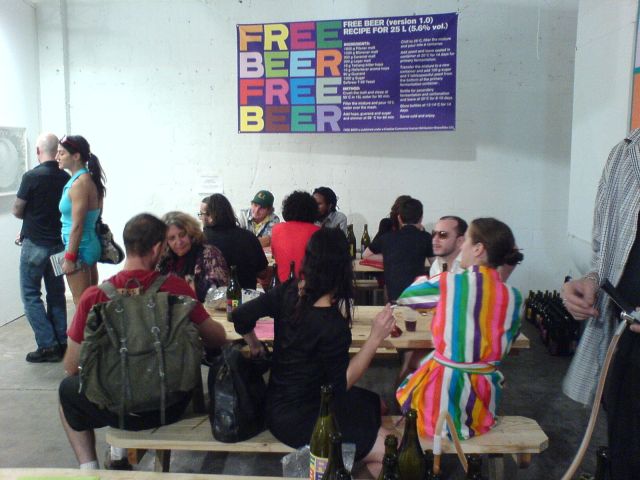
Free beer at Art Basel Miami. Photo by Jakob Fenger, CC 2.0.
Sekellik uses Uber drivers as an example of people trying to make it in a gig economy from which only the corporation, Uber, profits; the drivers themselves are exploited. But Uber drivers are not entrepreneurs; they are contract workers. Unlike artists who create a unique product and send it into the world, Uber drivers pick people up and drop them off.
What if we separate entrepreneurship from “the market” all together? To be an entrepreneur means to:
- create something new, something of value: aesthetic value, cultural value, social value, or, maybe, financial value
- recognize or create opportunity to create that something new
- make use of both internal resources (knowledge, skills, ability) and external resources (social connections, money, facilities, partnership) to create that something new
- create a structure or process for connecting that something new its audience
- start all over again if things go wrong – or if things go right – to keep making
These behaviors exist in non-capitalist economies and capitalist economies. In our own late capitalist economy, such behaviors can generate income that can be reinvested in the making of more art.
But is it enough income? Sekellik writes:
What we must demand is our fair share: wages, jobs, pensions, health care. We must demand dignity and respect so that the capitalists and entrepreneurs who think our work worthless must recognize our contributions to civic society. And we must ensure our demands our heard.
I couldn’t agree more. Our work as artists, playwrights, lighting designers, musicians… should be valued and compensated. But working as a freelancer, as Seth Godin recently pointed out, is not the same as being an entrepreneur and although I quibble with Godin’s focus on the financial goal of a profitable “harvest,” his distinction between the two is important. As freelancers, we must demand equitable pay for freelance work. As artists putting new work into the world, we have to be willing to take risks and may need to bundle our entrepreneurial and freelance work together; that’s not neoliberalism, it’s pragmatism.
Ultimately, it’s really hard to make a living as an artist. It’s also really hard to make a living as a public elementary school teacher (many of whom work second jobs as Uber drivers). Both artists and teachers are critical to the functioning of society and both are grossly undervalued by the market. We can’t ignore the market, but we can think beyond it.
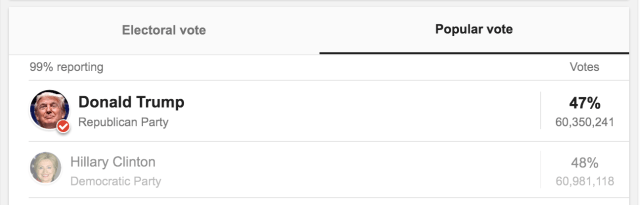 The president-elect would be wise to pay attention to that fact – that he lost the popular vote – as he moves from unabashed self-interest to governing in the public interest. I’m not convinced someone can make such a fundamental shift in perspective in the few short weeks between election and inauguration.
 Robert Greenleaf developed a theory of servant leadership in the 1970s to describe the kind of leader needed to head organizations in which people are building a better tomorrow through ethics and virtue. Bolman and Deal call it “leading with soul.” I just call it “putting people first.” In a servant leader model, the leader leads by serving, by helping followers reach their full potential ethically. In servant leadership, the leader is servant first. According the
  than the boys she will have the same chances as them? Hillary worked a lot harder than the boys. Not only has she worked harder, she has been more thoroughly examined than any candidate in history – certainly working harder than the unqualified buffoon who is ahead in the electoral college. I liken the public examination of Hillary Rodham to something only women experience: Hillary has had her feet up in the stirrups on the exam table with the entire world looking into every cavity, every email, and every tax return.
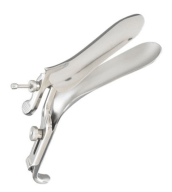 I will not let him or his evolution-denying running mate anywhere near my body. Ultimately, that is what this election and so many of our statewide elections are about: controlling women’s bodies. One could argue that it’s also about controlling bodies of color, and I wouldn’t disagree, but while I empathize with the anger, frustration, and fear my friends and colleagues of color are feeling, I don’t experience it myself and this post, more personal than most, is about my own anger, frustration, and fear.
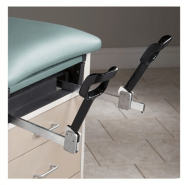 damn stirrups? To very loosely paraphrase Arlo Guthrie, if one woman were to do so, she would be called a bitch (as Hillary has been, as have many women), but if three women do it, it starts to look like an organization, and if fifty women say “STOP! You cannot grab my pussy! STOP! You do not own my body!”
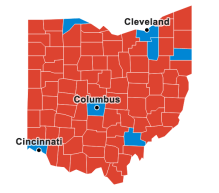 A lot of attention is being paid to demographic outcomes like “the women’s vote,” “the Latinx vote,” the “White working class vote,” and so on, many of which defied the expectations set up by pollsters and analysts. Looking at the geography that uses actual voting results is, in my opinion, more accurate than any exit polling can be (we have seen that polling is inaccurate; more on that in the next post). What the maps of election results show us is that there is a deep divide between urban and non-urban Americans. In general, the densely populated (and well-educated) cities went for Clinton and the less dense (and less well-educated) rural America
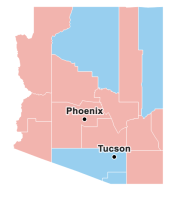 went for Trump. (One notable exception is the rural counties of my state of Arizona, two of which are populated largely by Native Americans.) We will see in the coming weeks what the inaccurate pollsters think went wrong, but my guess is, they didn’t seek out or listen to rural America. So, based on connecting the dots between election result geography and inaccurate polling, here are some opportunities for cultural leaders: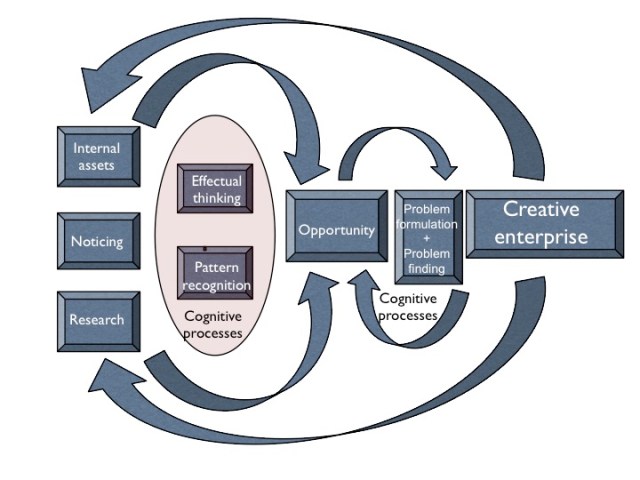
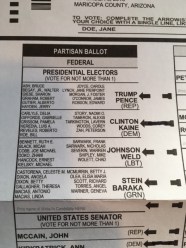 I rushed home from the airport today knowing that my early ballot would be waiting in my mailbox. Then, I voted with tears in my eyes. The tears were tears of joy, because after participating in eight presidential elections (nine if you count the envelope-stuffing I did as an underage volunteer) I was able to cast my vote for a woman, a woman whom I have supported since the beginning of this cycle and who I sincerely believe will be an outstanding president, who will work across the aisle as she did while a US senator and as she has done in securing the support of Democrats and Republicans alike in this unprecedented election cycle. But I was also crying tears of sadness, sadness that our election process has been turned into a reality TV show, not just by the appalling Republican candidate but by the media he pretends to decry. I was also crying tears of fear, for as I drive home from the airport, I heard news reports of the firebombing of a Republican party office in North Carolina.


 Creative Infrastructure