
“Intern” need not be a dirty word

Internships, a form of experiential learning in which a student works in an entry-level capacity at an organization external to the school for little, or more frequently, no, pay, is touted in the pedagogy literature – including some written by me — as a key component of both business and arts entrepreneurship education (e.g. Solomon, 2007; Essig, 2009; Hong, Essig & Bridgstock, 2011).  A recent article in the New York Times, however, exposes the downside of the intern/firm relationship.

Despite Perlin’s concerns, which are valid, I maintain that a field experience is an integral part of a portfolio of pedagogies for learning the habits of mind and the practices of entrepreneurship as well as many other disciplines. How, then, can the student, the university, and the internship site mediate those concerns and potential pitfalls?  I offer a few thoughts:

  1. The internship is about student learning NOT free labor.  If an organization is looking for unpaid help on a project, in an office, on a production, the student and his or her school should stay away.
  2. Because it’s about student learning, the learning objectives must be clear to the student, a supervising faculty member, and the site supervisor.
  3. The internship activities should align with the learning objectives. For example, if a student in an arts management program is interested in learning more about development, the internship should be in the development office of a nonprofit organizations, not in, for example, a theatre’s scene or costume shop.  Placement far from the student’s learning objectives is a sign that the organization is looking for labor nor learning.
  4. The learning objectives should be evaluated and assessed by the site supervisor and a supervising faculty member at the home institution.
  5. The student should keep a journal and write a summative self-assessment of the ways in which the learning objectives are being met.
  6. All of the above: student learning objectives, activities, evaluation plans, should be agreed to in writing by student, supervising faculty member, home institution, site supervisor, and external organization

Perlin cites an internship with NBC as an example of less-than-ideal experience, but my own experience working with the same parent company was quite different.  I worked with NBC/Universal on a film internship program that placed a very small number of students in production settings according to the guidelines above and it worked both for Universal and for the students, several of whom have subsequently found employment with the company or elsewhere.  Plus, they received some real credits and experience prior to graduation.

At the recent p.a.v.e. symposium on entrepreneurship and the arts, I was asked by a former student considering a move from freelance theatre technician work in San Francisco to an arts management position elsewhere, “would you recommend a post-graduate internship?”  Here the issue of working an organization without pay is a bit muddier than when one is a student.  I suggest she (or anyone) consider the following:

  1. Do you have clear objectives for what will be gained from the experience?
  2. Are the internship duties aligned with the objectives?
  3. Does the internship position displace a paid employee? (Stay away!)
  4. Is the placement time-bound? Before entering into an internship of any type, I strongly recommend setting a clear end date and sticking to it.  An open-ended internship is indentured servitude, or worse.
  5. Will the placement include mentorship? Developing a strong professional mentoring relationship with someone may make two months without pay worthwhile – but that is a very personal decision
  6. Will there be networking opportunities? Many companies will “sell” their internship experiences based on the opportunity to network.  Are these opportunities real? Check with previous interns.
  7. Is this internship about “learning the biz?” or “laboring free?”

Last season, I helped a former student attain a stage management internship placement on the Broadway hit “Wicked.”  This was in an established professional transition program with the company, the duties were in the stage management department, it was a six-week placement, a mentor was assigned, there were networking opportunities, and, due in large part to his keen attention, he learned a lot about the business, learning that he has subsequently parlayed into paying work. This kind of short-term, structured placement can be very useful, even after graduation, but, again, be cautious, ask questions, ask previous interns, and if it doesn’t feel right, it probably isn’t.

Much of the learning that happens on an internship, or in any experiential setting, results from the students themselves: observe, ask questions (as appropriate), reflect, and synthesize.  Good luck!

image from buzz paradise, creative commons license.
Posted in Arts education, Arts entrepreneurship, Arts management, Higher education | Tagged , , , , , | 3 Comments

Conference Shake-up

I posted the following comment response to Diane Ragsdale’s blog post decrying the structure of annual arts organization conferences:

Perhaps the conference model can be reconceived along the lines that some arts orgs are evaluating their value proposition: 1) who is the audience? 2) how best to reach them? 3) what impact or outcomes are desired? I would advocate for taking the first and third questions together and the second may answer itself. If the first and third are taken seriously, its unlikely that Ballroom D at the end of the Hutchinson concourse will be the answer. We are more likely to end up with participatory, diverse, media-rich, and INTERESTING sessions at professional conferences.

My comment hasn’t been moderated yet (is it Sunday in the Netherlands?), but since I’ve been thinking about large public meetings almost exclusively for the last two weeks – I’m hosting one just over 48 hours from now – I thought it an opportune time to build on this idea.

What makes a successful professional meeting? For many attendees, it is the networking over coffee before the morning session or at the lobby bar after the evening one.  Kidding aside, what makes a successful meeting is giving the audience what they need.  I don’t mean this in the market sense of what will “sell,” but what the attendees need to meet their professional goals.  What community is being served by the conference?  Why not ask the community what it needs?  The first p.a.v.e. symposium on entrepreneurship and the arts in October 2008 was intellectually successful, but its impact was severely limited by low attendance. A small group of practioners and scholars were talking to themselves. In contrast, in planning this year’s symposium, the first thing we did was ask the stakeholders (see question 1 above) what they wanted from future symposia.  “Hands-on workshops” they replied.  That’s why, in organizing this year’s event, we organized the schedule around four interactive workshops led by arts entrepreneurship educators, arts activists, and, yes, attorneys.  Why attorneys?  Because the audience told us in advance that would help them in their professional practice

What impact or outcomes are we looking for?  More than anything, p.a.v.e.’s goals are to increase artists’ capacity to produce creative work by employing entrepreneurial thinking.  This is hard to measure, but our keynote address, workshops, and forums are designed to broaden an understanding of entrepreneurial habits of mind and habits of action.  We are asking for feedback on the requisite feedback form, but will also follow up with focus groups after the close of the event to asses to what extent our desired outcomes have been met.

Conferences, symposia, meetings, oh my! They traditionally imply a structure that is one dimensional: talking heads on a platform in front of rows of chairs in, as Diane vividly describes, Ballroom D at the end of the Hutchinson concourse.  This is due, in part, to the need to reserve space a year or more in advance, and in part, to sheer inertia.  Given that many of use get together to talk about reaching our performance audiences more effectively, more broadly, and more deeply, we should be able to give similar consideration to how to reach our professional audience/community. If we’re moving to a more participatory arts consumption model, why not do the same for conferences.  We can do things differently –interactive workshops, mixed up with a traditional lecture, mixed up with a creative activity: imagine going to conferences that include creative charettes, not only for students, but for senior professionals.  I hope the next conferences I attend will provide participatory experiences that build both knowledge and community.  And, I certainly hope we’ll provide that for the attendees at the Creating Infrastructure for Creativity and Innovation symposium this weekend!

Posted in Arts education, Arts entrepreneurship, Uncategorized | Tagged , , , , , | 1 Comment

Bragging Rights

Because Creative Infrastructure is what my brother would call a “vanity blog” I’m going to use my wordpress space today to brag – not about me, but about the p.a.v.e. program in arts entrepreneurship and the creative, enthusiastic students who submitted proposals to it.  P.a.v.e. provides experiential learning opportunities for budding arts entrepreneurs through its arts venture incubator program, as well as public programming (like the “Creating Infrastructure” symposium later this week) and formal curricula.

We selected six extraordinary projects this spring for support:

Blue Bike Productions: Hip hacker/makers creating multimedia interactive performances for young people, touring to schools and events, from Theatre/Arts Media Engineering grad student Boyd Branch

Shakespeare Hero: Learning scansion via gaming, also the brainchild of Boyd Branch

Merj.org: a virtual space for interdisciplinary collaboration, led by Heidi Nielsen, an Honors student in the Creative Writing program

FrojoMojo Productions: Hip/hop urban performance collective led by Dance/Theatre major Anthony Kelly

MyLiveMusicLessons.com: a clearinghouse for distance music education from Law student and music educator Michael Rolland

DanceLoop.net: a video sharing site specifically geared to the dance community from Dance/Arts Media Engineering grad student Julie Cruse.

How the incubator works:

Step 1: Workshop.  Students are introduced to concepts of art entrepreneurship and finance as well as the incubator process

Step 2: Grantwriting. Students learn about grantwriting by experiencing grantwriting. Most students have never written a grant proposal before, so they submit a letter of intent to apply, receive feedback from the steering committee and guidance on developing their projects teams and budgets before submitting a full application.   We received online letters of intent for projects ranging from climbable sculptures for preschools to software for learning Shakespearean scansion.  Six projects were ultimately chosen to receive seed grants (see following)

Step 3: Seed grants and mentorship.  Project teams that receive seed grants also receive guidance.  The guidance takes two forms: milestones and mentorship.  As part of the grant review process, the steering committee sets milestones or benchmarks students need to meet over the sis or twelve-month funding cycle.  Each project is required to have a faculty sponsor and then an inside member of the p.a.v.e. committee is also assigned to each project as a mentor.  Students learn about budgeting by developing their budget, about marketing by developing their marketing plan, about business models but researching which business model might be appropriate for their specific project, etc.

Step 4: Development and referrals.  As students develop their projects, we guide them to the appropriate resources in the extensive Entrepreneurship at ASU network and externally.

Step 5: Follow up and assessment.  Through both informal and formal means (admittedly more the former than the latter), we attempt to track the success (or failure) of the student ventures.  We are starting to point our students toward formal assessment tools so that they can measure their success and adjust their path if necessary.

P.a.v.e. has been the fortunate beneficiary of the Kauffman Campus Initiative.  As we move into our fifth year, our own path is in a period of adjustment as we work to diversify our revenue streams to sustain our program in the long run.  For more information about p.a.v.e. and the ASU School of Theatre and Film, click here.

You can follow p.a.v.e. on twitter @paveASU

Posted in Arts education, Arts entrepreneurship, Higher education, Uncategorized | Tagged , , , , , | Leave a comment

Please Don’t Blame (only) the Artists

Got Brain? by aigarius (Creative Commons)

A tweet from 20Under40 called my attention to an open letter from the “Creative Arts Think Tank,” a “loose collection of [New York-based] contemporary performance stakeholders” about improving the business ecosystem for the contemporary performing arts.  There’s a lot to agree with in their manifesto (they don’t call it that, but that’s what it is), but there are a few things to argue about and some language to quibble over.

It was particularly interesting to read their piece a day or two after Lee Liebeskind’s energetic first blog about risk and reward in which he asks us to put aside the supply/demand issue for a little while to talk about risk and reward or, put another way, why we put ourselves out on a limb.  The CATT piece is all about the supply side of the supply/demand equation however; not the supply of arts organizations as was the blogosphere’s focus in February of this year, but rather the quantity of output by artists.  They give a lot of credit to — or lay a lot of blame on, depending on your perspective — artists themselves for oversupplying art and therefore undervaluing their own creative capital.

What I agree with

  1. There is too little attention paid to actual costs at every level of the “food chain.”  Funders, presenters, generative artists, collaborators and audience members need to acknowledge the real cost of making art.
  2. The people in the production stream “at the bottom of the food chain,” in this case the artists, have a lot of latent power.  [but see below: control of production is only one source of power]
  3. Artists – and their collaborators — should be paid a living wage by arts organizations.
  4. Artists should view themselves as entrepreneurs, and develop a business plan accordingly.  A plan that considers all revenue sources, all budget expenditures, and realistically addresses the potentialities for the future is a necessity, even for artists who are full time employees of arts organizations.  By thinking of it s a business plan rather than a personal budget, the artist professionalizes their activities.  Which brings me to what I question…

What I question

  1. “artists who do not get paid are not professionals. Period.” CATT’s criterion seems arbitrary.  Why measure one’s status as a professional by money, especially when money is so hard to come by.  Let’s say, for example, that you are a painter. Eight hours a day are spent in the studio painting, eights hours a week spent on visiting galleries.  Your professional business plan calls for diversified income streams that include a freelance graphic design business and the ubiquitous food service industry job on weekends. Your income stream is not generated from painting, but you enter the studio every single day and create art.  You consider yourself a professional artist.  Why should CATT say you aren’t?  Was Van Gogh a professional artist? Even though he didn’t sell a painting in his lifetime? [I do agree, however, that there are instances in which incorrect notions of professionalism have been used as a veil for the exploitation of artists]
  2. Although artists have latent power in the production stream, control of the means of production is one of only several bases of power over supply.  Others include control of information and control of resources.  The artist controls neither of these.

Two other thoughts

  1. We can’t really talk about the oversupply of artists, arts organizations, or artistic product without talking about the oversupply of training programs.  Why are there so many MFA programs training theatre artists, dancers, and even arts administrators, if there is not viable employment for them?  What are we [i.e. the academic arts community] teaching our students to do when they get out of graduate school?
  2. A performing arts ecosystem is a local ecosystem.  It involves artists creating in a specific location for live audience in a specific location, often with locally or regionally generated funding.  The CATT members write from a specific New York-centric perspective. (Since I once had that perspective myself, I readily recognize its presence.) There are people making interesting work in urban — and rural — enclaves throughout the country, but in each region or city, the arts “food chain” is unique.  Artists who choose to live in a city like Phoenix, for example, must create a portfolio career to sustain their work, even when they are fortunate and talented enough to have part of their income derived from that work (CATT’s definition of a professional artist).

Don’t get me wrong, I WANT ARTISTS TO BE PAID FOR THE TIME THEY SPEND MAKING WORK.  While artists need to take ownership of this issue, that ownership must be shared by arts organizations, funders, educators, and audience members, who need to better educated on the real cost of art. In Lee Liebeskind’s blog, he talks about educating audiences about mission. Often, too little attention is paid to the audience and encouraging them to participate rather than merely spectate.

We have to recognize the complexity of the problem and its dual local and national implications.

I applaud CATT for its openness, forthrightness, and commitment – and for engaging with this national conversation about local work.

Posted in Arts education, Arts entrepreneurship, Arts funding, arts infrastructure | Tagged , , , , , , , | 4 Comments

An Object of Value

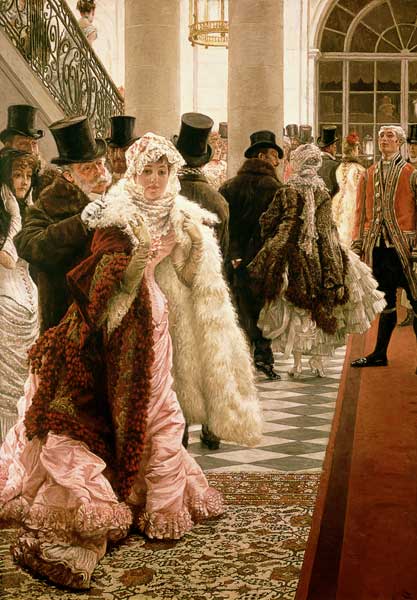
Tissot “La Mondaine”

I flew across country and back last week for a conference, which afforded me the time to read a novel, something I don’t often get to do in the middle of a semester. I chose Steve Martin’s “An Object of Beauty.”  Early on, the narrator describes the transformation undergone by Lacey, the anti-heroine protagonist of the story.  Newly employed by Sotheby’s, she starts to develop a “calculus of worth:”

When Lacey began these computations, her toe crossed ground from which it is difficult to return: she started converting objects of beauty into objects of value.

Later in the book, the narrator describes the impact of one fictional collector’s purchase:

The paintings, in retrospect, weren’t that good, but when Hinton Alberg bought them out, they suddenly became good.  The theory of relativity certainly applies to art: just as gravity distorts space, an important collector distorts aesthetics.  The difference is that gravity distorts space eternally, and a collector distorts aesthetics for only a few years.

At the center of the novel, at least for this reader, is the moral ambiguity around commodifying things of beauty, of putting a price tag on art.  In Lacey’s world, there is a positive correlation between auction value and aesthetic value.  Not so for the narrator, Daniel Franks, who earns high praise for writing a piece for ArtNews that doesn’t mention money.

There is a lot of good material available about this issue, from scholarly publications like The Journal of Cultural Economics to novels by an erudite movie star/playwright/collector and I’m admittedly not as well-versed on this topic as I would like to be.  But, like the narrator of “An Object of Beauty,” I remain decidedly skeptical about assuming that high-priced art is good or that really good, innovative art will find a place in the market.

Posted in Arts funding, Arts policy, Uncategorized | Tagged , , , , , | Leave a comment

A Broken String

The Bead Museum in Glendale AZ shut its doors today.  It did so, according to a posting on the AZ Commission on the Arts website, because of significant decrease in contributed income over the last several years due to the Great Recession.  The Bead Museum was unique in the world: the only facility dedicated to the study and exhibition of beads.  The collection included beads as old as 20,000 years, chronicling for scholars and the general public the “exploration of world culture through beads.”  Lest you think this is a frivolous endeavor, consider that beads were the currency with which Manhattan was bought and sold; beads have historical, cultural, and aesthetic value.

That the Bead Museum closed is an example of market failure, not in the sense that a monopoly is a market failure, but rather a failure of the market to recognize value. If the market is the only arbiter of what is important in our culture, then cultural gems (pun intended) like the Bead Museum are doomed to similar failures.  At the risk of repeating earlier posts, I’ll re-iterate that government subsidy is one viable way to remedy such failures.  Yet, given pressures on public budgets, direct government subsidies are shrinking.  The problem for the Bead Museum and other – especially small – arts organizations, is that as those subsidies shrink simultaneous with reduced private sector contributions.   Small cultural organizations feel the hit most acutely.  Are there other models?  Oregon has a tax credit program, other states have arts and/or culture license plates, Arizona has an arts trust fund – but even that is not secure as the governor picks away at its endowment eight percentage points at a time.   Maybe the arts and cultural community can explore some other models – bridge loans, cultural bond issuances (hey it works for sports), public/private institutional structures, and so on.

I titled this post “The Broken String” because when I read about the Bead Museum closing, I imagined a string of beads breaking and the thousands of beads, large and small, colorful and not, bouncing and skittering across the floor.  Fortunately, there is an institution that will catch the beads; the entire collection is going to the Mingei International Museum in San Diego, a museum of folk art and craft.  While the Mingei does not have the specificity of focus of the Bead Museum, it is gratifying to know that the collection will remain available to scholars.  The people of Glendale and the Phoenix metro area, however, are not so lucky.  Yes, they can see the Cardinals play football or the Diamondbacks play baseball (in a publicly financed stadium), but they won’t have the opportunity to access the rich history of beads and beadmaking ever again.

Posted in Arts funding, arts infrastructure, Arts policy | Tagged , , , , | Leave a comment

A FOURTH Dimension of Arts Entrepreneurship

Sometimes, coincidences mount in ways that are truly mysterious.  On March 5, I completed work on a co-authored book chapter, The Enterprising Artist and the Arts Entrepreneur: Emergent pedagogies for new disciplinary habits of mind for a forthcoming volume on signature pedagogies.  The next day, I came across Andrew Taylor’s blog posting dated February 28 that references James Undercofler’s February 25 post about the course in arts entrepreneurship he’s developing at Drexel.  This was followed by Undercofler’s further discussion, picked up by Taylor’s blog, about three dimensions of arts entrepreneurship.  Undercofler defines these three dimensions as 1) career prep, 2) extensions of one’s artistic expertise, and 3) systems-level rethinking that goes beyond organizational structure (I paraphrase).

In the nascent arts entrepreneurship literature, there tends to be a focus around two dimensions, career self-management, which would be inclusive of Underclofer’s #1 and partially #2, and new venture models, inclusive of #2 (if the extensions include NVC) and #3.  Although I appreciate Undercofler’s three-dimensional model, there seems to be a fourth dimension missing from the discourse as it relates to arts entrepreneurship pedagogy: innovation and creativity.  While this last dimension is not the focus of my recently completed book chapter, it is likely to be a focus of future scholarship.

Reading Taylor’s postings out of order and reviewing Gary Beckman’s edited volume on arts entrepreneurship (mostly music entrepreneurship pedagogy) got me thinking about how the field has been developing over the last decade.  Many of the early voices in arts entrepreneurship have come from schools of music and programs in music entrepreneurship, which have traditionally tended to focus on career preparation, especially in the U.S.  Other perspectives, like Taylor’s, have come from arts management or business schools and have therefore understandably focused on organizational structures and business models.  Coming from a theatre and consulting background I have tended to embrace both views.

Peter Drucker famously wrote, “Innovation is the engine of entrepreneurship.”  It would seem that this would be as true of arts entrepreneurship as it is of traditional venture-creation entrepreneurship.  As the field of arts entrepreneurship is maturing as both a professional and academic discipline, we have an opportunity to define it in ways that will help not only our students and ourselves, but also the arts disciplines more generally.  Let’s include innovation in our discourse around arts entrepreneurship pedagogy so that we are helping to support the future directions of both our individual disciplines and of the arts writ large.

Posted in Arts education, Arts entrepreneurship, arts infrastructure, Higher education | Tagged , , , , | Leave a comment

Measuring Success (first thoughts)

Late last week, the NEA released a re-interpretation of its 2008 Survey of Public Participation in the Arts.  In the announcement of the new analysis, the agency writes “For nearly three decades, the periodic survey has focused primarily on live attendance at “benchmark” arts activities which are defined as live attendance at jazz or classical music concerts, opera, plays, ballet, or visits to art museums or galleries.”  Stated another way — in the broadest terms for intentional effect — the NEA had been measuring elite attendance at elite events produced by elite institutions.  No wonder, then, that there has been discussion of an oversupply of said institutions under the pressure of declining attendance.  The shift from measuring attendance to measuring participation is long overdue. When we concern ourselves with both the quality and quantity of participation, we shift the dialogue away from an over-supply of arts institutions to an undersupply of arts experiences. When we re-frame the discussion around participation, arts and democracy go hand-in-hand.

In that vein, I’ve become enamored recently of Americans for the Arts’ Animating Democracy project, and most especially its tools for measuring the social impact of the arts.  Their portfolio of tools challenges arts makers (and arts funders, one would hope) to rethink who we make art both for and with and how we evaluate the success of our creative endeavors.  The Animating Democracy website talks about the arts in terms of social impact and the support for civic dialogue, among other subsets of social impact.  Success on the social impact indicators is measured not only by butts in seats but by more qualitative measures derived from interviews with participants, minutes of meetings, content analysis of media coverage, entrance and exit surveys, and so on.  These types of measures are HARD; they take work – far more work than audience head count, but as my colleague Stephani Woodson like to remind me, we measure things because they matter.

In these divisive and meager times, what can matter more than measuring the social impact created by increasing community capacity for civic dialogue?  That’s why I signed on to a project recently to collaborate with some very creative colleagues to measure the social impact of the artswork they plan to create in a collaboration between artists and youth.  It’s an entrepreneurial joint venture that’s designed not to achieve financial gain, but rather positive social impact.  Watch for developments here about At Home in the Desert: Youth Engagement and Place and the measurements of our social impact outcomes.   And let’s hope that the NEA, to whom we’ve applied for funding, finds value in the project as well.

Posted in Arts entrepreneurship, Arts funding, arts infrastructure, Culture and democracy, Uncategorized | Tagged , , , , , , , , , | 1 Comment

Publicly Financed Film Wins Best Picture Oscar!

By the time you read this, you will likely already know that “The King’s Speech” won the Oscar for Best Picture.  What you may not know is that the film was, in part, publicly funded through the UK Film Council.  Too bad that won’t ever happen again.  Screen Daily notes:

As for The UK Film Council, The King’s Speech simply came too late. The irony is self-evident. If Tom Hooper’s movie about Bertie and his speech impediment had appeared with the same fanfare a year earlier, it would have been very hard indeed for the British coalition Government elected last summer to justify dismantling The Film Council in the wake of likely Oscar glory. After all, this is the “biggest recouping project” the UKFC has ever supported. That’s why UKFC representatives past and present will be watching Sunday night’s Oscar ceremony with distinctly mixed feelings.

So, what if the timing were different? It may be too late for the UK, but it’s not too late for the U.S.  Maybe we can learn some lessons here not only about diversifying public support for the arts but also about sticking with  our public arts agencies through both thin AND thick.

Just a thought…

Posted in Arts funding, arts infrastructure, Arts policy, Uncategorized | Tagged , , , , , | Leave a comment

Individual Advocacy

In his createquity blog, Ian David Moss wrote “of fostering a sense of shared responsibility among arts advocates in every state for what happens to the arts in every other state.” Of course we need to do so.  But, we also need to start telling a different story and telling it in different ways.  Politicians love stories, they tell stories, and they will (maybe) listen to stories.  We need to drill down deeper than the state level, deeper than the municipal level, down to the individual level.  As Jaime Dempsey wrote in a comment here, “Governments invest in that which benefits the individuals and families within their jurisdictions.”  When we take our discourse out of the realm of the state and into the realm of the individual, we make support for the arts about people rather than about institutions, and therefore make it more palatable to those politicians who can see themselves supporting schoolchildren and their families, but not necessarily theatre companies or dancers.

So, here is an idea: write to your representative, assembly person, senator, and governor, but write from your perspective as an individual, as a neighbor, as a parent.  Sending a letter pre-written by an advocacy group to your representative is akin to the representative delivering a robo-call to your cell phone – and he or she pays it about as much attention.  Instead, tell your representative an interesting, and hopefully true, story about how some publicly funded art program or institution actually affected your life, your family, your neighborhood for the better.  Talk to your neighbors — not other arts advocates – but to the physical therapist or business owner or teacher who lives next door and find out how some experience with the arts affected them.  Help them tell their story to their representatives.  Ask them this: What would happen if young Ethan didn’t have orchestra in middle school? And then help them write that in a letter to their representative.

Yes, states advocating on behalf of states is critically important, institutions advocating on behalf of institutions is critically important, but ultimately, politicians listen to people.

Posted in Arts funding, arts infrastructure, Arts policy, Culture and democracy, Uncategorized | Tagged , , , , , , | 2 Comments