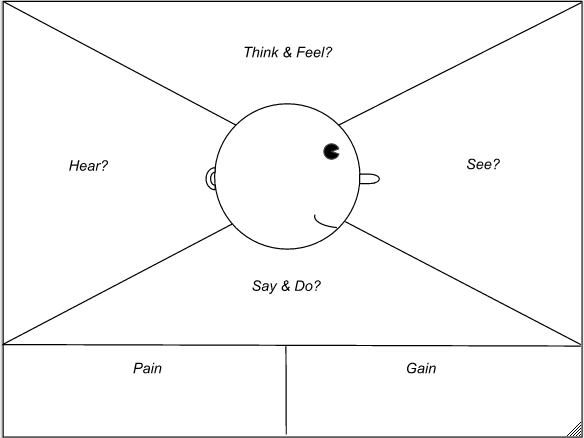
 Our adventure in translating entrepreneurial tools for the arts domain continued today as I introduced my graduate seminar to the concept of an “empathy map.” Empathy mapping asks the entrepreneur to consider how potential customers think and feel, what they hear and see, what they fear, what they hope for, and so on. Although the empathy map is itself a kind of thought exercise, I asked the group to expand the thought exercise to consider what it would mean to use empathy mapping in a traditional performing arts production or presenting context. What might mean to sit down at the coffee house and get to know the people in the neighborhood before programming a concert series or trying to sell them a ticket? Rather than looking at demographic data about so-called millenials, what if an artistic director took three millenials to lunch and asked them about their fears and dreams? A focus group led by a marketing consultant isn’t good enough – empathy happens between people authentically, without a consultant mediating that relationship. There are of course people in the performing arts who engage deeply, directly, and empathetically (I think of Michael Rohd and his Sojourn Theatre or Rachel Grossman at dog & pony co, for example). It is not the norm – at least not yet – but we’re getting there, one entrepreneurial artist at a time.

-
Recent Posts
Recent Comments
Archives
- April 2024
- November 2023
- July 2023
- August 2022
- April 2022
- December 2021
- October 2021
- April 2021
- February 2021
- January 2021
- December 2020
- October 2020
- September 2020
- June 2020
- May 2020
- April 2020
- February 2020
- December 2019
- November 2019
- September 2019
- August 2019
- July 2019
- June 2019
- April 2019
- March 2019
- February 2019
- January 2019
- December 2018
- September 2018
- August 2018
- July 2018
- May 2018
- March 2018
- February 2018
- January 2018
- December 2017
- November 2017
- October 2017
- September 2017
- August 2017
- July 2017
- June 2017
- May 2017
- April 2017
- March 2017
- February 2017
- January 2017
- December 2016
- November 2016
- October 2016
- September 2016
- August 2016
- July 2016
- June 2016
- May 2016
- April 2016
- March 2016
- February 2016
- January 2016
- December 2015
- November 2015
- October 2015
- September 2015
- August 2015
- July 2015
- June 2015
- May 2015
- April 2015
- March 2015
- February 2015
- January 2015
- December 2014
- November 2014
- October 2014
- September 2014
- August 2014
- July 2014
- June 2014
- May 2014
- April 2014
- March 2014
- February 2014
- January 2014
- December 2013
- November 2013
- October 2013
- September 2013
- August 2013
- July 2013
- June 2013
- May 2013
- April 2013
- March 2013
- February 2013
- January 2013
- December 2012
- November 2012
- October 2012
- September 2012
- August 2012
- July 2012
- June 2012
- May 2012
- April 2012
- March 2012
- February 2012
- January 2012
- December 2011
- November 2011
- October 2011
- September 2011
- August 2011
- July 2011
- June 2011
- May 2011
- April 2011
- March 2011
- February 2011
- January 2011
- December 2010
Categories
Meta


 Creative Infrastructure