
I’m currently teaching a new course titled “Strategy: Opportunity Recognition in the Creative and Cultural Industries” as part of the Curb MA in Creative Enterprise and Cultural Leadership. My concept of strategy may be different than a business school conception of it, but the course draws on a variety of sources from business literature and elsewhere including organizational creativity, cognitive theories of entrepreneurship, and problem formulation. We also learn some basic research methods, from inventorying internal assets through conducting field observations and “noticing” (thanks to Andrew Taylor for bringing Verlyn Klinkenborg’s work on that topic to my attention).
Only now that I’m in the thick of it and we have touched on each of the individual topics in class, has the relationship between them all emerged:
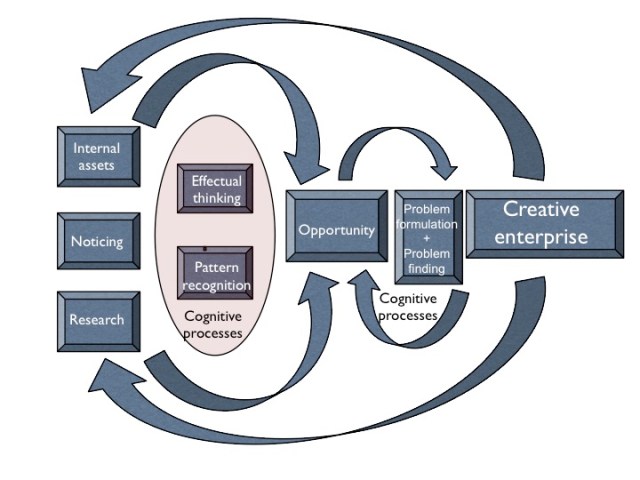
I look forward to exploring this model for creative enterprise development further in the coming months.
If you’re interested in digging into the source material for the model, here is a short list of some resources:
Baron (2006). Opportunity recognition as pattern recognition: How entrepreneurs “Connect the Dots” to identify new business opportunities. Academy of Management Perspectives. [I referenced this article in an earlier post on networking]
Basadur and Basadur (2011). Where are the generators? Psychology of Aesthetics, Creativity, and the Arts, 5(1).
Gassman and Zeschky (2008). Opening up the solution space: The role of analogical thinking for breakthrough product innovation. Creativity and Innovation Management 17(2).
Klinkenborg, V. (2012). Some short sentences about writing. Ecotone 7(2).
Sarasvathy (2001). Causation and Effectuation: Toward a Theoretical Shift from Economic Inevitability to Entrepreneurial Contingency. The Academy of Management Review, 26, 2, pp. 243-263 [here’s a fun take on effectual thinking from an earlier post]
Ward, T.B. (2004). Cognition, creativity, and entrepreneurship. Journal of Business Venturing 19.


 Creative Infrastructure
Pingback: Outrage is Easy; Strategy is Hard | Creative Infrastructure
Pingback: What Can We Do? Part 2 | Creative Infrastructure
Pingback: What Can We Do? Part 1 | Creative Infrastructure