

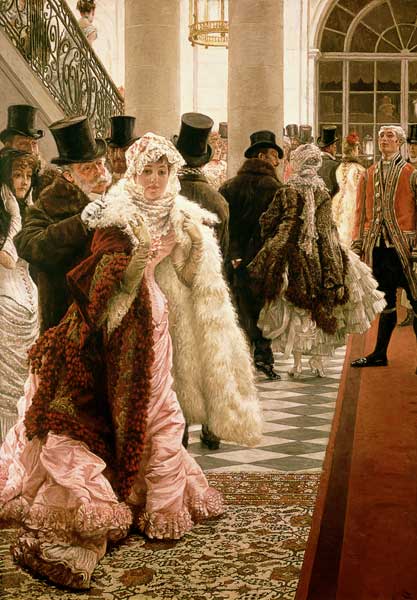
- Tissot “La Mondaine”
I flew across country and back last week for a conference, which afforded me the time to read a novel, something I don’t often get to do in the middle of a semester. I chose Steve Martin’s “An Object of Beauty.” Early on, the narrator describes the transformation undergone by Lacey, the anti-heroine protagonist of the story. Newly employed by Sotheby’s, she starts to develop a “calculus of worth:”
When Lacey began these computations, her toe crossed ground from which it is difficult to return: she started converting objects of beauty into objects of value.
Later in the book, the narrator describes the impact of one fictional collector’s purchase:
The paintings, in retrospect, weren’t that good, but when Hinton Alberg bought them out, they suddenly became good. The theory of relativity certainly applies to art: just as gravity distorts space, an important collector distorts aesthetics. The difference is that gravity distorts space eternally, and a collector distorts aesthetics for only a few years.
At the center of the novel, at least for this reader, is the moral ambiguity around commodifying things of beauty, of putting a price tag on art. In Lacey’s world, there is a positive correlation between auction value and aesthetic value. Not so for the narrator, Daniel Franks, who earns high praise for writing a piece for ArtNews that doesn’t mention money.
There is a lot of good material available about this issue, from scholarly publications like The Journal of Cultural Economics to novels by an erudite movie star/playwright/collector and I’m admittedly not as well-versed on this topic as I would like to be. But, like the narrator of “An Object of Beauty,” I remain decidedly skeptical about assuming that high-priced art is good or that really good, innovative art will find a place in the market.


 Creative Infrastructure